The Rise of Mobile Banking
Over the past decade, the financial industry has changed rapidly. Today, users expect to manage money, transfer funds, and invest directly from their smartphones. As a result, mobile banking apps have become essential for both traditional banks and fintech startups. Because of this trend, partnering with a mobile app development company in USA helps businesses build secure and user-friendly banking applications.
According to recent reports, the global mobile banking market is growing fast. In fact, it is expected to reach billions in value by 2030. Moreover, millions of users now rely on mobile apps as their primary banking method. Because of this growth, businesses have a strong opportunity to enter the market. However, building a banking app is not simple. It requires proper planning, the right technology, and strong security measures.
The Current State of Mobile Banking: Why It Matters Now
Before starting mobile banking app development, it is important to understand why this industry is growing so fast. Today, the demand for digital banking solutions is higher than ever. As a result, businesses are investing heavily in mobile-first financial services.
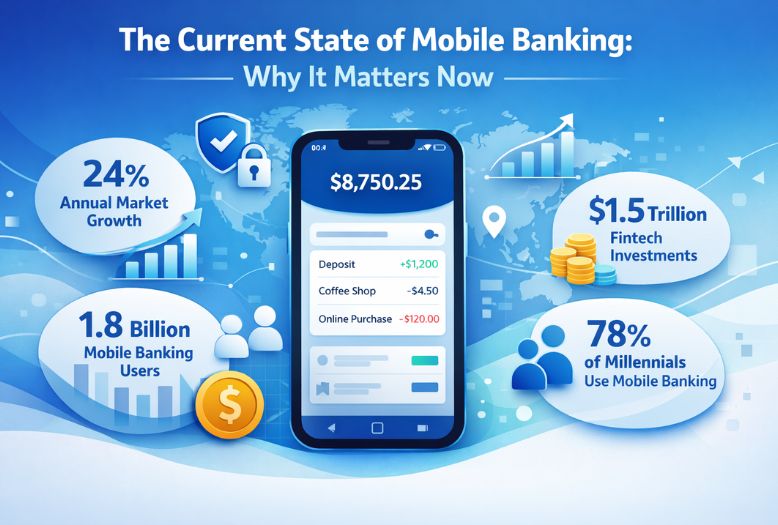
The numbers clearly show this rapid growth:
- According to Statista, the global mobile banking market was valued at around $1.15 billion in 2023. Moreover, it is expected to reach $5.4 billion by 2030, growing at a CAGR of over 24%.
- In addition, more than 2.5 billion adults worldwide are expected to use mobile banking services by 2025.
- A 2024 report by Business Insider reveals that 89% of US bank customers now use mobile banking as their primary method. This is a significant increase from 67% in 2019.
- At the same time, the fintech industry saw a 38% rise in investment for on demand app development in 2024. Notably, mobile banking apps received a major share of this funding.
- Furthermore, due to rising concerns about fraud and data breaches, the industry attracted over $9 billion in cybersecurity investments in 2025.
Because of this massive growth, mobile banking app development offers strong business opportunities. However, it also comes with challenges such as intense competition and strict regulatory requirements.
Therefore, companies must follow a structured development approach. More importantly, partnering with experienced mobile banking app development services can help ensure security, compliance, and long-term success.
Define Your Vision: Ideation and Market Research for Mobile Banking App Development
Decide your monetization strategy: First, choose how your app will generate revenue. For example, options include subscriptions, transaction fees, premium features, or lending services. As a result, you can build a sustainable and scalable business model.
Conduct market research: Next, analyze competitors like traditional banks and fintech apps. This way, you can understand market gaps and opportunities. Moreover, it helps you identify trends and position your app more effectively in the market.
Use analytics tools: Additionally, tools like App Annie and Sensor Tower provide insights into user behavior, trends, and app performance. As a result, you can make data-driven decisions and improve your app’s overall performance.
Gather user feedback: Moreover, speak directly with potential users. As a result, their feedback helps you understand real challenges and expectations.
Consult a development partner: Finally, work with a banking mobile app development company in USA that has strong experience in fintech solutions. In turn, they can guide your strategy, estimate costs, and define timelines effectively.
Choose the Right Development Partner for Mobile Banking App Development
Understand the importance of your choice: First of all, selecting the right custom mobile banking app development company is critical. Otherwise, a wrong decision can lead to delays, security risks, and higher costs. Therefore, it is important to evaluate your options carefully before making a final decision.
Check technical expertise: Ensure the company has strong experience in fintech technologies. This includes payment gateways like Stripe, Plaid, and Dwolla, as well as real-time transaction systems and biometric authentication.
Evaluate security practices: Next, a reliable partner should follow a security-first approach. For instance, they must implement data encryption, secure API design, and regular security testing, including penetration tests. As a result, your application remains protected against potential threats and vulnerabilities.
Verify compliance knowledge: Additionally, banking apps must follow strict regulations. Therefore, your partner should understand KYC, AML, PCI DSS, GDPR, and Open Banking standards relevant to your target market. As a result, you can avoid legal issues and ensure smooth operations.
Look for regulatory experience in your region: If you are targeting the US, choose a team familiar with local laws and compliance requirements. This helps avoid legal issues later.
Review portfolio and past projects: Always check previous fintech or banking apps. Analyze their UI/UX design, system architecture, and overall performance.
Check client feedback and references: Furthermore, client reviews give insights into reliability, communication, and delivery quality. As a result, you can make a more informed decision when choosing the right development partner.
Assess post-launch support: Finally, ensure the company offers ongoing maintenance, updates, and technical support after launch. This way, your app stays secure, up to date, and performs smoothly over time.
Plan Your Feature Set: Core vs Advanced Functionality
Understand feature prioritization: Mobile banking apps offer different levels of functionality. Therefore, you should first define features for your Minimum Viable Product (MVP) and add advanced features later.
Focus on MVP first: To begin with, start with essential features that solve core user needs. This approach helps reduce development cost and ensures a faster launch. As a result, you can validate your idea quickly and make improvements based on real user feedback.
Plan for future expansion: Advanced features can be added in later stages based on user feedback and business growth.
Balance cost and timeline: Prioritizing features helps control your budget while keeping the project on schedule.
Mobile Banking App Development Core Features (MVP)
Secure user authentication: In addition, enable login with biometrics and two-factor authentication for better security. As a result, users can access their accounts safely while reducing the risk of unauthorized access.
Account dashboard: For example, display the current balance and transaction history in a simple interface. This way, users can quickly review their finances and manage their accounts with ease.
Fund transfers: Allow users to send money both domestically and internationally.
Bill payments: Provide options to pay bills and schedule future payments.
Push notifications: Send alerts for transactions and important account activities.
Customer support: Offer live chat and chatbot support for quick assistance.
Card management: Allow users to freeze cards and create virtual cards for secure usage.
Mobile Banking App Development Advanced Features (Post-MVP)
AI-powered insights: Moreover, analyze spending patterns and provide smart financial suggestions. As a result, users can make better financial decisions and manage their money more effectively over time.
Investment management: Offer tools to manage investments and track wealth.
Peer-to-peer (P2P) payments: Enable users to send money directly to others instantly.
Open banking integration: Connect with multiple financial services using APIs.
Cryptocurrency wallet: Supports digital asset storage and transactions.
Loyalty and rewards programs: Provide offers, cashback, and rewards to improve engagement
Development Approach
- Adopt on-demand app development: Many fintech startups follow an on demand app development approach, releasing features step by step instead of building everything at once.
- Use an iterative method: Continuously improve the app based on real user feedback.
- Reduce risks and improve efficiency: This approach speeds up delivery and ensures you build features users actually need.
Mobile Banking App Development: Feature & Cost Comparison
Understand app levels: Mobile banking apps can be built at different levels, such as Basic, Standard, and Enterprise.
Choose based on your goals: Each level offers different features, costs, and timelines. Therefore, selecting the right type helps you plan your budget and scope effectively.
Feature & Cost Comparison Table
| Feature | Basic App | Standard App | Enterprise App |
|---|---|---|---|
| User Authentication | Simple PIN/Password | Biometric + 2FA | Advanced MFA + SSO |
| Fund Transfers | Domestic Only | Domestic + International | Real-time + SWIFT/SEPA |
| Bill Payments | Limited Billers | Wide Biller Network | Custom + API Integrations |
| Investment Tools | Not Included | Basic Portfolio View | AI-Driven Analytics |
| Customer Support | FAQs Only | Live Chat | 24/7 AI Chatbot + Human Support |
| Compliance (PCI DSS) | Basic | Full PCI DSS | Full + Regulatory Reporting |
| Estimated Cost (USD) | $30,000 – $60,000 | $80,000 – $150,000 | $200,000 – $500,000+ |
| Timeline | 3–5 Months | 6–10 Months | 12–18+ Months |
Key Insights
Basic apps are ideal for startups: They focus on essential features and allow quick market entry.
Standard apps offer balanced functionality: They include advanced features while keeping costs moderate.
Enterprise apps are highly scalable: They support complex integrations, compliance, and large user bases.
Technology Stack Selection for Mobile Banking App Development
Understand the importance of the tech stack: First, choosing the right technology stack is crucial. This is because it directly affects your app’s performance, scalability, and maintenance cost. Therefore, selecting the right stack helps ensure long-term success and smoother app growth.
Plan for long-term growth: In addition, a well-chosen stack helps your app handle more users, integrate with services, and meet compliance needs. As a result, your app can scale smoothly and support business growth over time.
Frontend (Mobile)
Use cross-platform frameworks: React Native and Flutter allow you to build apps for both iOS and Android using a single codebase. This reduces cost and development time.
Choose native for high performance: For instance, Swift (iOS) and Kotlin (Android app development) are ideal for apps that need maximum speed, security, and device-level access. As a result, you can deliver a faster, more secure, and highly responsive user experience.
Backend
Select scalable backend technologies: Additionally, Node.js, Python (Django/Flask), and Java (Spring Boot) are popular choices for banking apps. As a result, these technologies help ensure high performance, scalability, and reliable backend operations.
Adopt microservices architecture: Moreover, this approach allows you to update features independently and scale different parts of the system easily. As a result, you can improve flexibility, reduce downtime, and manage your application more efficiently.
Database
Use reliable databases: PostgreSQL and MySQL are best for transactional data.
Add flexibility and speed: MongoDB supports document storage, while Redis improves performance with caching and session management.
Ensure data security: Always encrypt data both at rest and in transit.
Cloud Infrastructure
Choose trusted cloud providers: AWS, Google Cloud, and Microsoft Azure offer scalable and secure environments.
Support compliance requirements: These platforms provide certifications like SOC 2, ISO 27001, and PCI DSS.
Security Layer
Implement strong encryption: Use SSL/TLS for secure communication and AES-256 for data protection.
Use secure authentication methods: For example, OAuth 2.0 and JWT tokens help manage secure user access. As a result, you can ensure safe authentication and protect user sessions from unauthorized access.
Add advanced protection: Include features like session management, monitoring, and regular security testing.
Mobile Banking App Development Process: Phase by Phase
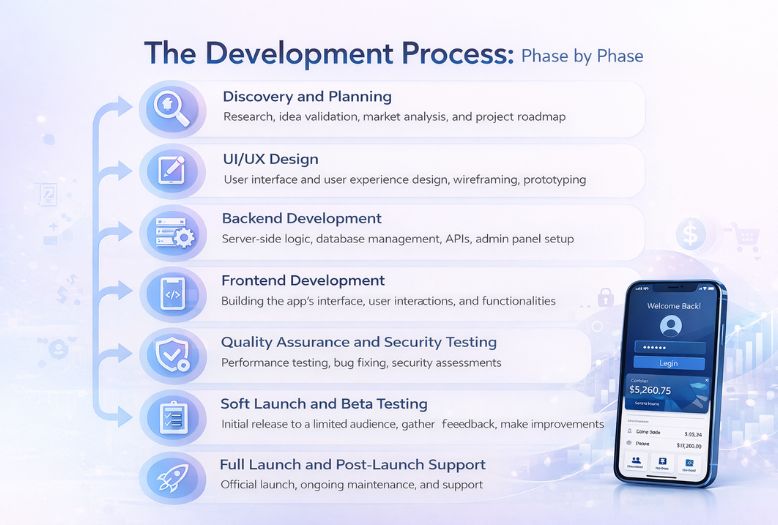
Start with a structured approach: After defining your vision, selecting a partner, and choosing your tech stack, development begins. A phased approach ensures smooth execution and better results.
Phase 1: Discovery and Planning (Weeks 1–3)
- Gather business and technical requirements
- Define project scope and goals
- Create Product Requirements Document (PRD)
- Design system architecture
- Prepare a sprint-based development roadmap
Phase 2: UI/UX Design (Weeks 3–7)
- Create wireframes and design prototypes
- Develop user-friendly interfaces
- Build final design mockups
- Conduct early user testing
- Follow WCAG 2.1 accessibility standards
Phase 3: Backend Development (Weeks 5–16)
- Develop APIs and database structure
- Implement payment processing logic
- Build authentication and security systems
- Add compliance modules (KYC, AML, etc.)
- Ensure scalability and performance
Phase 4: Frontend Development (Weeks 7–18)
- Develop a mobile app for iOS and Android
- Integrate frontend with backend APIs
- Ensure smooth user experience
- Use CI/CD pipelines for faster updates
Phase 5: Quality Assurance & Security Testing (Weeks 16–22)
- Perform functional and performance testing
- Conduct security testing (penetration tests)
- Validate compliance requirements
- Fix bugs and system vulnerabilities
Phase 6: Soft Launch & Beta Testing (Weeks 22–26)
- Release the app to a limited group of users
- Collect feedback and identify issues
- Improve performance and usability
- Fix edge-case bugs
Phase 7: Full Launch & Post-Launch Support
- Publish app on App Store and Google Play
- Complete regulatory approvals
- Start marketing and user acquisition
- Provide ongoing monitoring and support
- Release updates based on user feedback
Compliance and Security: The Non-Negotiables
Understand the importance of compliance and security: First of all, mobile banking apps must follow strict security and regulatory standards. Otherwise, failing to comply can lead to heavy fines, legal issues, and loss of trust. Therefore, it is essential to prioritize compliance and security from the beginning.
Protect your business and users: Strong security measures help prevent fraud, data breaches, and unauthorized access.
Key Compliance Frameworks for Mobile Banking App Development
PCI DSS (Payment Card Industry Data Security Standard)
- Mandatory for apps handling card payments
- Requires end-to-end encryption
- Includes regular security audits
- Enforces strict access control policies
GDPR and CCPA (Data Privacy Regulations)
- Govern how user data is collected, stored, and shared
- Apply to apps operating in Europe and California
- Ensure transparency and user data protection
KYC and AML (User Verification & Fraud Prevention)
- Require identity verification during onboarding
- Include continuous transaction monitoring
- Help prevent fraud and illegal activities
- Can be integrated using providers like Jumio, Onfido, and Persona
Open Banking Standards (PSD2, CFPB 1033)
- Required when integrating with third-party financial services
- Ensure secure data sharing through APIs
- Vary based on regional regulations
Post-Launch: Growth, Optimization, and Scaling
The launch of your application is just the beginning, not the end. In fact, leading banking apps grow by using user data, market insights, and regulatory updates.
Data-Driven Optimization: Use tools like Mixpanel and Firebase Analytics to track user behavior and identify drop-offs. As a result, you can prioritize features effectively.
Performance Monitoring: Platforms like New Relic, Datadog, and Sentry provide real-time insights. Moreover, they help prevent small issues from becoming major problems.
Regulatory Updates: The fintech space changes often. Therefore, you must stay compliant and adapt quickly to new regulations.
Feature Expansion: As users grow, add features based on feedback and trends. In addition, the on demand app development model keeps your product competitive.
Community Building: Create feedback forums, beta programs, and surveys. As a result, you improve continuously and build long-term user loyalty.
Conclusion
Building a successful mobile banking app requires strong planning, security, the right tech stack, and expert developers. Therefore, choosing the right partner, such as a trusted mobile app development company in USA, becomes essential for long-term success. With the support of modern practices like on demand app development and expertise in android app development, you can confidently launch and scale in a growing global fintech market.
Frequently Asked Questions – About Mobile Banking App Development
Development timeline: Generally, a basic MVP takes around 3–5 months, while a full-featured app can take 12–18 months. However, the timeline depends on factors such as regulations, third-party integrations, and team size. As a result, proper planning helps ensure timely and efficient delivery.
Look for a strong fintech portfolio, transparent process, security certifications (ISO 27001, SOC 2), and positive client reviews. Additionally, these factors help ensure reliability and trust. As a result, you can confidently choose a development partner that meets your business and security requirements.
React Native is faster and cost-effective for MVPs. On the other hand, native development with Swift and Kotlin offers better performance and security for banking apps. Therefore, your choice should depend on your budget, timeline, and app requirements.
Security features: In addition, include AES-256 encryption, biometrics, OTP, session timeout, certificate pinning, and regular security testing. As a result, your app can protect sensitive user data and reduce the risk of security breaches.
Banking apps need full lifecycle development with compliance. On the other hand, on-demand apps focus on iterative feature releases based on user needs. Therefore, the development approach should align with your app’s purpose and regulatory requirements.
Not mandatory. However, US companies understand local regulations better. On the other hand, offshore teams can also deliver effectively if their compliance knowledge is strong. Therefore, the right choice depends on expertise rather than location alone.
Expect 15–20% of development cost yearly, plus cloud ($1K–$10K/month), APIs, and security audits.