
The way people travel in cities has changed in recent years. Earlier, passengers had to wait on the roadside, wave at passing cabs, or call a local taxi number. Now, technology has made things much easier. With just a few taps on a smartphone, anyone can book a ride, track the driver, and even pay online. Apps like Hala Taxi in the UAE make this even simpler and more reliable.
In the UAE, therefore, one of the most popular ride-hailing options is Hala Taxi. It connects passengers with Dubai’s official RTA taxis through the Careem app. People trust it because it is safe, government-backed, and very convenient. If you’re planning to launch your own taxi app like Hala in the UAE, this guide will help you. We’ll walk you through how the app works, must-have features, development steps, and even the costs involved. By the end, you’ll have a clear idea of how to create a taxi booking app and grow a successful business.
What is Hala Taxi App?
Hala Taxi is therefore a smart taxi booking service, available in Dubai and also in other parts of the UAE. It’s a partnership between Dubai’s Roads and Transport Authority (RTA) and Careem, one of the leading ride-hailing platforms.
When you open the Careem app, you can select the “Hala Taxi” option. This lets you book official Dubai taxis with fares set and approved by the government. The process is simple:
- Enter your pickup and drop-off location.
- Get the estimated fare in advance.
- A nearby RTA taxi is assigned to you.
- Track your ride in real-time.
- Pay by cash, card, or Careem wallet.
This system combines the convenience of ride hailing apps with the trust of Dubai’s official taxis.
Why Build an App Like Hala Taxi in UAE?
The UAE is one of the fastest-growing countries when it comes to technology and transport. With millions of residents, workers, and tourists, the need for taxis is constant. Here’s why starting a taxi app like Hala can be a smart move:
- High Demand – Consequently, people in Dubai, Abu Dhabi, and Sharjah rely on taxis every day for commuting, shopping, and traveling.
- Tourism Growth – Millions of tourists visit the UAE every year, and they need reliable, safe, and easy transport options.
- Government Support – Moreover, the UAE encourages smart mobility and digital transport solutions.
- Convenience – Modern riders prefer booking through apps instead of waiting outside for a cab.
- Business Opportunity – Therefore, a taxi app can earn revenue from commissions, through in-app ads, or via premium features.
With the right app and user experience, there’s a strong chance to succeed in this growing market.
How Does an App Like Hala Taxi Work?
A taxi booking app works through three main components:
- Passenger App
- Driver App
- Admin Panel
Here’s the step-by-step flow:
- A passenger opens the app and enters pickup and drop-off details.
- As a result, the system calculates the estimated fare.
- Then, a ride request is sent to nearby drivers.
- Next, a driver accepts the request.
- The passenger tracks the driver in real-time.
- After the ride, payment is completed through cash, card, or wallet.
- Both driver and passenger can leave ratings and feedback.
This process makes taxi booking quick, transparent, and safe.
Key Features You Need in an App Like Hala Taxi
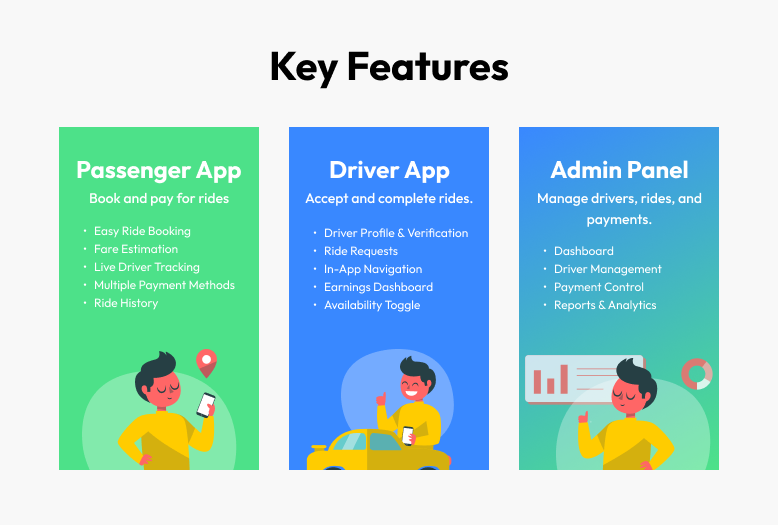
To compete with apps like Hala, therefore, your taxi booking app should have strong and user-friendly features. Now, let’s break them down:
Hala Taxi Passenger App Features
- Simple Registration/Login (via phone, email, or social login)
- Easy Ride Booking (pickup and drop-off selection)
- Fare Estimation (see cost before booking)
- Live Driver Tracking on the map
- Multiple Payment Methods (cash, card, or wallet)
- Ride History (view previous trips)
- Ratings & Reviews (share feedback on drivers)
- Push Notifications (updates on booking, driver arrival, or offers)
Hala Taxi Driver App Features
- Driver Profile & Verification (secure registration and approval)
- Ride Requests (accept or reject rides)
- In-App Navigation (GPS for routes)
- Earnings Dashboard (track income daily/weekly)
- Availability Toggle (switch online/offline)
- Ratings & Feedback (view rider reviews)
Hala Taxi Admin Panel Features
- Dashboard (manage bookings, users, and drivers)
- Driver Management (approve, suspend, or monitor drivers)
- Payment Control (track transactions)
- Reports & Analytics (get insights on rides and revenue)
- Promo Codes & Discounts (run offers and campaigns)
Step-by-Step Plan to Build a Hala Taxi Booking App
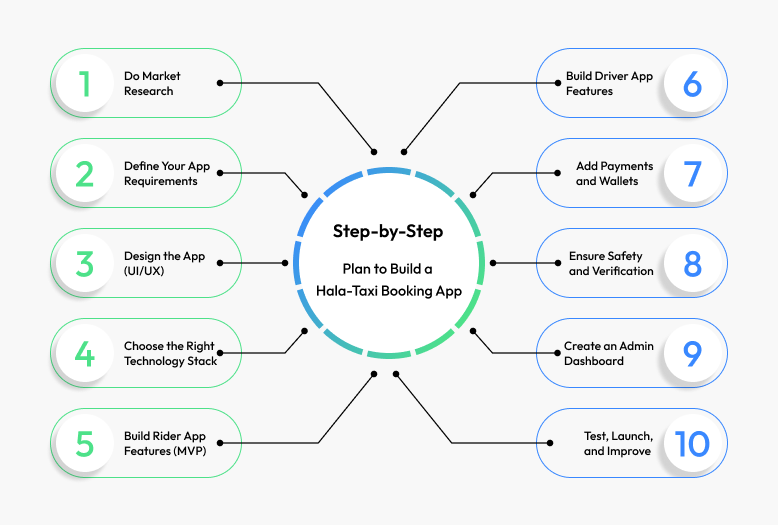
Apps like Hala, Uber, and Careem are successful because they make travel simple, safe, and cashless. If you want to build a similar app, you need a clear roadmap. Here’s a detailed plan in simple steps.
Step 1: Do Market Research
Every successful app begins with research. Before development, understand your audience: Are they daily commuters, tourists, or business travelers?
Check how many people in your city or country use taxi services. Study competitors like Uber, Careem, Lyft, and Hala. Learn what features customers enjoy and where they feel dissatisfied.
Also, study local laws and transport rules. Some cities require permits, licenses, or partnerships with local taxi firms. For example, Hala partnered with the Dubai Taxi Corporation, which gave them credibility and access to thousands of taxis. Knowing these regulations early will help you avoid legal issues.
Step 2: Define Your App Requirements
Once you know your market, then decide exactly what your app will include. Next, break this down into three parts: Passenger App, Driver App, and Admin Panel.
- Rider App Features: First, easy registration; then booking rides, fare estimates, live GPS tracking, multiple payment options, ride history, and finally customer support.
- Driver App Features: Additionally, you can accept or reject rides, use navigation with maps, view earnings reports, toggle online/offline status, and review trip history.
- Admin Panel: manage drivers, track rides, set fares, check payments, and monitor overall activity.
Writing these requirements down in detail helps your developers know exactly what to build. It also helps you control costs and timeline.
Step 3: Design the App (UI/UX)
Design is one of the most important parts of a taxi booking app. If users find it confusing, they will delete the app quickly. Keep the design simple. Use large buttons, clear icons, and a few easy steps to book a ride.
For example, Hala’s app allows users to set a pickup point with one tap on the map. The fewer steps the rider takes, the better the experience. Tools like Figma, Sketch, or Adobe XD can be used to make wireframes and clickable prototypes. Testing these designs with a few users before building the app will save time and money.
Step 4: Choose the Right Technology Stack
Furthermore, technology is the backbone of your taxi app. You need to decide whether to build native apps or cross-platform apps.
- Native apps (Swift for iOS, Kotlin for Android) are fast and reliable but require two separate teams.
- Cross-platform apps (Flutter or React Native) let you build once and run on both Android and iOS, saving cost and time.
For the backend (server side), you can use Node.js, Python, or PHP with databases like MySQL or MongoDB. For real-time location tracking, you need map APIs such as Google Maps, Mapbox, or OpenStreetMap.
Step 5: Build Rider App Features (MVP)
Initially, start with an MVP (Minimum Viable Product). This is a simple version of your app that includes only the most important features. For riders, this includes:
- Signup/login
- Next, booking rides.
- Fare calculation
- Real-time driver tracking
- Notifications for ride updates
- Trip history
Building an MVP allows you to launch faster, test the market, and collect feedback before adding advanced features like ride-sharing or loyalty programs.
Step 6: Build Driver App Features
The driver app is equally important because drivers use it all day. It must be fast and simple. Core features include:
- Accept/reject ride requests
- Navigation with maps
- Online/offline availability toggle
- Earnings report and wallet
- Trip history
Drivers should not feel confused while using the app. For example, Hala drivers can easily accept rides with one tap and get turn-by-turn directions. This keeps the app reliable and driver-friendly.
Step 7: Add Payments and Wallets
In addition, modern taxi apps work best with digital payments. Integrate secure payment gateways like Stripe, PayPal, or local wallets. Riders should be able to pay by card, wallet, or even cash if required.
Adding a wallet system helps both riders and drivers. Riders can add money in advance, while drivers can track their earnings. Automatic receipts after every ride also increase trust. Always make sure payments are secure to protect users.
Step 8: Ensure Safety and Verification
Most importantly, safety is one of the biggest concerns for riders. Therefore, to build trust, you must include:
- Driver ID and license verification
- Background checks
- SOS button inside the app
- Additionally, a share ride option (riders can share trip details with family).
- Driver and rider ratings after each trip
Hala and Uber both focus on safety features because they know customers will only use the app if they feel safe. Adding these features from the beginning is a must.
Step 9: Create an Admin Dashboard
Finally, the admin panel is where you control the entire system. With this, you can then:
- Manage drivers and approve registrations
- Track live rides and locations
- Adjust fare pricing and add surge pricing during busy hours
- Monitor payments and driver earnings
- Generate reports for business insights
Without a strong admin panel, it will be difficult to manage your business as the number of users grows.
Step 10: Test, Launch, and Improve
Once the app is built, test it carefully. Do functional tests, real-world tests, and load tests. Check how it works on different devices and network speeds. Run a pilot launch in one city or area. This helps you identify real problems before scaling up.
After launch, keep monitoring performance. Collect feedback from both riders and drivers. Release regular updates with bug fixes, new features, and improvements. Marketing is also important—use social media ads, referral programs, and partnerships with local taxi companies to attract users.
Tech Stack for Hala Taxi App Development
Choosing the right tech stack is very important when building a taxi booking app like Hala, Uber, or Careem. In addition, the tech stack is the collection of tools, programming languages, and services used to develop and run your app. As a result, a strong stack makes the app reliable, fast, and scalable as more users join.
Here is a simple and detailed tech stack you can use:
Frontend (Rider and Driver App)
- Flutter – For example, a cross-platform framework created by Google allows you to use the same codebase to create apps for iOS and Android. As a result, this reduces time and cost.
- React Native – Similarly, a popular cross-platform framework by Facebook is fast and has a large community; therefore, it makes development easier.
- Swift – The official language for iOS development. If you want the best performance for Apple devices, Swift is the right choice.
- Kotlin – The modern and recommended language for Android development. It is safe, fast, and widely supported.
Users see and interact with the frontend. A smooth and simple interface is important for both riders and drivers.
Backend (Server Side)
- Node.js – Excellent for real-time apps like taxi booking because it can handle many requests at once without slowing down.
- Python (Django/Flask) – Easy to use, with many libraries for data processing and analytics.
- Java (Spring Boot) – A strong and secure option, especially for large-scale enterprise applications.
Meanwhile, the backend runs in the background. It manages bookings, payments, driver allocation, and all the data exchange between riders and drivers.
Database
- MySQL – A relational database used for structured data such as user profiles, ride records, and payment history.
- MongoDB – For instance, a NoSQL database works well with unstructured or flexible data like ride tracking, logs, and live updates.
Databases are the backbone for storing and retrieving information quickly and reliably.
Maps and Navigation
- Google Maps API – Offers accurate GPS tracking, real-time navigation, and estimated travel time.
- Mapbox –In addition, it provides customizable maps and better offline support, which is useful in areas with weak internet connections. Most importantly, maps are central to a taxi booking app, as they allow users to see driver locations, track rides, and estimate arrival times.
Payments
- Stripe – A global payment gateway that is easy to integrate.
- PayPal – A widely trusted option for international transactions.
- Local UAE Gateways (PayTabs, Telr, etc.) – Furthermore, this is necessary if you are launching in Dubai or the Middle East, as they support local banks and wallets.
Offering multiple payment options builds trust and ensures convenience for riders.
Push Notifications
- Firebase Cloud Messaging (FCM) –Additionally, it is a free and reliable service from Google for sending real-time notifications.
Notifications keep riders and drivers updated about ride status, payments, offers, and reminders.
Cloud Hosting and Storage
- AWS (Amazon Web Services) – Moreover, it is highly scalable and secure, making it suitable for growing apps.
- Google Cloud – In addition, it offers strong AI and machine learning tools along with reliable hosting.
- Microsoft Azure – Known for its enterprise-level security and reliability.
Cloud hosting ensures that your app stays online, stores data safely, and scales as the number of users grows.
Other Helpful Tools
- Twilio or Nexmo – Additionally, it is used for SMS verification and in-app calling between riders and drivers.
- ElasticSearch – Moreover, it enables fast and accurate searching of addresses, locations, or previous rides.
- Redis –Additionally, it is used for caching, which speeds up the app by reducing pressure on the database.
- Docker and Kubernetes –Finally, it is used for containerization and scaling, thereby making it easier to manage the app as it grows.
Cost of Developing a App Like Hala Taxi in UAE
The cost of building a taxi app like Hala depends on features, design, and the development approach. Here is a rough estimate:
- Basic Taxi App (MVP): $50,000 – $100,000
Initially, it includes essential features like user registration, ride booking, GPS tracking, and payment integration. Therefore, it is perfect for startups testing the market. - Advanced Taxi App with More Features: $100,000 – $300,000
Next, it adds features like ride scheduling, multiple payment options, driver ratings, referral programs, and push notifications, thereby providing a better user experience. - Enterprise-Level Taxi App: $300,000+
Finally, it is designed for large taxi companies or enterprises. Its features include AI-based ride matching, real-time analytics, loyalty programs, automated dispatch, and multiple admin dashboards, making it highly scalable.
Cost and Development Time Table
| Type of Taxi App | Estimated Cost (USD) | Estimated Development Time |
| Basic Taxi App (MVP) | $50,000 – $100,000 | 3 – 4 months |
| Advanced Taxi App with More Features | $100,000 – $300,000 | 5 – 8 months |
| Enterprise-Level Taxi App | $300,000+ | 9 – 12 months |
Key Factors That Affect Cost
- Features: More features increase cost and development time.
- Design: Custom UI/UX costs more than simple designs.
- Platform: Whether iOS, Android, or both — however, building for both increases cost.
- Development Team: Hiring local UAE or USA developers costs more than offshore teams.
- Maintenance: Regular updates, server costs, and bug fixes add to the total.
By planning features carefully and choosing the right development team, you can build a taxi app like Hala efficiently and within budget.
Challenges in Taxi App Development
When building a taxi app like Hala, you may face challenges such as:
- Legal Compliance – UAE has strict rules for taxi services.
- Competition – Indeed, big players like Uber, Careem, and Hala are strong.
- Driver Onboarding – Additionally, getting enough drivers on the platform is important.
- User Trust – Moreover, people want safe rides with professional drivers.
- Technical Issues – GPS accuracy and payment failures can upset users.
You can overcome these challenges with proper planning, good partnerships, and high-quality development.
Future of Taxi Apps in UAE
The future of taxi apps in the UAE looks bright because of:
- Smart City Vision 2030 – Dubai and Abu Dhabi want to use more AI and smart mobility solutions.
- Green Transport – Furthermore, electric and eco-friendly taxis are becoming popular.
- Autonomous Vehicles – Driverless taxis will be tested soon.
- Digital Payments – More people will use cashless methods.
If you start now, your taxi app can grow with these future trends.
Conclusion
Indeed, building a taxi app like Hala in the UAE is a big opportunity. With growing demand for fast, safe, and digital transport, you can create a business that serves thousands of riders every day. To succeed, focus on user-friendly design, secure payments, strong driver onboarding, and government compliance. Make sure your app has the right features for passengers, drivers, and admins. With the right technology partner, you can launch your own taxi app and compete with big names like Hala, Uber, and Careem.
If you are ready to take the next step, choose an experienced app development company that understands both technology and the UAE market. This will save you time, reduce risks, and help you grow faster.