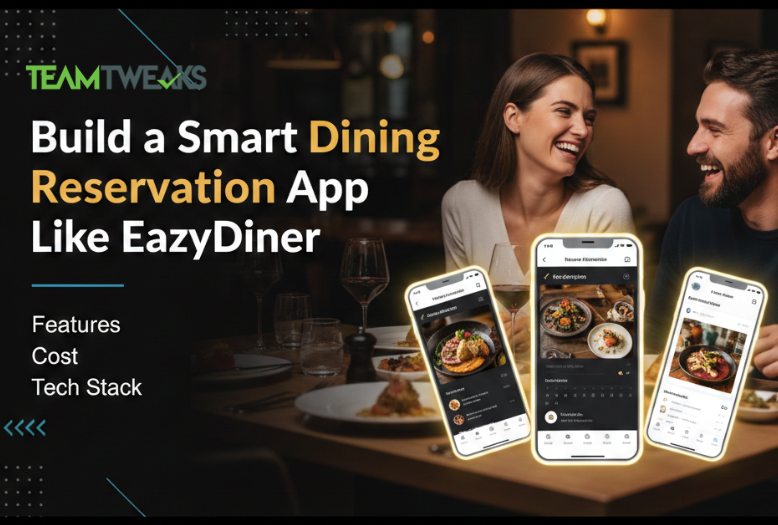
The restaurant industry is becoming more digital every year. Today, customers search online before choosing a place to dine. They compare prices, read reviews, check menus, and look for discounts before making a reservation. Because of this change in customer behavior, dining reservation apps are becoming very popular. One of the well known dining reservation platforms in India is EazyDiner. It allows users to discover restaurants, book tables, and enjoy exclusive discounts.
If you are planning to launch a food tech startup or expand your restaurant business, building a dining app like EazyDiner can be a strong business opportunity. In this detailed guide, we will explain the business model, features, technology stack, development process, cost estimation, and monetization strategy.
Understanding the Business Model of a Dining App
A dining app like EazyDiner mainly focuses on restaurant discovery and table reservations. Unlike food delivery apps, the primary goal is not delivering food to homes but increasing dine-in bookings at restaurants.
These apps connect customers directly with restaurants. Customers get convenience, offers, and easy reservations. Restaurants get more foot traffic and better table management. The platform earns revenue through commissions, subscriptions, and premium listings.
The success of such an app depends on three major factors:
- Easy booking process
- Attractive dining offers
- Strong restaurant partnerships
When these three elements work together, the platform grows quickly.
Why Invest in Building a Dining App?
The demand for restaurant reservation apps is growing, especially in metro cities. People prefer booking a table in advance rather than waiting in long queues. This creates a strong market opportunity.
From a business perspective, a dining app offers multiple revenue streams. You do not rely on only one source of income. You can earn from restaurants, premium users, and advertisements at the same time.
Some major reasons to build a dining app include:
- Increasing digital dining culture
- Growing smartphone usage
- High customer retention through loyalty programs
- Strong repeat booking behavior
If planned correctly, a dining app can become a scalable and profitable business.
Food Industry Insights: Important Stats for 2026
Understanding the market trends and future projections in the food industry helps you make better decisions before building a dining or food delivery app. Below are key insights backed by recent market forecasts and industry data.
Global Online Food Delivery Market
The online food delivery market has grown rapidly over the last few years and continues to expand as more people order food using mobile apps.
The global online food delivery market was valued at around USD 303.24 billion in 2025, and it is projected to reach about USD 339.39 billion in 2026. The Asia Pacific region is expected to lead growth due to high population, increasing smartphone use, and rapid digital adoption.
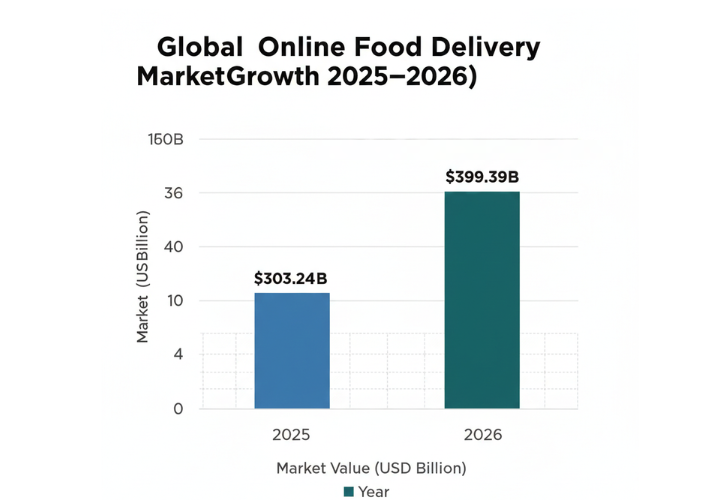
These long term forecasts show that the online food delivery market will grow steadily beyond 2026, driven by rising demand for digital ordering and convenience.
Key Consumer Trends for 2026
Industry data and forecasts for 2026 highlight several important trends:
- About 75% of smartphone users are expected to place food orders online, showing strong preference for mobile app based services.
- Large companies are expected to spend around USD 12 billion on food delivery services for employees and corporate events, indicating enterprise demand for delivery platforms.
- Orders from rural and suburban regions are growing at more than 15% year over year, showing expanding reach beyond major cities.
- Subscriptions (like premium loyalty plans) could account for nearly 45% of total orders by 2026, making recurring revenue an important growth lever for platforms.
India’s Online Food Delivery Market
India’s online food delivery sector is one of the fastest growing in the world. Rising internet access, changing lifestyles, and expanding cloud kitchens are major growth drivers.
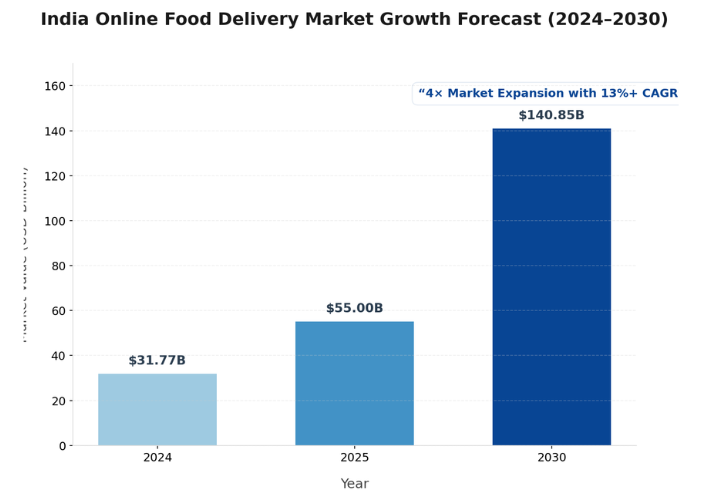
India’s online food delivery revenue is projected to reach about USD 55 billion in 2025, and the market is expected to grow at a CAGR of over 13% through 2030. The online ordering and delivery segment in India is forecasted to grow from USD 31.77 billion in 2024 to about USD 140.85 billion by 2030, showing exceptional long term expansion.
Industry Growth Drivers and Trends
The food delivery and dining segments are influenced by several major trends:
- Mobile Ordering Adoption: A growing share of consumers now prefer using apps over websites, with mobile apps accounting for a large portion of orders.
- Cloud Kitchens Expansion: Shared kitchen models reduce costs and improve delivery efficiency, helping restaurants reach more customers.
- Youth Engagement: Younger demographics especially Millennials and Gen Z are major users of online food services and highly responsive to loyalty programs.
- Rise of Subscriptions: Subscription and loyalty models are expected to hold a larger share of orders by 2026, supporting repeat usage and higher revenue per user.
Summary of 2026 Food Industry Insights
- The global online food delivery market is projected to grow significantly in 2026, reaching over USD 339 billion.
- Long term forecasts show continued growth through the early 2030s.
- In India, the online food delivery market could exceed USD 100 billion by 2030, with strong adoption across urban and rural areas.
- Consumer behavior trends such as mobile first ordering, rural adoption, and subscription use will shape the industry landscape in 2026.
App Like EazyDiner – Overview
An app like EazyDiner is a restaurant discovery and table reservation platform. It helps users find restaurants, book tables in advance, access exclusive dining offers, and earn rewards. At the same time, it helps restaurants increase foot traffic, manage reservations, and attract loyal customers.
EazyDiner is a popular restaurant reservation and dining deals platform that allows users to:
- Discover restaurants
- Book tables instantly
- Get exclusive dining offers
- Read reviews and ratings
- Make secure online payments
Unlike food delivery apps, dining apps focus on in restaurant experiences. The goal is to make dining out easier, smarter, and more rewarding for customers while offering restaurants better visibility and customer management tools.
Why Build a Dining App Like EazyDiner?
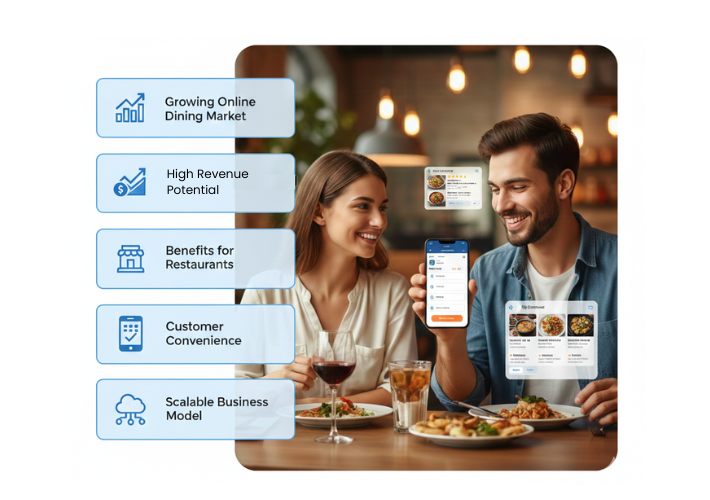
Launching a dining reservation app offers several business advantages:
1. Growing Online Dining Market: More people now prefer booking tables online instead of calling restaurants. The demand for dining apps is increasing rapidly.
2. High Revenue Potential: Dining apps generate revenue through commissions, featured listings, premium memberships, and brand partnerships.
3. Benefits for Restaurants: Restaurants get better visibility, higher occupancy, and customer insights through analytics.
4. Customer Convenience: Users enjoy quick bookings, special offers, reviews, and cashless payments.
5. Scalable Business Model: You can start locally and expand to multiple cities and countries over time.
Key Features of a Dining App Like EazyDiner
To build a successful dining app, it is crucial to include essential features that enhance user experience and restaurant management. We can divide these features into user side, restaurant side, and admin panel features.
A. User Side Features
The user interface should be easy to use, clear, and attractive. Key features include:
- User Registration and Login
- Users should sign up easily via email, phone number, or social media accounts.
- Secure authentication ensures privacy and safety.
- Restaurant Search and Filters
- Users can search restaurants by cuisine, location, rating, price, or special offers.
- Filters enhance convenience and save time.
- Table Booking & Reservation
- Users can choose their preferred date, time, and guest count.
- Instant confirmation of reservations improves trust.
- Menu Exploration
- Detailed restaurant menus with images, descriptions, and prices.
- Option to sort dishes by popularity, category, or dietary preferences.
- Reviews & Ratings
- Users can read and write reviews about their dining experience.
- Helps maintain transparency and improve restaurant credibility.
- Special Offers and Loyalty Programs
- Discounts, cashback, or reward points can be offered to attract users.
- Push notifications inform users about deals and events.
- Payments & Wallet
- Secure in-app payments with credit/debit cards, UPI, and digital wallets.
- Payment history helps users track transactions.
- Booking History
- Users can view past reservations and reorder favorite dishes or restaurants.
B. Restaurant Side Features
That restaurant owners and managers need robust features to handle reservations and customer data effectively:
- Restaurant Profile Management
- Restaurants can add details like menu, opening hours, address, images, and special offers.
- Restaurants can add details like menu, opening hours, address, images, and special offers.
- Reservation Management
- Real time updates for table availability and bookings.
- Option to accept or reject reservations.
- Menu Management
- Restaurants can add, edit, or remove menu items with pricing and images.
- Seasonal menu updates are easy.
- Order & Payment Tracking
- Manage payments, track completed and pending reservations.
- Access to analytics for business insights.
- Push Notifications
- Restaurants can notify customers about special events, discounts, or offers.
C. Admin Panel Features
The admin panel ensures smooth operation of the entire app ecosystem:
- User & Restaurant Management
- Admin can manage users, restaurants, and resolve disputes.
- Monitor app activity in real time.
- Content Management
- Control restaurant listings, banners, promotions, and app content.
- Control restaurant listings, banners, promotions, and app content.
- Analytics & Reports
- View insights such as app downloads, bookings, revenue, and user activity.
- Helps in making data driven decisions.
- Payment Management
- Oversee transactions and payment settlements between users and restaurants.
Types of Dining Apps You Can Build
Depending on your target audience and business model, you can choose from different types of dining apps:
- Restaurant Discovery Apps: Focus on helping users find restaurants based on location, cuisine, and reviews.
- Table Reservation Apps: Allow users to book tables directly from the app.
- Food Ordering & Delivery Apps: Make it simple for users to book tables and get food delivered.
- Restaurant Loyalty Apps: Focus on reward programs, special offers, and customer retention.
- Hybrid Apps: Integrate discovery, reservations, and loyalty programs for a complete experience.
Tech Stack Required to Build a Dining App
The technology stack plays a vital role in ensuring the app is scalable, secure, and efficient. Here’s a recommended stack for a dining app:
1. Frontend Development
Frontend development handles everything the user interacts with in the app. For a dining app, this includes menus, restaurant listings, booking screens, search features, and payment gateways. The frontend must be visually appealing, fast, and user friendly.
Technologies for Frontend:
a. Mobile App Frameworks:
- React Native: A widely used framework to build apps for both iOS and Android using one codebase. It allows faster development and reduces cost.
- Flutter: Developed by Google, Flutter is known for its rich UI and smooth performance. It also supports cross platform development.
- Swift (iOS) & Kotlin (Android): Combine Swift and Kotlin to make responsive native apps for iOS and Android. Native apps usually perform better and provide deeper integration with device features.
b. Web Frontend :
- HTML, CSS, JavaScript: If your dining app also has a web version, these technologies are essential for building responsive web pages.
- React.js or Angular: These are modern JavaScript frameworks for creating interactive web interfaces.
c. UI/UX Design Tools:
- Figma: Used for designing user interfaces and prototyping.
- Adobe XD: Another tool to design user flows and interactive screens.
- Sketch: Popular among designers for building app layouts.
Picking the right frontend tech stack ensures your app is attractive and simple to use.
2. Backend Development
The backend is the engine of your dining app. It handles data processing, user management, bookings, payments, and other core functionalities. A strong backend ensures reliability and speed.
Technologies for Backend:
a. Programming Languages:
- Node.js: A JavaScript runtime that is lightweight and highly scalable. Suitable for real time features like table booking and notifications.
- Python (Django or Flask): Python frameworks offer easy coding and fast development. Django, in particular, is secure and supports complex databases.
- Java (Spring Boot): Java is robust, secure, and suitable for large scale applications with high traffic.
- PHP (Laravel): PHP is widely used for web apps and Laravel makes backend development faster and secure.
b. Server & Hosting:
- AWS (Amazon Web Services): Offers scalable cloud hosting and storage solutions.
- Google Cloud Platform: Reliable cloud infrastructure for backend hosting.
- Microsoft Azure: Another popular cloud solution with integrated analytics and security.
c. API Integration:
Dining apps require multiple APIs for functionality:
- Google Maps API: For locating nearby restaurants and navigating routes.
- Payment Gateway APIs (Stripe, Razorpay, PayPal): To handle online payments securely.
- SMS/Email APIs: For booking confirmation and promotional notifications.
- Restaurant Data APIs: Some apps integrate with third party restaurant listing services for menu updates and reviews.
A strong backend ensures that your dining app performs fast and manages user requests efficiently.
3. Database Management
Databases store and manage all your app’s data, including user profiles, restaurant details, menus, bookings, reviews, and transactions. Choosing the right database is essential for speed, reliability, and scalability.
Database Options:
a. SQL Databases:
- MySQL: A popular choice for structured data with relational databases.
- PostgreSQL: Known for reliability and advanced features like JSON support, which helps in storing complex menu details.
b. NoSQL Databases:
- MongoDB: A flexible database for storing unstructured data like reviews, images, and ratings.
- Firebase Realtime Database: Ideal for real time updates like live table availability or chat support.
c. Cloud Databases:
- Many cloud services offer managed databases that scale automatically with traffic. Examples include AWS RDS, Google Firebase, and Azure SQL Database.
A combination of SQL and NoSQL can be used depending on your app requirements. For instance, SQL can store structured restaurant data, while NoSQL manages dynamic user generated content.
4. Cloud Services and Storage
Dining apps involve storing large amounts of data, including images, videos, and documents. Cloud solutions ensure reliability and speed.
Popular Cloud Services:
- Amazon S3: For storing restaurant images, user profile pictures, and menus.
- Google Cloud Storage: Highly scalable and integrates easily with apps.
- Firebase Storage: Works seamlessly with Firebase backend for real time apps.
Using cloud services ensures your app can handle growth without performance issues.
5. Push Notifications & Messaging
Communication is key for a dining app. Users need updates for bookings, special offers, and discounts. Integrating push notifications improves engagement.
Technologies:
- Firebase Cloud Messaging (FCM): For sending push notifications to Android and iOS devices.
- OneSignal: Another popular solution for notifications and messaging.
- Twilio: For SMS alerts and reminders.
Notifications help your app stay connected with users and drive repeat usage.
6. Analytics & Tracking
Studying user behavior is important to enhance your app experience. Analytics tools track how users navigate your app, what restaurants they visit, and what dishes they prefer.
Technologies:
- Google Analytics: Tracks app and website interactions.
- Mixpanel: Provides advanced insights into user behavior.
- Firebase Analytics: Ideal for apps built with Firebase backend.
Analytics helps you make data driven decisions to improve your dining app features and marketing.
7. Security Measures
Security is critical, especially when dealing with payments and personal information. Dining apps must follow industry standards to protect user data.
Key Security Measures:
- SSL Certificates: To encrypt data between the app and server.
- Auth 2.0: For secure user authentication via Google, Facebook, or email.
- PCI Compliance: Required for secure payment processing.
- Data Encryption: Encrypt sensitive data in the database.
A secure app builds user trust and ensures compliance with regulations.
8. Advanced Technologies
Depending on your app’s complexity, you may consider additional tech:
- AI & Machine Learning: For personalized recommendations, predicting popular dishes, and suggesting restaurants.
- Chatbots: For customer support and queries.
- AR/VR: Some apps use AR for virtual restaurant tours or menu previews.
- Blockchain: For secure and transparent payment systems or loyalty programs.
These advanced features can differentiate your dining app and improve user engagement.
A Complete Roadmap to Develop a Dining App like EazyDiner
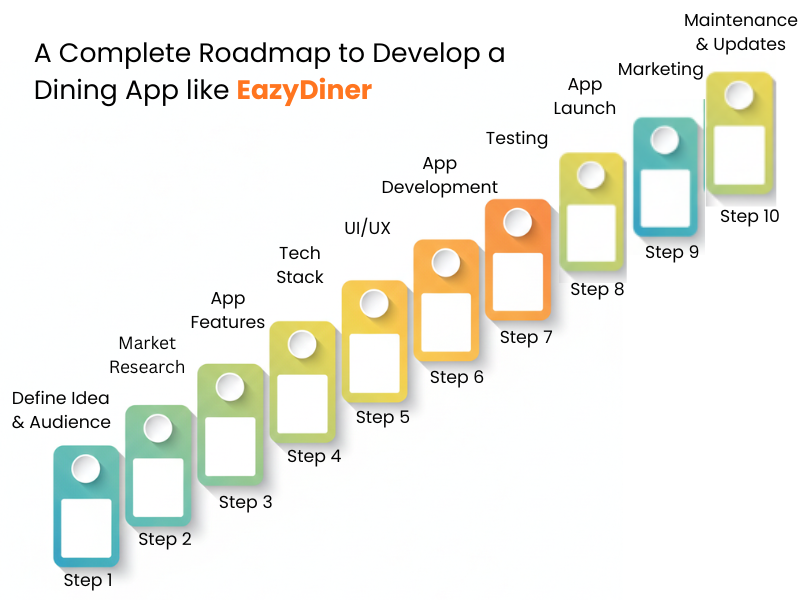
The dining and restaurant industry is evolving rapidly, and mobile apps are at the center of this transformation. Apps like EazyDiner have changed the way people explore restaurants, book tables, and enjoy dining experiences. If you want to build your own dining app, following the right steps is essential to ensure your app is user friendly, functional, and successful in the market.
Here’s a step-by-step guide to creating a dining app like EazyDiner.
Step1: Define Your Idea and Target Audience
Before starting development, it’s crucial to define your app’s concept clearly. Think about what problem your app will solve and who it will serve.
Like EazyDiner, which focuses on helping users discover restaurants, check menus, and book tables easily, you should identify your app’s core purpose. Ask yourself:
- What features will my app provide?
- Who will use it – families, office goers, tourists, or food enthusiasts?
- What makes my app different from others in the market?
Defining your idea clearly ensures your app has a strong foundation, making development faster and more efficient.
Step 2: Conduct Market Research
Market research helps you understand the competition and audience preferences.
Like Zomato or OpenTable, which analyze user behavior, reviews, and dining trends, you should check:
- Which features users love the most.
- What problems users face in existing apps.
- Any unmet needs or opportunities in the market that your app can address.
Proper research ensures your app offers unique value and meets real user needs.
Step 3: Decide on App Features
Features are the backbone of any app. They determine user engagement and satisfaction.
Like EazyDiner, you can include essential features such as:
User Panel Features:
- Sign-up/Login via email, phone, or social accounts.
- Browse restaurants by location, cuisine, or rating.
- Real time table booking.
- Access to special offers and discounts.
- Menus, images, and customer reviews.
- Online payment integration.
- Save favorites or wishlist restaurants.
Admin Panel Features:
- Manage restaurant listings and details.
- Track bookings and cancellations.
- Create and manage offers.
- Access analytics and reports.
Optional features could include AI based recommendations, chat support, or loyalty programs. Like EazyDiner, focusing on simplicity and convenience is key.
Step 4: Choose the Right Tech Stack
The tech stack ensures your app is fast, scalable, and secure.
Like popular dining apps, you can use:
Frontend: React Native or Flutter for cross platform apps, Swift for iOS, and Kotlin for Android.
Backend: Node.js, Python (Django), or Java (Spring Boot) for server side development.
Database: SQL (MySQL, PostgreSQL) for structured data and NoSQL (MongoDB, Firebase) for real time or unstructured data.
APIs & Cloud Services: Use Google Maps API for location tracking, Stripe, PayPal, or Razorpay for payments, and AWS or Firebase for hosting.
Choosing the right stack ensures your app runs smoothly and handles growth effectively.
Step 5: Design a User-Friendly UI/UX
User experience is critical in a dining app. The design must be simple, intuitive, and attractive.
Like EazyDiner, focus on:
- Easy navigation for browsing restaurants, menus, and bookings.
- Responsive design for all devices.
- High quality images and visually appealing layouts.
- Consistent colors, fonts, and buttons.
Design tools like Figma, Sketch, or Adobe XD can help you create interactive prototypes before development.
Step 6: Develop the App
Development brings your app to life. This phase involves:
Like OpenTable, your app should:
- Implement frontend screens with smooth navigation.
- Build backend servers, databases, and APIs.
- Integrate features like search, bookings, payments, and notifications.
- Connect third party services like Google Maps or payment gateways.
Using agile development allows incremental releases and continuous testing.
Step 7: Testing and Quality Assurance
Testing ensures your app works as expected and is free from bugs.
Like Zomato, conduct:
- Functional testing to check all features.
- Performance testing for speed under high traffic.
- Security testing to protect user data.
- Perform User Acceptance Testing (UAT) with real users to collect valuable feedback.
Testing is vital to deliver a reliable and professional app.
Step 8: Launch the App
Once testing is completed successfully, your app is ready to be launched.
Like EazyDiner, you should release your app on:
- Google Play Store for Android users.
- Apple App Store for iOS users.
Optimize your app store listing with screenshots, a clear description, and relevant keywords to attract downloads.
Step 9: Marketing and Promotion
Launching your app is just the beginning; marketing ensures visibility.
Like popular dining apps, you can:
- Use social media platforms to showcase restaurant listings and offers.
- Publish blogs or guides on dining experiences for SEO.
- Collaborate with food bloggers or influencers for promotion.
- Introduce referral programs to motivate users to invite their friends.
Effective marketing drives downloads and increases user engagement.
Step 10: Maintenance and Updates
A dining app requires regular updates and maintenance to stay relevant.
Like OpenTable or EazyDiner, you should:
- Fix bugs and optimize performance.
- Add new features based on user feedback.
- Update restaurant listings, menus, and offers.
- Ensure compatibility with new OS versions and devices.
Continuous improvement keeps users satisfied and encourages repeat usage.
Estimated Cost to Build a Dining App Like EazyDiner
Dining apps like EazyDiner have become extremely popular as they simplify restaurant discovery, table booking, and meal planning. If you’re planning to build your own dining app, understanding the development cost is crucial. The total cost depends on multiple factors, including the app’s features, platform, design complexity, and the development team’s location.
Here’s a detailed breakdown to help you estimate the investment required.
Cost Based on Feature Complexity
The features and functionality of your app play a major role in determining development cost.
| Feature Complexity | Cost Range (USD) |
|---|---|
| Basic MVP (iOS or Android) | $50,000 – $150,000 |
| Medium Complexity (iOS + Android) | $200,000 – $450,000 |
| Advanced Features (AI recommendations, analytics, multi-language support) | $500,000+ |
Timeline for Dining App Development
Building a dining app like EazyDiner requires careful planning, design, and development. The time it takes to develop the app depends on the complexity of features, platform, and the development process. Understanding the timeline helps businesses plan resources, marketing, and app launch effectively.
Here’s a breakdown of the estimated timeline for developing a dining app based on different levels of complexity.
1. MVP (Minimum Viable Product) Version
Estimated Time: 3 to 4 months
An MVP version focuses on core features to test the app idea in the market. Like EazyDiner’s initial version, the MVP typically includes:
- Basic restaurant listings and search.
- Table booking functionality.
- Menu display and reviews.
- Simple user registration/login.
- Basic payment integration.
The MVP allows you to launch quickly, gather user feedback, and make improvements before adding advanced features. It is cost effective and ideal for startups testing the market.
2. Medium Complexity App
Estimated Time: 5 to 6 months
A medium complexity app includes more features and works on multiple platforms (iOS and Android). Like EazyDiner’s growth version, this app usually includes:
- Advanced search filters (cuisine, rating, price).
- Push notifications for offers and booking reminders.
- Loyalty programs or reward points.
- Online payments with multiple gateways.
- Admin panel for restaurant management and analytics.
Developing a medium app requires more time for backend integration, cross platform testing, and UI/UX enhancements. It is suitable for businesses looking to provide a complete dining experience to users.
3. Advanced App
Estimated Time: 7 to 9 months
An advanced dining app is feature rich and offers a highly personalized experience. Like EazyDiner’s latest version, it may include:
- AI-based restaurant recommendations.
- Multi language support for global users.
- Advanced analytics and reporting for business insights.
- Chat support or chatbot integration.
- AR/VR features for virtual restaurant tours.
- Scalable cloud infrastructure for high user traffic.
Developing an advanced app requires careful planning, a skilled development team, and extensive testing to ensure performance, security, and user satisfaction.
The development timeline for a dining app depends on the level of complexity and features.
| App Type | Estimated Timeline |
|---|---|
| MVP Version | 3 to 4 months |
| Medium App | 5 to 6 months |
| Advanced App | 7 to 9 months |
Team Tweaks: Your Trusted Partner for Dining and Food Delivery App Development
In the food and dining industry, success depends on more than just great food; it requires smart, technology driven solutions that make it easier for customers to discover, order, and enjoy meals. Whether you are planning to build a restaurant reservation app like EazyDiner or a food delivery app like Zomato or Swiggy, having a well designed, reliable, and user friendly app can help your business reach more customers, streamline operations, and increase revenue.
Team Tweaks is recognized as a leading dining and food delivery app development company in Chennai, India, with over 12+ years of experience building high quality, scalable, and intuitive apps. We help startups, restaurants, and food tech entrepreneurs turn their ideas into apps that work seamlessly for both users and business owners.
Our Services
Team Tweaks is a leading mobile app development company in Chennai providing complete digital solutions to help businesses grow successfully. We deliver innovative, scalable, and secure technology services tailored to your business needs.
Our key services include:
- Mobile App Development: High performance Android and iOS apps designed for smooth user experience and long term scalability.
- Cross Platform App Development: As a trusted Flutter app development company in Chennai, we build cost effective apps that run seamlessly on both Android and iOS using a single codebase.
- Web Development: As a professional web development company in Chennai, we create responsive websites and powerful admin panels to manage bookings, customers, payments, and reports efficiently.
- WordPress Development: Secure, fast, and SEO friendly WordPress websites that strengthen your online presence. As a leading wordpress development company in Chennai.
- IoT Solutions: As an innovative IoT company in Chennai, we develop smart systems that enable real time monitoring and improve operational efficiency.
- DevOps & Cloud Solutions: Our experienced DevOps consultant team ensures secure cloud deployment, automation, and scalable infrastructure.
- Digital Marketing & SEO: As a reliable digital marketing agency in Chennai and trusted SEO company in Chennai, we help increase visibility, generate leads, and drive measurable business growth.
Why Team Tweaks Is the Right Choice
- Custom App Development: We build apps that match your business model perfectly whether it’s table reservations, food delivery, or a hybrid solution.
- Complete End-to-End Services: From idea and design to development, testing, launch, and ongoing maintenance, we handle every step.
- Secure Payments: Our apps integrate UPI, credit/debit cards, wallets, and net banking for safe and smooth transactions.
- Scalable and Reliable: Apps built to manage thousands of bookings and orders without downtime or performance issues.
- User-Friendly Design: Simple, clean, and intuitive interfaces that enhance user experience and retention.
- Advanced Features: AI-based restaurant recommendations, real time order tracking, loyalty programs, dynamic offers, and push notifications.
Our Expertise
- On-demand food delivery apps
- Multi-restaurant marketplace apps
- Cloud kitchen and delivery management apps
- Apps that combine restaurant reservations and food delivery
By choosing Team Tweaks, you get a trusted technology partner who understands the Indian food and dining market. We don’t just build apps, we create digital platforms that drive growth, improve customer satisfaction, and maximize revenue.
Whether you are launching a local dining app, a city wide food delivery platform, or a multi city hybrid solution, Team Tweaks delivers apps that are easy to use, reliable, and built for the future.
Final Thoughts
Creating a dining app like EazyDiner is not just about following a trend, it is about investing in a business model that aligns with modern dining habits.With strong market demand, multiple revenue streams, and growing digital adoption, dining apps represent a high potential opportunity in the food tech ecosystem.
By choosing the right features, technology stack, and an experienced development partner like Team Tweaks, you can build a dining platform that delivers value to users, restaurants, and your business alike.
Frequently Asked Questions (FAQs)
A dining app like EazyDiner is a restaurant reservation platform that allows users to discover restaurants, book tables, and get exclusive dining discounts.
The cost to build a dining app like EazyDiner typically ranges between $15,000 to $3,00,000+. The final cost depends on features, technology stack, design complexity, platform (Android/iOS), and advanced integrations like AI recommendations and real time booking systems.
A basic dining app may take 3 to 4 months to develop. A mid level app with advanced features can take 5 to 7 months. A fully advanced and scalable platform may require 8 to 10 months including testing and deployment.
If you want faster development and lower cost, cross platform frameworks like Flutter or React Native are a good choice. If you need high performance and deep customization, native development (Swift for iOS and Kotlin for Android) is better.
Common technologies include Flutter or React Native for frontend, Node.js or Laravel for backend, MySQL or MongoDB for database, and AWS or Google Cloud for hosting.
Yes. You can use cross platform technologies like Flutter or React Native to build a single app that works on both Android and iOS, reducing development cost.
Yes, it can be very profitable if planned properly. The digital dining market is expanding in metro cities and tier-2 cities.
Revenue opportunities include:
Commission per booking, Restaurant subscription plans, Featured listings, Premium membership programs, In-app advertisements
With the right strategy and technology, it can become a scalable business model.
Yes, AI will continue to shape the future of dining apps. In the coming years, we may see:
Voice based restaurant search, AI-powered chat support, Dynamic pricing based on demand, Automated customer feedback analysis, Smart loyalty programs
AI helps platforms make better decisions using data. This makes the app more efficient, profitable, and user friendly.