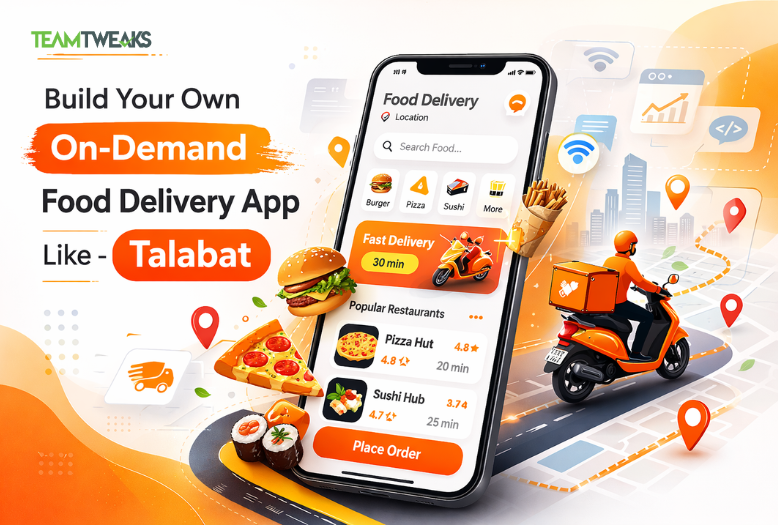
The demand for instant services has reshaped how people live, shop, and eat. In the UAE and across the Middle East, today, the Talabat app has become a household name, offering fast and reliable food delivery at the tap of a button. Moreover, its user-friendly platform and wide range of restaurant options have further strengthened its popularity among customers. If you’re considering launching your own food delivery app Development, inspired by Talabat’s success, this comprehensive guide will help you understand the process, costs, and strategies involved.
Whether you’re a startup or an established business, creating a custom mobile app tailored to your audience can open up new revenue streams and strengthen your brand presence. Let’s explore how to build an app like Talabat and make it thrive in today’s competitive market.
Talabat app – Overview
The Talabat app is a leading online food delivery platform that operates across several countries in the Middle East, and then United Arab Emirates, Kuwait, Bahrain, Oman, Qatar, and Jordan. Therefore it allows users to browse menus, place orders, and receive deliveries from a wide range of restaurants and grocery stores directly through their smartphones.
Additionally, known for its user-friendly interface and reliable service, Talabat has become a preferred choice for customers seeking convenience and speed in their daily lives. Additionally, the app offers multiple payment options, including credit cards, mobile wallets, and cash on delivery, making it accessible to a broad audience.
With features like real-time order tracking, personalized recommendations, and promotional offers, Talabat has successfully built a digital ecosystem that caters to both individual users and business partners. Finally, its continued growth and adaptability have positioned it as a benchmark for food delivery apps in the region.
Building the Next Talabat App: Why Now, Why UAE?
Tech-Savvy Population
- High smartphone penetration: With over 90% smartphone adoption, therefore, UAE residents are deeply integrated into mobile-first lifestyles.
- Digital fluency across demographics: From Gen Z to working professionals, therefore, app usage is second nature, reducing onboarding friction.
- Social media and app ecosystems: UAE’s population is highly active on platforms like Instagram, TikTok, and then WhatsApp, enabling viral growth and seamless integrations.
Advanced Infrastructure
- Reliable high-speed internet: Consistent 5G coverage and fiber-optic networks also ensure uninterrupted app performance and real-time updates.
- Modern road networks and logistics hubs: Efficient urban planning and smart city initiatives also support fast, predictable delivery routes.
- Smart city alignment: Moreover, Dubai and Abu Dhabi’s smart city ambitions align perfectly with tech-enabled delivery platforms.
On-Demand Convenience
- Real-time tracking and updates: Real-time tracking and updates: In any modern taxi app, Moreover, consumers expect transparency and control; and then features like live driver tracking and ETA notifications are now baseline.
- Mobile payments and digital wallets: Widespread adoption of Apple Pay, Google Pay, and local fintech solutions also streamline checkout and reduce cart abandonment.
- Instant gratification culture: The United Arab Emirates’s fast-paced lifestyle therefore fuels demand for quick, reliable service—from food to pharmacy.
Government Support
- Pro-startup policies: Additionally, initiatives like Dubai Future Accelerators and Hub71 offer funding, mentorship, and regulatory ease.
- Digital-first governance: The UAE’s e-government services and paperless mandates also foster a culture of tech adoption.
- Visa and licensing reforms: Streamlined business setup, golden visas freelance permits attract global talent and founders.
Business Ecosystem
- Cloud kitchens and aggregators: Rapid growth of dark kitchens and food-tech startups also creates plug-and-play partnerships.
- Restaurant digitization: Additionally, many F&B outlets already use POS systems and delivery APIs, simplifying integration.
- Logistics and fleet providers: A mature ecosystem of third-party delivery fleets, in addition to logistics tech firms, supports scalability.
UI/UX Advantage
- Cultural customization: Arabic-English bilingual interfaces, halal filters, as well as region-specific design elements boost engagement.
- Behavioral design: UAE users respond well to gamified loyalty programs, cashback incentives, as well as personalized recommendations.
- Accessibility and inclusivity: Interfaces optimized for diverse user groups, also expats to locals, increase retention.
Market Readiness
- Consumer expectations: UAE residents are accustomed to premium service and digital convenience, therefore making them ideal early adopters.
- Competitive benchmarking: The success of platforms like Talabat, Deliveroo, and Careem shows strong market appetite as well as room for innovation.
- High disposable income: A wealthy consumer base supports premium tiers, subscription models, as well as value-added services.
Scalability Potential
- Regional expansion: The UAE’s central location and business ties make it a springboard to the GCC, MENA, as well as South Asia.
- Cross-platform growth: Opportunities to expand into groceries, pharmacy, as well as pet care and even B2B delivery.
- Tech stack extensibility: A modular backend enables future integration with AI, as well as drone delivery and smart home ecosystems.
How a Talabat -Like Food Delivery App Works
1.User Onboarding
- Users download the app and then create an account. Then Login grants access to restaurant listings and personalized features.
2. Restaurant Discovery :
- First, browse a wide range of restaurants.
- Filter by cuisine, price range, ratings, or delivery time.
- View detailed menus with item descriptions and prices.
3.Order Placement :
- Select food items and add them to the cart.
- Choose a payment method: card, mobile wallet, or cash on delivery.
- Next, confirm the order with the estimated delivery time|
4. Order Fulfillment :
- The restaurant receives the order and then begins preparing it.
- The app automatically assigns a nearby delivery driver.
- Real-time GPS tracking allows users to monitor delivery progress.
5.Notifications & Feedback :
- Push notifications update users on order status.
- After delivery, users can rate their experience and leave feedback.
6. Backend Operations :
The secure backend system manages orders, as well as payments and logistics.
Admins and restaurant partners use dashboards to:
- Performance
- Update menus
- Customer feedback and reviews
7. Technical Foundation :
- Strong UI/UX design ensures intuitive navigation.
- Fast loading times and reliable mobile development enhance user experience.
8.Regional Relevance :
In tech-savvy regions like the UAE, such apps offer:
- User Convenience
- Scalable growth for food businesses
Key Features of a Food Delivery App Like Talabat
Talabat is designed to make ordering food simple and convenient for users, whether they are customers, restaurants, or delivery partners. Therefore, understanding these features can help in creating a similar food delivery app and entering the industry. Specifically, the features can be divided based on the type of user:
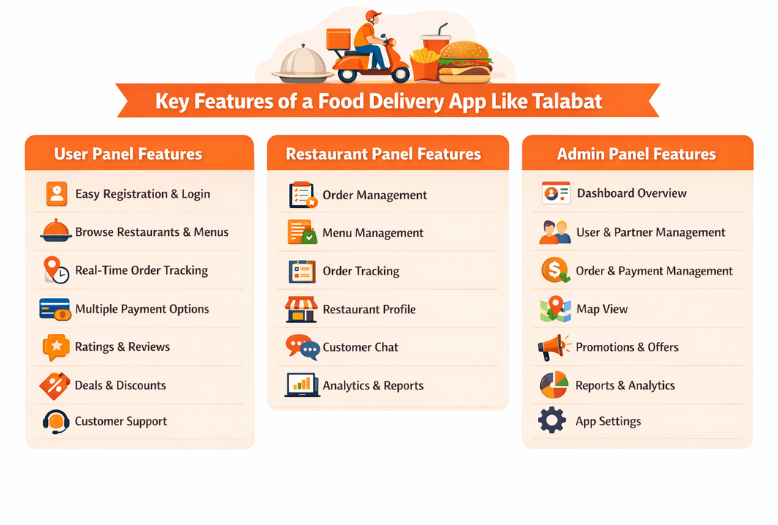
User Panel Features
- Easy Registration & Login: First, users can quickly create an account or log in using their email, phone number, or social media accounts. As a result, the onboarding process becomes fast and convenient.
- Browse Restaurants & Menus: Additionally, customers can easily search for nearby restaurants, explore cuisines, and view detailed menus with prices and images.
- Real-Time Order Tracking talabat app: Once an order is placed, users can track their food’s journey from preparation in the restaurant to its delivery at their doorstep.
- Multiple Payment Options: The app supports various payment methods such as debit/credit cards, online wallets, and cash on delivery, offering flexibility and security.
- Ratings & Reviews: Finally, after receiving their order, customers can rate the restaurant and delivery service and share feedback to help others make better choices.
- Deals & Discounts: Additionally, users can enjoy special offers, discount codes, and loyalty rewards to save money on their favorite meals.
- Customer Support: Furthermore, a built-in s support system allows users to contact customer care easily for help with orders, payments, or delivery issues.
Restaurant Panel Features
- Order Management: Additionally, restaurants can view all incoming orders, accept or reject them, and update the status in real time for better workflow and faster service.
- Menu Management: Restaurant owners can add, edit, or remove menu items, as well as update prices and upload new food images to keep their listings accurate and attractive.
- Order Tracking: Restaurants can monitor the delivery process and at the same time communicate with delivery partners to ensure orders reach customers on time.
- Restaurant Profile: Manage restaurant details such as name, contact information, opening hours, and delivery areas to keep customers informed.
- Customer Chat: Restaurants can directly communicate with customers through chat, as well as for order confirmations, customizations, or queries.
- Analytics & Reports: Access detailed sales reports, while also tracking popular dishes and analyzing daily performance to improve operations and marketing.
Admin Panel Features
- Dashboard Overview: Moreover, the admin can view all key statistics at a glance including total users, active restaurants, and live orders on the platform.
- User & Partner Management: Additionally, adminscan manage customers, restaurants, and delivery partners, including adding, editing, or restricting users as needed.
- Order & Payment Management: Furthermore, track and manage every order placed on the platform along with payment details, refunds, and commissions.
- Map View: A map interface allows the admin to see real-time locations of restaurants, as well as delivery agents and active delivery routes.
- Promotions & Offers: Admins can create and manage platform-wide promotions, as well as deals and special discounts to attract more users and partners.
- Reports & Analytics: Generate detailed analytical reports on orders, earnings, meanwhile, app usage, and customer behavior to support better decision-making.
- App Settings: Manage and update system settings, meanwhile, notifications, and other configurations to ensure the app runs smoothly and efficiently.
Step-by-Step Plan – How to Build a Food Delivery App Like – Talabat app
In summary, creating a food delivery app like the Talabat app takes careful planning, the right tools, and a strong understanding of what users expect. Whether you’re a startup or an established business, this step-by-step guide will help you build a custom mobile app that works well in the UAE market and stands out from the competition.
Step 1: Choose Your Business Model
Firstly, start by deciding how your app will operate. This, in turn, will shape your features, design, and revenue strategy.
- Single restaurant app: Best for restaurants that want direct access to customers.
- Multi-vendor marketplace: Like the Talabat app, this connects users to many restaurants.
- Cloud kitchen aggregator: Focuses on delivery-only kitchens with no dine-in service.
Each model has different needs, so choose the one that fits your goals and budget.
Step 2: Understand the UAE Market
Firstly, the UAE is a great place to launch a food delivery app. People here use smartphones often and prefer fast, app-based services. Therefore, study local habits, popular cuisines, and payment preferenWorking with experts in mobile app development in the UAE helps you build an app that matches local expectations and follows government rules.
Step 3: Do Market Research
Look at other food delivery apps like Zomato, Deliveroo, and Uber Eats. What features do they offer? What do users like or dislike? Also, ask potential users what they want. As a result, this helps you design a food delivery app that solves real problems and offers a better experience.
Step 4: Plan the Key Features
Your app should include all the important tools users expect. Some must-have features are:
- Easy sign-up and login
- Restaurant listings with filters
- Menu with images and prices
- Real-time delivery tracking
- Multiple payment options
- Push notifications
- Ratings and reviews
- Admin dashboard for restaurants
- Loyalty programs and offers
- Contactless delivery option
These features improve user engagement and help your app grow.
Step 5: Focus on UI UX Design
Secondly, a clean and simple design makes your app easy to use. Good UI/UX helps users find what they need quickly and keeps them coming back. Additionally, use clear layouts, readable fonts, and smooth navigation. Finally, make sure your app works well on all devices and supports multiple languages.
Step 6: Choose the Right Technology
Therefore, your app’s performance depends on the technology you use. Choose tools that support fast loading, secure payments, and easy updates. Recommended tech stack:
- Frontend: React Native or Flutter
- Backend: Node.js or Django
- Database: MongoDB or PostgreSQL
- Cloud hosting: AWS or Google Cloud Computing
- APIs: Google Maps, Stripe, Firebase
A strong tech foundation helps you scale your app and add new features later.
Step 7: Start Development
Next, work with a skilled team to build your app step by step. Additionally, use agile methods to stay flexible and make changes as needed. Finally, test each part of the app carefully to avoid bugs and make sure everything works smoothly.
Step 8: Test Your App
Before launch, test your app for:
- Functionality: Do all features work?
- Speed: Does the app load quickly?
- Security: Is user data safe?
- Usability: Is the app easy to use?
Fix any issues and make improvements based on feedback.
Step 9: Launch and Promote Your App
Once your app is ready, launch it on the App Store and Google Play. Use strong marketing to attract users.
- Run ads on social media
- Partner with food bloggers
- Offer referral bonuses
- Use SEO keywords like e-commerce app, build an app, and custom mobile app in your website and blog
Good promotion helps your app reach more people and grow faster.
Step 10: Provide Ongoing Support
Finally, after launch, keep improving your app. Additionally, add new features, fix bugs, and listen to user feedback. Moreover, offer customer support through chat or email. Also, keep users updated with real-time notifications and offers.
Step 11: Track Performance and Scale
Additionally, use analytics to see how your app is doing. Then we track orders, user activity, and delivery times. As your app grows, add more restaurants, expand to new areas, and improve your delivery system.
Tech Stack for Food Delivery App Development Like Talabat
Next, choosing the right tech stack is key to building a fast, secure, and scalable food delivery app. Therefore, a strong tech foundation helps your app run smoothly, handle more users, and support features like real-time tracking, mobile payments, and push notifications. Below is a step-by-step breakdown of the essential technologies to use:
1. Frontend (User Interface)
This is what users see and interact with on their phones.
- React Native or Flutter: For building cross-platform mobile apps (iOS and Android) with one codebase.
- HTML5, CSS3, JavaScript: For web-based versions of the app.
2. Backend (Server Side)
Specifically, this handles data, orders, payments, and communication between users, restaurants, and delivery partners.
- Node.js or Django: Fast and scalable frameworks for building APIs and managing app logic.
- Express.js (with Node.js): For handling routes and server-side functions.
3. Database
Stores user profiles, restaurant menus, orders, and payment history.
- MongoDB: A flexible NoSQL database for handling large volumes of data.
- PostgreSQL or MySQL: Reliable relational databases for structured data.
4. Cloud Hosting & Storage
Keeps your app online and stores images, files, and backups.
- Amazon Web Services (AWS) or Google Cloud Platform (GCP): Scalable cloud hosting with high security.
- Firebase Storage: For storing user-uploaded content like profile pictures or menu images.
5. Real-Time Features
Supports live order tracking, updates, and chat.
- Firebase Realtime Database or Socket.IO: For real-time communication between users and delivery drivers.
- Google Maps API: For location tracking, route optimization, and map views.
6. Payment Gateway Integration
Allows users to pay securely through the app.
- Stripe, PayPal, or Telr: Popular payment gateways with support for UAE-based transactions.
- Mobile wallet integration: Moreover, support for Apple Pay, Google Pay, or local wallets like PayBy.
7. Push Notifications
Keeps users updated about order status, offers, and alerts.
- Firebase Cloud Messaging (FCM): For sending real-time notifications across devices.
8. Admin Dashboard & Analytics
Helps restaurants and app owners manage orders, menus, and performance.
- React.js or Angular: For building responsive admin panels.
- Google Analytics, Mixpanel, or Hotjar: For tracking user behavior and app performance.
9. Security Tools
Protects user data and prevents fraud.
- OAuth 2.0 and JWT (JSON Web Tokens): For secure login and authentication.
- SSL Encryption: To protect data during transmission.
10 Popular Food Delivery Apps Like Talabat in UAE
Additionally, below is a list of popular food delivery apps that operate in Dubai, UAE, and other global markets, offering similar features and user experiences.
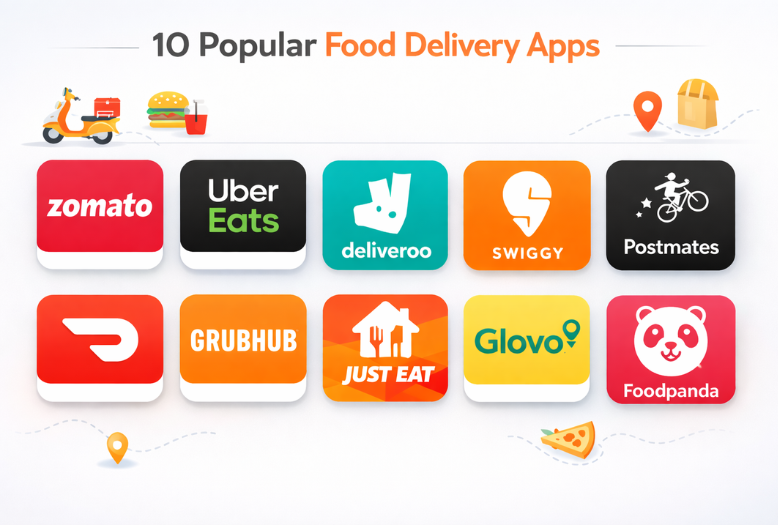
| App Name | Estimated Downloads | Rating | Launch Year | Platforms |
| Zomato | 100+ million | 4.2 | 2008 | iOS, Android, Web |
| Uber Eats | 50+ million | 4.4 | 2014 | iOS, Android, Web |
| Deliveroo | 30+ million | 4.3 | 2013 | iOS, Android, Web |
| Swiggy | 20+ million | 4.5 | 2014 | iOS, Android, Web |
| Postmates | 15+ million | 4.1 | 2011 | iOS, Android, Web |
| DoorDash | 10+ million | 4.2 | 2013 | iOS, Android, Web |
| Grubhub | 10+ million | 4.3 | 2004 | iOS, Android, Web |
| Just Eat | 10+ million | 4.2 | 2000 | iOS, Android, Web |
| Glovo | 5+ million | 4.3 | 2015 | iOS, Android, Web |
| Foodpanda | 5+ million | 4.1 | 2008 | iOS, Android, Web |
How Much Should You Invest in a Talabat App in the UAE?
The investment required to develop a Talabat-like food delivery app in the UAE depends on several factors including the cost of build, and then app complexity, feature set, and platform choice. Basic apps may cost less, while advanced apps with real-time tracking, payment integration, and admin dashboards demand higher budgets.
| Package | Estimated Cost (AED) | Features Included |
| Basic | 15,000 – 30,000 | User registration/login, basic UI, simple functionality |
| Standard | 30,000 – 60,000 | Basic features + push notifications, profile management, basic analytics |
| Advanced | 60,000 – 100,000 | Standard features + payment integration, social sharing, admin panel |
| Premium | 100,000+ | Advanced features + AI/chatbot integration, multi-language support, advanced analytics, custom design |
Team Tweaks – Your Trusted Partner to Build a Food Delivery App Like Talabat
Team Tweaks is a leading mobile app development company with over 12+ years of experience delivering high-performance digital solutions across the globe. Then we specialize in building scalable, user-friendly apps tailored to meet the unique needs of startups, SMEs, and enterprises. Additionally, our team blends deep technical expertise with creative problem-solving to transform your food delivery concept into a market-ready platform.
Why Choose Team Tweaks?
Proven Expertise: Moreover, a decade of experience, Team Tweaks has successfully developed food delivery apps, restaurant management systems, and logistics platforms for clients across the UAE, GCC, and beyond.
Custom software Solutions: Additionally, we understand that every food delivery business is different. Therefore, our solutions are fully customizable from UI/UX design to backend architecture ensuring your app reflects your brand, audience, and operational model.
End-to-End Services: From ideation and wireframing to development, testing, and deployment, we offer complete support throughout your app development journey. We also provide post-launch maintenance and feature upgrades.
Cutting-Edge Technology: We use the latest frameworks and tools including Flutter, React Native, Node.js, and cloud-native stacks to ensure your app is fast, secure, and future-proof.
Customer-Centric Approach: Furthermore, we work closely with clients to meet timelines, budget goals, and business objectives. Additionally, our agile workflow ensures transparency, flexibility, and continuous improvement.
Services Offered by Team Tweaks
- Food Delivery App Development : Then we build apps similar to Talabat, Uber Eats, or Deliveroo with features like real-time tracking, multi-vendor support, secure payments, and loyalty programs.
- Mobile App Development : Specifically, native Android, iOS, and cross-platform app development using Flutter and React Native.
- Web Development : Additionally, responsive websites, vendor dashboards, and admin panels tailored for food delivery operations.
- Restaurant & Cloud Kitchen Solutions : Additionally, custom portals for menu management, order flow, inventory tracking, and analytics.
- Courier & Logistics Integration : Moreover, fleet management, driver assignment, route optimization, and real-time delivery tracking.
- Payment Gateway Integration : Furthermore, support for Apple Pay, Google Pay, Stripe, PayTabs, and regional wallets.
- Digital Marketing Services : SEO, social media marketing, and performance campaigns to grow your app’s visibility and user base.
- IoT & Smart Delivery Tech : Additionally, integration with smart lockers, drone delivery systems, and connected devices for next-gen logistics.
Final Thoughts
Creating a Talabat-like app for on-demand food delivery represents a significant opportunity in the rapidly growing digital food service industry. Such an app not only connects customers with a wide range of restaurants but also provides real-time order tracking, secure payments, and personalized recommendations, enhancing the overall user experience. By leveraging advanced technologies like AI for predictive analytics and route optimization, the app can streamline operations for delivery partners while ensuring faster and more reliable service.
From a business perspective, developing a robust on-demand food delivery app can open multiple revenue streams, including delivery fees, and then subscription models, advertising, and partnerships with restaurants. However, success hinges on understanding market dynamics, addressing logistical challenges, and prioritizing user convenience and safety.
FAQ’s
1. How long does it take to build a food delivery app like Talabat?
Typically, developing a food delivery app similar to Talabat takes around 3 to 6 months. However, the exact timeline depends on the complexity of features, the number of platforms (Android, iOS, or Web), and the level of customization required. For example, a basic app may take about 8–12 weeks, whereas advanced apps with real-time tracking and AI-based recommendations may require additional development time.
2. What are the essential features required in a Talabat-like food delivery app?
First, a food delivery app should include core features such as easy user registration, restaurant listings, menu browsing, and secure payment options. Additionally, functions like real-time order tracking, push notifications, ratings and reviews, and an admin dashboard help improve user experience. Moreover, advanced features like loyalty programs and contactless delivery can further increase customer engagement.
3. How do food delivery apps like Talabat make money?
Food delivery platforms such as Talabat generate revenue through multiple streams. Primarily, they earn commission fees from restaurants for each order placed through the platform. In addition, they charge delivery fees from customers and offer premium subscriptions for exclusive benefits. Furthermore, many platforms earn through in-app advertisements and promoted restaurant listings.
4. Is it profitable to launch a food delivery app in the UAE?
Yes, launching a food delivery app in the United Arab Emirates can be highly profitable. This is mainly because the region has high smartphone usage and strong demand for on-demand services. Moreover, the growing restaurant industry and tech-friendly ecosystem make it easier for new platforms to attract both customers and restaurant partners.
5. What technology is best for building a food delivery app?
To begin with, modern food delivery apps often use cross-platform frameworks like React Native or Flutter to build apps for both Android and iOS. Meanwhile, Node.js or Django are commonly used for backend development. Additionally, databases such as MongoDB or PostgreSQL, along with cloud platforms like AWS or Google Cloud, help ensure scalability, security, and reliable performance.
6. How can you make a food delivery app stand out from competitors?
To stand out in a competitive market, your app must focus on delivering a better user experience than established platforms like Talabat, Uber Eats, and Deliveroo. For instance, offering faster delivery, personalized recommendations, and attractive loyalty rewards can attract more users. Furthermore, a simple UI/UX design and responsive customer support can significantly improve user retention.