In today’s world of highly congested urban centers, the evolution of bike taxi services have changed the way people navigate the complexities of city travel. With traffic, fuel prices, and the need for swift commuting options, bike taxis are a smart and inexpensive alternative. Rapido is one of the fastest growing and highly popular bike taxi services in the country. Looking at Rapido’s success, several startups and aspiring entrepreneurs are keen to replicate this bike taxi service model. A bike taxi service app is inexpensive to start, easy to grow, and a necessity in cities with traffic congestion.
In this blog, we discuss the Rapido bike taxi app’s business model, features, technology stack, how to build a powerful and scalable bike taxi app, cost, and development steps.
Overview Of Rapido Bike Taxi
Rapido is an app based bike taxi service that allows users to book rides and travel at a lower cost than if they were to book a car. This is a great service for people living in cities with a lot of traffic.
Rapido mainly operates in urban areas and offers services such as:
- Daily office commutes
- Short distance trips
- Economical last mile connectivity
Why Bike Taxi Apps Are Getting Popular
Bike taxi apps are getting popular for a few reasons.
- First, bikes are able to move through traffic quicker than other vehicles. This helps users save time.
- Second, the cost to take a taxi bike is cheaper than a car, making it perfect for students, employees, and everyday commuters.
- Lastly, bike taxis are better for the environment and use less gas than car taxis.
For business owners, bike taxi apps are appealing because the initial costs for opening in a new city is lower than for car taxi apps. Also, there is a higher demand for bike taxis than car taxis in urban areas.
How Does the Rapido Bike Taxi Business Model Work?
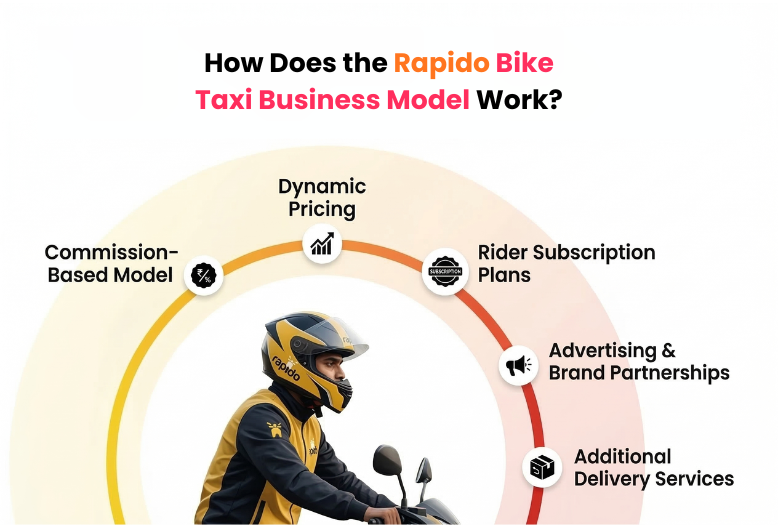
The first step for creating a bike taxi app is figuring out the business model. There are several ways to set up a business model for a bike taxi app, but all of them will have the following:
Commission-Based Model: This is the primary way Rapido generates is through commission. A rider will make money through each trip, and Rapido will take a cut as commission. This cut will differ by city, demand, or other promotional events.
Dynamic Pricing: Rapido will use dynamic pricing in cases of increased high demand. This helps maintain a balance between supply and demand.
Rider Subscription Plans: Some platforms launch weekly or monthly subscription plans for riders, giving riders benefits such as reduced commissions and priority ride assignments.
Advertising and Brand Partnerships: Bike taxi apps can further monetize their platforms by advertising brands within their apps, such as in banner ads, notification ads and promotional sections.
Additional Delivery Services: Many bike taxi platforms broaden their service offerings by incorporating food and parcel/document delivery, creating additional revenue streams without developing a new platform.
Core Features of a Rapido Bike Taxi App
Building a bike taxi app requires incorporating the right features.
1. User App Features
User apps need to be intuitive, and uncomplicated.
Users need the option to register through a mobile number or email, and the ability to select pickup and drop off locations in seconds using GPS. Estimated fares and time to complete the ride must be displayed before booking the ride.
Real time ride tracking should be available to see the rider’s current location. UPI, card, wallet, and cash payment options should be included for user convenience, and users should be able to rate riders and give ride feedback.
2. Rider App Features
The rider app assists bike captains in controlling the flow of rides and managing their earnings.
Riders can register by submitting their driver’s license, vehicle registration, and identification documents. They can also be able to approve or deny ride requests. Integrated gps makes it easier for them to get to the pickup and drop off locations.
The app shows riders’ daily and weekly profits. They can also adjust their availability status, and may receive extra pay or bonuses.
3. Admin Panel Features
The admin panel plays a key role in operating and managing the entire system.
The Admin also has the ability to manage the users, riders, and rides in one place. Included in fare management is the ability to set a base fare, per mile rate, and the rules for surge pricing. Each admin has the ability to verify documents and approve or deny updates on a rider’s profile.
The Reports and analytics section is used to monitor the system’s revenue, number of trips taken, peak times, and performance of riders. The Admin has the ability to control the availability of promotions, and also control the incoming support requests from the customers.
The Tech Stack used to develop the Rapido bike taxi app
The selection of technology is essential for the performance and scalability of the system.
Mobile App Development: For Android apps, Kotlin or Java is commonly used. For iOS apps, Swift is preferred. A lot of companies elect to use Flutter or React Native in order to develop a single app for both platforms and also minimize the cost of development.
Backend Development: The backend processes user requests like ride matching, payment processing, and notification sending. Common backend technologies are Node.js, Python, and Java. Mobile applications and backend systems are connected using REST APIs or GraphQL APIs.
Database Management: User information, ride history, payment, and reports are stored in databases. Commonly used databases include MySQL, PostgreSQL, MongoDB, or Firebase.
Maps & Navigation Integration: Platforms such as Google Maps API or Mapbox are used to monitor real time locations, find the best routes, and measure distances.
Payment Gateway Integration: For secure payments and a seamless transaction experience, payment gateways such as Razorpay, Stripe, or Paytm are integrated. In India, UPI payment options are essential.
Hosting & Cloud Services: Many applications rely on cloud providers like AWS, Google Cloud, or Azure for secure, scalable, and high uptime hosting.
Step-By-Step Instructions For Creating A Rapido Like Application
In a world where modern transportation and digital products are continually innovating and evolving, creating a Rapido like application is a great potential business opportunity. They provide a fast, low cost alternative to traditional cabs. However, to make sure you succeed, it is crucial to have the right skills and knowledge to implement the right features and the right tech.
The following instructions provide a detailed overview on how to create a bike taxi application like Rapido.
Step 1: Learn The Business Model For Bike Taxis
Before any development can begin, a method to monetize the application has to be determined. This is a crucial step, as this will assist in determining essential features, pricing, and how to implement growth strategies in the future.
Most apps that are similar to Rapido operate under a commission based model. This means that bike taxis can make money by completing driving assignments and the system takes a percentage (or commission) of the driver’s earnings. The percentage is usually determined by variables like the location, time of the year, and bike taxi peak demand.
During high demand times (peak hours) for bike taxis, you can implement a strategy where bike taxis can make money by completing driving assignments and the system takes a percentage (or commission) of the driver’s earnings. The percentage is usually determined by variables like the location, time of the year, and bike taxi peak demand.
Having a strong business model from the beginning will increase likelihood for success, as it will allow you to create a better designed application.
Step 2: Planning the App Components
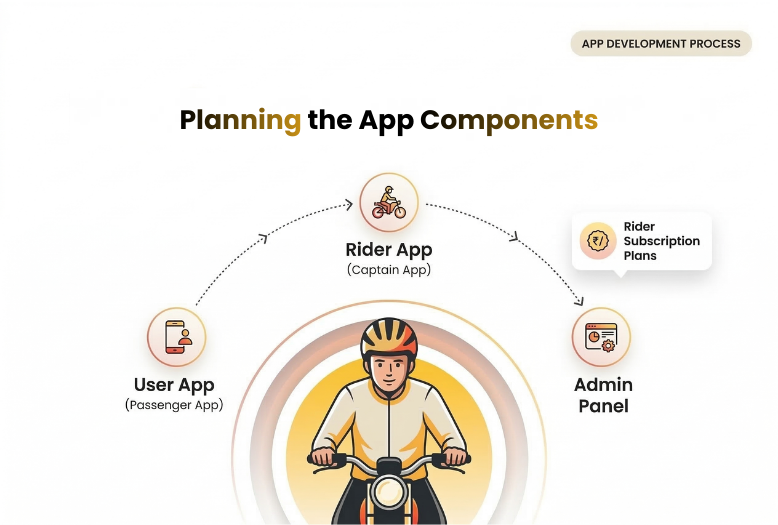
An app like Rapido has a complete system in place, and is not just one app. There are a number of elements that work together.
There are typically three components of the platform:
User App (Passenger App)
The user app is the one that customers use to book bike rides. They can request a ride, make a payment, track the bike rider, and provide feedback.
Rider App (Captain App)
The rider app is used by bike riders. They can accept ride requests, manage their availability, track their earnings and navigate their route.
Admin Panel
The Admin panel is the control center of the complete system. They manage the users, bike riders, payments, pricing, offers and reports.
Each component is crucial and if one of the components fails, the other components will be affected, so it needs planning.
Step 3: Incorporate the Essential Features
Features will determine how user-friendly your app will be and how useful it will be. An app like Rapido needs to emphasize simplicity, speed and reliability.
User App Features
The user app needs to be easy to navigate and use, even for someone who is using it for the very first time. It needs to provide easy mobile number/email sign up and GPS based location detection to avoid typing and selection of the pickup and drop locations.
Users should see the estimated fare and time for the ride before confirming. A feature for real time tracking and viewing the driver’s location on the map is necessary. Payments must be secure and support UPI, cards, wallets, and cash.
Users should have ride history, access to support, and be able to submit ratings and reviews.
Features of the Rider App
The rider app should facilitate captains with managing their day’s duties. Riders should be able to register by submitting the documents pertaining to their driving license, vehicle RC, and ID.
They should be able to set their availability to online or offline. Ride request notifications must be instant. Navigational assistance is provided so captains can easily get to their pick up and drop off points.
Earnings for the day and week, as well as incentives and bonuses must be plainly visible. This helps to encourage riders to stay active on the app.
Features of the Admin Panel
The admin panel helps to manage the entire business, as the name entails. Admins must have the ability to see and control users, riders, and trips, in real time.
Setting and changing pricing rules, commission rates, surge pricing, and promotional offers should be simple and straightforward. The trust and safety of riders is enhanced with rider document verification.
The analytics and demand reports will provide insights into total rides, total revenue, peak periods for service usage, and user habits. These analytics provide business insight.
Step 4: Pick a Tech Stack
The right technology makes sure that your application runs great and helps the business grow by adding features in the future.
In Mobile App Development, you can use Flutter, or React Native, for a single codebase solution for both Android and iOS. For performance, you can use Native Technologies, Kotlin for Android and Swift for iOS.
For Backend Development, you can choose any of the 3: Node.js, Python, or Java. These will handle the user requests, matching rides, and processing.
For Databases, MySQL, PostgreSQL, or MongoDB. You will have user data, rides, and pay storage. For real time data and optimized routing use Google Maps or Mapbox.
Secure Payment Gateways, secure payments. For Cloud Hosting, secure data, speed, and scalability.
Step 5: Keep the User Interface clear and simple.
User experience impacts the application’s performance. If there is a hiccup, users will leave.
The App’s design must be clean, modern, and simple to use. Key activities, such as booking a ride and accepting requests, should be contained within a small number of taps. The design must ensure that text is easily readable, buttons are self explanatory, and workflows are seamless.
A simple design has also been shown to decrease the number of support requests, and increase user satisfaction.
Step 6: Build and Integrate APIs
APIs are what will allow parts of the system to communicate with the structure of the backend and are built to connect to the mobile apps.
APIs can be built to handle user registration, ride booking, ride requests, fare calculations, payments, and admin capabilities. The APIs will also allow the app to access mapping, real time tracking, and push notifications.
To assist with communication and performance analytics, third party API integrations will allow SMS, push messaging, email system, and analytics.
Step 7: Perform Thorough Testing of the App
Before the actual launch, ample time should be allotted to identify and correct as many deficiencies before the app is to be used under “real world” conditions.
Testing should be performed for bug elimination, system crashes, stagnant system performance, the accuracy of GPS, failures to capture payments, and system security. Testing should be performed under various hardware platforms and various network performance profiles.
The perceived trust of the users on the app increases once the app has been properly tested.
Step 8: Launch the App
Once testing is complete and adjustments are made, the app is ready to be published on the Google Play Store and the Apple App Store. You must adhere to the rules and guidelines of each app store to ensure your app is approved.
As your app launches, you should implement marketing strategies which may include promotions, referral offers, and social media marketing to drive customer and driver acquisition.
A solid launch helps to drive initial customer and driver acquisition, as well as making your app more visible.
Step 9: App Maintenance and scaling.
Once the app has been launched, it is not the final step. In order to maintain the app and for the app to have a good user experience, a lot of backend work is needed.
It is imperative that your app receives updates, as these updates will fix bugs that are present, and improve the user experience by making it easier to use. Additionally, your app can gain new functionality with each update.
Once your app has an established user base, you can then expand your services to new markets and add new features such as delivery, and the use of electric bikes to assist with green travel.
Also, you will need your app to have the correct technology in order for it to scale and be able to work successfully for a long period of time without a lot of updates which will, in turn, drive your app’s revenue.
Cost Breakdown for Creating a Rapido like Bike Taxi App
The estimated cost for developing a Rapido like bike taxi app is dependent on the app’s features, complexity, and how long the developers would need to complete it. Here, we provide a basic breakdown for the three versions: Simple, Medium, and Advanced.
Simple Bike Taxi App (Basic Version)
This option would suit a startup that is looking to create a basic bike taxi app for the purposes of market testing.
App Features
- Mobile or email user registration
- Basic booking of rides
- Pick up and drop off locations
- Estimated fare calculation
- Rider application to accept rides
- Basic GPS
- One payment option (cash or UPI)
- Basic Admin panel
- Ride history
Cost & Timeline
| Details | Information |
|---|---|
| Development Cost | ₹50,000 – ₹1,00,000 |
| Development Time | 2 – 3 months |
| Best For | MVP launch, single city |
Medium Bike Taxi App (Standard Version)
This version comes with highly advanced features needed for an expanding bike taxi business.
Key Features
- Both Android and iOS apps
- Real time GPS tracking
- Diverse payment methods (UPI, card, wallets)
- Document verification and rider onboarding
- Implementation of surge pricing
- Notifications (Push)
- Referral programs
- Comprehensive admin dashboard
- Financial report and data analytics
Cost & Timeline
| Details | Information |
|---|---|
| Development Cost | ₹1,00,000 – ₹3,00,000 |
| Development Time | 4 – 6 months |
| Best For | Multi-city launch, growing startups |
3. Advanced Bike Taxi App (Enterprise Version)
This is an advanced fully featured app, designed for large operational scale, similar to Rapido.
Included Features
- Rider Match Using AI
- Pricing Surge Based on Demand
- Heat Maps Displaying Demand for Areas
- Chat and Call Options Within the Application
- SOS and Emergency Features
- Support for Multiple Cities and Languages
- Subscription Plans for Users
- Wallet Features
- Delivery and Logistics Features
- Advanced Analytics and Reports
- Analytics and Reports
- Scalable Cloud Based Infrastructure
Cost & Timeline
| Details | Information |
|---|---|
| Development Cost | ₹3,00,000+ |
| Development Time | 6 – 9 months |
| Best For | Enterprise & national-level business |
Cost & Time Comparison Table
| App Type | Cost Range | App Development Time | Ideal For |
|---|---|---|---|
| Simple App | ₹50,000 – ₹1,00,000 | 2 – 3 months | MVP, small launch |
| Medium App | ₹1,00,000 – ₹3,00,000 | 4 – 6 months | Growing startups |
| Advanced App | ₹3,00,000+ | 6 – 9 months | Large-scale platforms |
Future Of Bike Taxi Apps
- Electric Bike Integration: Utilization of electric bikes can aid in curtailing operational costs and combating pollution. Electric bikes are fuel free, more inexpensive to operate, and as an additional benefit are supported by governmental initiatives in various cities.
- AI Based Pricing and Routing: Apps will utilize AI for dynamic smart pricing based on demand, traffic, and time. AI also selects the quickest routes to minimize travel time and aid users in timely arrivals to their destinations.
- Smart City Integration: Bike taxi apps will integrate with smart city tech and public transport systems. This will improve traffic control and travel planning for users.
- Encouragement of Sustainable Transport: Bike taxis promote green mobility by decreasing carbon footprints and traffic jams. Cities investing in sustainable transport will keep encouraging bike taxi options.
- Improved User and Rider Experience: Apps of the future will allow easier bookings, safer transports, and better rider incentives through cutting edge tech.
- Increased Urban Mobility Solutions: Bike taxi apps will be a vital answer for quick and cost effective travel in cities due to the rising urban population and consequent traffic challenges.
How Team Tweaks Assists You in Creating a Rapido Like App
Team Tweaks, a mobile app development company in Chennai with over 12+ years of expertise in building scalable and secure digital solutions for businesses, has established a reputation in the industry.
We specialize in:
- Mobile App Development (Android, iOS, Flutter): Team Tweaks provides scalable, user-centric, and high performance mobile apps for businesses in all sectors.
- Android App Development: Our team creates high performance Android apps designed to provide a smooth user experience and effortless navigation.
- iOS App Development: We create high quality, engaging, and secure iOS apps developed specifically for iOS devices.
- Flutter App Development: We provide cost and time effective development solutions using Flutter (cross platform) technology.
- Taxi & Ride Hailing Development: We help businesses establish their own ride hailing apps by developing sophisticated taxi and ride hailing app like Uber.
- Web Development: We provide responsive, secure, and growth oriented websites and web apps to support your business.
- Internet of Things (IoT): We provide smart IoT solutions that enhance business operations by device interconnection, increasing efficiency and automating processes.
- DevOps Consulting: We provide top tier DevOps Consulting to improve development processes, system performance, and scalability.
- Cloud Computing: We offer advanced and tailored cloud solutions that provide secure and scalable infrastructures.
- Digital Marketing Services: We focus on driving growth in businesses’ digital presence through effective online marketing strategies.
- SEO Services: We aim to provide our customers with the best possible outcome through effective SEO.
Our expert team has combined experience in technology and business, and this ensures your bike taxi app is developed with the best potential to grow and succeed in the long run.
Last Words
Creating a Rapido style bike taxi app can be a great business opportunity. With the right business model, up to date technology, and a skilled development team, you can provide a platform that will offer your customers speed, low prices, and convenience.
Team Tweaks is ready to assist you in the development of your bike taxi app by providing complete end to end development to bring your idea to fruition.
FAQs
A bike taxi app is a type of mobile app that enables users to book bike rides for short distance travel for a cheaper rate.
Users book rides using the app and nearby riders pick the request. The platform makes money through a commission for each ride.
Depending on what features you want, a basic app will cost you between ₹50,000 – ₹1,00,000. More advanced apps will begin to cost you ₹3,00,000.
The simpler the app, the less time it will take to design. A simpler app will take about 2–3 months, while a more advanced app will take 6–9 months.
Some of the most necessary features are user registration, GPS tracking, estimated fares, secured payment options, rider management, and an admin dashboard.
A bike taxi business is a good business to own and can be very profitable due to the low startup costs, high demand with in cities and multiple streams of income.
Certainly, you can incorporate additional services such as food delivery, parcel delivery, or document delivery, as it can help in boosting your revenue.