The tech world is changing fast. In 2026, companies are not just looking for degrees, they want people with real, in-demand skills. Businesses of all sizes, from startups to big corporations, are using new technologies. They want workers who know how to build, manage, and protect modern digital systems.
Because of this shift, certain IT skills have become much more important. If you learn these skills now, you can get good jobs, earn more money, and build a future proof career. This blog covers the top 15 IT skills that are most in-demand in 2026 and can help you get high paying roles.
What Makes an IT Skills “In-Demand” in 2026
Why do these skills matter so much now? Several big trends have changed the way companies work.
- More companies are using cloud services, SaaS platforms, and remote infrastructure rather than managing their own hardware. This increases demand for cloud and cloud native skills.
- Businesses are expanding use of data, AI and analytics to understand customers, make predictions, automate tasks, and gain competitive advantage. That drives demand for AI, ML, data science, and analytics skills.
- As everything becomes digital, security threats increase. Organizations need cybersecurity experts to keep data and systems safe.
- Software development is growing in complexity: apps are expected to scale, integrate with cloud, work across platforms so full stack, DevOps, backend/frontend, and testing skills are vital.
- New technologies such as blockchain, IoT, big data, AR/VR are opening fresh domains. People with expertise in these areas may get high value roles.
In short: companies want people who can build, manage, secure, and innovate not just follow old rules.
Hence, the “in-demand” skills of 2026 are those that help organizations stay competitive, secure, and ready for future growth.
Top 15 In-Demand IT Skills for 2026
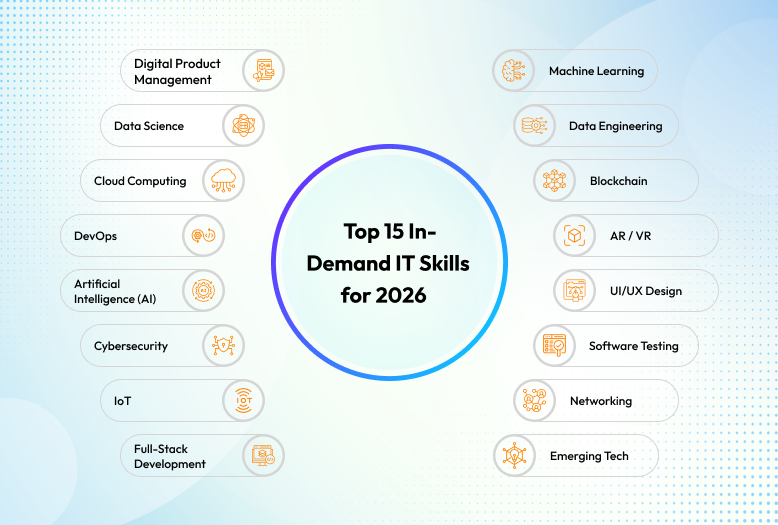
Here are 15 IT skills that are poised to remain highly valuable in 2026. For each, I explain what it is, why it’s important, what roles usually require it, and why learning it can pay off.
1. Artificial Intelligence (AI)
AI remains one of the top skills across global industries. AI helps companies automate tasks, extract insights, personalise services, and build intelligent products.
Why it’s important: AI can solve complex problems from fraud detection, customer recommendation, to predictive maintenance faster and with less human effort. Organizations are willing to pay premiums for AI experts who can build robust, scalable AI systems.
Typical roles: AI Engineer, AI Researcher, NLP Engineer, AI Product Developer, AI/ML Architect.
Core skills to learn:
- Programming languages (commonly Python)
- Frameworks & tools (e.g. TensorFlow, PyTorch)
- Skills in neural networks, effective problem solving, data processing, deploying models, and maintaining ethical and safe AI practices.
Why it pays: Because AI drives innovation, companies view AI skilled professionals as strategic assets. As AI adoption grows, demand (and pay) will only rise.
2. Machine Learning (ML)
ML is tightly connected to AI; it’s often how AI “learns” from data. From prediction systems, recommendation engines, automation workflows, to analytics platforms ML is everywhere.
Why it’s important: As data volumes grow, human only processing is not enough. ML helps make sense of large data sets, detect patterns, forecast trends, and automate decisions. Businesses across sectors healthcare, finance, e-commerce, logistics rely on ML for smarter operations.
Typical roles: Machine Learning Engineer, Data Scientist (with ML focus), ML Researcher, Model Validator, ML Ops Engineer.
Core skills to learn:
- Python / other common ML languages
- Statistical modelling, data preprocessing, feature engineering, model evaluation
- ML libraries and frameworks (TensorFlow, PyTorch, scikit learn, etc.)
- Understanding of algorithms, data pipelines, data ethics & fairness
Why it pays: ML specialists help companies use their data to make decisions, gain insights, and stay ahead making them very valuable.
3. Data Science & Analytics
Data is the new gold. But raw data does not help until someone interprets it. That’s where data science and analytics play a crucial role. Data science combines math, statistics, programming and domain knowledge to draw insights.
Why it’s important: As companies collect massive data about customer behaviour, sales, operations, usage logs they need data science to make sense of it. Good analytics can drive strategic decisions, improve products, reduce costs, and increase revenue.
Typical roles: Data Scientist, Data Analyst, Business Intelligence (BI) Analyst, Data Engineer (with analytics focus), Analytics Consultant.
Core skills to learn:
- SQL (for data querying)
- Programming languages like Python (or R) for data processing and analysis
- Statistics, probability, data visualization tools (Tableau, Power BI, etc.)
- Understanding of data modelling, cleaning, ETL processes, and reporting
Why it pays: Data driven decisions are becoming fundamental in business. Skilled data professionals help organizations make smarter decisions which translates into value and high pay for them.
4. Skills in cloud computing and cloud native platforms like (AWS, Azure, and GCP.)
Almost every company from startups to enterprises is using cloud infrastructure now. That means cloud computing skills are more relevant than ever.
Why it’s important: Cloud services give flexibility, scalability, cost savings, and global reach. Cloud native applications and services are easier to manage, deploy, and scale. Professionals who know how to design, build, and maintain cloud infrastructure are critical for modern IT operations.
Typical roles: Skills in cloud architecture, cloud security, Infrastructure as Code, and tools like Docker and Kubernetes.
Core skills to learn:
- Cloud platforms (AWS, Azure, GCP) services like compute, storage, databases, networking, serverless, etc.
- Architecture like cloud, cloud security, infrastructure as code (IaC), containerization & orchestration (Docker, Kubernetes)
- Native application design, microservices, API management, scalability & reliability
Why it pays: As cloud becomes central to enterprise IT, cloud skilled professionals become must haves. Their knowledge enables companies to innovate faster, reduce costs, and operate globally making their skill highly valuable.
5. DevOps / Full Stack / Backend + Frontend / Web Development
Modern software development often requires building complex systems rapidly, deploying updates frequently, and maintaining reliability. That’s where full stack, backend/frontend, and DevOps skills come in.
Why it’s important: In today’s agile, fast paced world, companies want to release features quickly, fix bugs fast, and scale systems reliably. Developers who can handle front end, back end, deployment, and operations or who understand the full lifecycle are extremely valuable.
Typical roles: Full Stack Developer, Backend Developer, Frontend Developer, DevOps Engineer, Web Developer, API Developer.
Core skills to learn:
- Frontend skills: HTML/CSS, JavaScript, frameworks (React, Angular, Vue, etc.)
- Backend skills: Node.js, Java, Python, C#, Go, etc., and RESTful API design
- Version control, CI/CD pipelines, containerization (Docker, Kubernetes), automation, testing
- Understanding of databases, server side logic, scalability, performance, and security
Why it pays: Developers who can handle end to end development from UI to server to deployment reduce the need for many different roles, improve delivery speed, and make products more reliable. That efficiency gets rewarded.

6. Cybersecurity
With more systems online, more data flows across networks, and more remote work, the risk of cyber attacks has increased drastically. Today, cybersecurity has become essential, not optional.
Why it’s important: Hackers, data breaches, ransomware these threats are real. Organizations protecting user data, business secrets, and financial information need cybersecurity experts to build secure systems, monitor for attacks, and respond quickly.
Typical roles: Security Analyst, Ethical Hacker, Security Architect, Network Security Engineer, Cybersecurity Consultant.
Core skills to learn:
- Network security, encryption, secure coding practices, vulnerability assessment, penetration testing
- Security frameworks, compliance standards, incident response, logging & monitoring
- Awareness of cloud security (if working with cloud), secure infrastructure, threat modelling, secure design
Why it pays: A single security breach can cost a company millions so they are ready to pay well for experts who can prevent or mitigate such risks. Skilled security professionals are in high demand and often scarce.
7. Blockchain & Distributed Ledger Technology
Blockchain is not just about cryptocurrencies; its use in supply chain, identity verification, secure transactions, and decentralized apps is growing. This creates demand for blockchain savvy professionals.
Why it’s important: Blockchain brings transparency, security, and decentralization. For industries like finance, supply chain, healthcare, and identity management, blockchain can solve trust and data integrity problems.
Typical roles: Blockchain Developer, Smart Contract Engineer, Blockchain Architect, Decentralized App (dApp) Developer, Crypto Security Specialist.
Core skills to learn:
- Understanding of blockchain architecture, decentralized systems, peer to peer networks
- Smart contract languages (e.g. Solidity, Rust), cryptography, secure coding for distributed systems, consensus algorithms
- Knowledge of blockchain platforms (Ethereum, Hyperledger, etc.), token standards, security and scalability issues
Why it pays: Because blockchain involves specialized and advanced knowledge that few have, developers with these skills are often rewarded well especially when working on cutting edge or enterprise grade blockchain solutions.
8. Big Data / Data Engineering
As data volume explodes, companies need experts who can handle, process, and manage big data. That’s where big data engineering comes in, helping consume, store, and analyze large datasets efficiently.
Why it’s important: Traditional databases and tools often can’t handle massive scale. Big data engineers build pipelines, distributed processing systems, data warehouses/lakes, and manage data flow enabling analytics, machine learning, and business intelligence at scale.
Typical roles: Data Engineer, Big Data Engineer, ETL Developer, Data Pipeline Architect, Hadoop / Spark Developer.
Core skills to learn:
- Big data frameworks/tools: Hadoop, Spark, Kafka, Flink, etc.
- Data pipeline design, distributed storage, data modeling, ETL, scalability solutions
- Database technologies (SQL, NoSQL), data warehousing, streaming data, data integrity and security
Why it pays: Handling big data requires deep technical knowledge and experience. Professionals who can manage data at scale are critical for companies relying on analytics, ML, or data driven decision making.
9. IoT (Internet of Things) & Edge Computing
More devices are connecting to the internet than ever before: sensors, smart devices, wearables, and industrial IoT. This makes IoT a growing area in demand.
Why it’s important: The Internet of Things enables smart solutions, smart cities, smart manufacturing, connected devices, real time monitoring, automation. Companies building such solutions need experts in IoT architecture, device programming, data handling, security, and edge computing.
Typical roles: IoT Developer, Embedded Systems Engineer, IoT Architect, IoT Security Specialist, Edge Systems Engineer.
Core skills to learn:
- Embedded programming, sensors, microcontrollers, communication protocols (MQTT, Bluetooth, etc.)
- Data collection, cloud integration, real time data processing, edge computing concepts
- Security and data privacy for IoT, device management, firmware updates, scalability
Why it pays: As more industries adopt IoT solutions healthcare, manufacturing, logistics, smart homes demand for skilled IoT engineers will rise. Experts in this niche are often scarce, so pay tends to be robust.
10. AR / VR / Metaverse & Immersive Technologies
Emerging technologies like augmented reality (AR), virtual reality (VR), and metaverse are gaining traction in gaming, training, real estate, e-commerce, education, healthcare. This opens up demand for developers and designers skilled in immersive technologies.
Why it’s important: AR/VR can deliver immersive experiences, new ways for businesses to interact with customers, new training methods, new entertainment formats. As businesses invest in digital experiences, AR/VR skills become valuable.
Typical roles: AR/VR Developer, 3D/Graphics Engineer, Immersive UX/UI Designer, Metaverse Engineer, Game Developer (with AR/VR focus).
Core skills to learn:
- 3D programming (Unity, Unreal Engine), graphics, real time rendering, shaders
- Understanding of user experience (UX) in 3D/immersion, spatial computing, VR/AR hardware integration
- Networking for multiplayer/multi user environments, performance optimization, cross platform deployment.
Why it pays: Because AR/VR is still relatively new and specialized, fewer experts exist companies working on immersive products are willing to pay more to get capable people.
11. Software Testing & Automation / QA Engineering
As software products become more complex, testing and quality assurance (QA) becomes critical. Automation helps ensure reliability and quick releases especially in Agile and DevOps environments.
Why it’s important: Bugs, downtime, security flaws are costly. Automation and rigorous testing ensure software quality, stability, user satisfaction, and security. Skilled testers and QA engineers help prevent issues before release.
Typical roles: QA Engineer, Automation Tester, Test Engineer, QA Analyst, DevOps QA Engineer.
Core skills to learn:
- Test scripting, automation tools (Selenium, Cypress, etc.), test frameworks
- Writing test cases, bug reporting, regression testing, performance testing
- Knowledge of CI/CD pipelines, DevOps practices, test driven development (TDD), integration testing
Why it pays: High quality software reduces maintenance cost and improves reputation. Companies value QA experts who can ensure stable, secure, and bug free delivery especially for large products.
12. UI/UX Design & Frontend Experience
As digital products grow, user experience (UX) and user interface (UI) design become more important. A good UI/UX design can make or break adoption, user retention, and satisfaction.
Why it’s important: Users expect smooth, easy to use interfaces. Whether it’s a web app, mobile app, or enterprise software design and user experience play a big role in success. Skilled designers help deliver products that users love.
Typical roles: UI Designer, UX Designer, Frontend Developer with strong UI/UX sense, Product Designer, Interaction Designer.
Core skills to learn:
- Design tools (Figma, Sketch, Adobe XD, etc.), wireframing, prototyping
- Understanding of user behaviour, experience flows, accessibility, responsive design
- Front end coding (HTML, CSS, JavaScript) for developers, or collaboration with dev teams for designers
Why it pays: In a market full of competing products, user experience can be a differentiator. Good UI/UX professionals help companies build products that attract and retain users which adds real business value.
13. Networking, Network Security & Infrastructure
Even with cloud and remote work, networking and secure infrastructure remain the backbone of IT operations. Professionals capable of managing networks, ensuring uptime, and securing data flow are essential.
Why it’s important: Without good infrastructure and network security, systems may be slow, unstable, or vulnerable. Organizations need experts who can design, operate, and protect networks, data centers, and hybrid cloud environments.
Typical roles: Network Engineer, Network Security Engineer, Infrastructure Engineer, Cloud Network Specialist, System Admin (with networking focus).
Core skills to learn:
- Network protocols, routing & switching, VPNs, firewalls, IDS/IPS, load balancing
- Infrastructure design, hybrid cloud networking, cloud on prem integration, server administration
- Security configurations, monitoring, threat prevention, disaster recovery, compliance
Why it pays: Reliable, secure infrastructure is critical for business continuity. Experts who can build and maintain such infrastructure bring great value, especially for enterprises operating globally.
14. Product Management (Tech / Digital Product Management)
In a world with many products and fast updates, someone needs to steer product development balancing business needs, user experience, technical feasibility, and market demands. That’s where product managers come in. In tech heavy products, product management skills are increasingly in demand.
Why it’s important: Good product managers can translate business goals into technical requirements, coordinate teams, prioritize features, and ensure timely delivery. They are the bridge between business, design, and development.
Typical roles: Product Manager, Technical Product Manager, Digital Product Manager, Product Owner, Program Manager (Tech).
Core skills to learn:
- Understanding of software development lifecycle, agile/scrum methodologies, UX/UI basics, data analysis
- Communication, stakeholder management, roadmap planning, requirement gathering, prioritization
- Basic technical knowledge to interact with developers, data driven decision making, user research, market analysis
Why it pays: A well managed product leads to successful launches, satisfied users, and business growth. Companies often pay well for product professionals who can deliver results especially when managing complex technical products.
15. Emerging Tech + Domain Expertise: The Power of Cross Disciplinary Skills
As technology spreads to all industries, finance, healthcare, logistics, manufacturing, retail companies increasingly need people who combine IT skills with domain knowledge (finance, health, supply chain, IoT, etc.). Also, emerging tech domains such as AR/VR, blockchain, and IoT often require cross disciplinary expertise.
Why it’s important: Tech alone is not always enough. Organizations want people who understand the business domain and can apply technology to solve real world problems. For example, healthcare apps, fintech solutions, IoT based water management system, and smart logistics all need domain aware tech professionals.
Typical roles: Industry specific software developer (e.g. fintech developer, healthcare app developer, IoT engineer), Technical Consultant, Solution Architect (domain + tech), Full Stack or Data Engineer with domain specialization.
Core skills to learn:
- Technical foundation (programming / data / cloud / domain specific tools) + domain knowledge (finance, healthcare, logistics, etc.)
- Problem solving, adaptability, communication, understanding business processes
- Ability to integrate tech tools with domain requirements, manage compliance, data privacy, user needs
Why it pays: Organizations value professionals who can bridge technology and domain because they help build solutions that actually serve user and business needs. This blend often leads to leadership roles and higher pay.
How to Choose Which Skill(s) to Learn
With so many in-demand skills, how should you choose what to learn? Here are some guidelines.
- Start with your interest and background. If you like maths and data, data science or ML might be good. You enjoy building apps, go for cloud/Full Stack/DevOps. Are security minded, cybersecurity or network security might suit you.
- Think about long term demand. Skills like cloud, data science, cybersecurity, and AI are likely to remain important for many years. Emerging technologies like blockchain, IoT, AR/VR offer high upside but also higher uncertainty.
- Be ready to learn continuously. IT is always changing. New frameworks, tools, threats, and architectures emerge. Prepare to update your skills regularly.
- Combine skills. Often, the most marketable professionals have a mix e.g. cloud + security, data science + domain knowledge, frontend + UX + backend, etc.
- Balance hard skills and soft skills. Communication, problem solving, teamwork, and learning ability remain critical. Tech alone is rarely enough.
Why These Skills Pay Well (What Employers Look For)
There are a few reasons why employers are ready to pay more for these skills.
- Complexity & Specialization: Modern systems are complex distributed, cloud based, data driven, secure, scalable. You need specialized knowledge to build and maintain them.
- Value Creation: Skills like AI, data science, cloud, cybersecurity help companies save money, grow revenue, automate tasks, reduce risks. That value translates into higher pay.
- Scarcity: Not enough professionals have deep, up to date skills across these fields. High demand + low supply = competitive salaries.
- Future Proofing: Companies are thinking long term. They want people who can handle future challenges (scaling, data growth, security threats, changing tech). Skilled employees give them confidence.
- Versatility: Many of these skills cross domains cloud, data, security, development which means you can apply them in many industries like e-commerce, finance, healthcare,, logistics, etc..
What This Means for You – Beginners or Experienced Professionals
If you are starting your career, this is a great time to pick skills that match your interest. Learning any of the top 15 skills can open doors. For example.
- Cloud + DevOps + full stack can help you become a versatile software engineer.
- Data science + ML + analytics can lead to roles in AI, data driven products, and analytics teams.
- Learning cybersecurity + networking + security infrastructure can push you into a high demand security role.
If you are already working in IT, upgrading your skills by adding cloud, AI, data stuff, or security can significantly boost your earning potential and open senior roles.
Also, combining technical skills with domain knowledge (finance, healthcare, logistics, etc.) can make you uniquely valuable.
Suggested Learning Roadmap for 2026
Here is a step-by-step guideline to build a strong IT skill set by 2026.
- Pick a core base – programming / fundamentals. Learn a language (Python, Java, C#, Go, etc.) plus basic computer science basics.
- Choose 1-2 “primary skills” based on interest – e.g. cloud, data science, AI, full stack, cybersecurity.
- Build real projects. Whether a simple web app, data analysis project, or ML model real projects matter more than certificates.
- Learn supporting skills. E.g., if you chose cloud, also learn containers, IaC, DevOps. If you choose data science, learn SQL, data visualization, and statistics.
- Stay updated. Tech is always changing. Follow industry news, explore new frameworks/tools, and participate in communities.
- Balance with soft skills. Communication, teamwork, problem solving, and a learning mindset cannot be ignored.
- Network & practical exposure. Participate in open source, internships, freelancing or side projects. Real world experience helps a lot.

Conclusion
The IT industry in 2026 is not just about degrees, it’s about skills. The 15 skills described above from AI and cloud to cybersecurity, data science, and full stack are the ones employers are looking for now.
If you invest time to learn and gain real experience in these areas, you increase your chances of getting high paying, future proof jobs. For beginners, it’s a great time to start learning. For experienced professionals, upskilling can open senior roles. Tech is evolving fast but if you equip yourself with the right skills, you can ride the wave.