Just like many other industries, the way customers interact with healthcare is constantly evolving. In fact, by 2026, simple and digital options are expected to become standard. Today, for example, patients want to book appointments online, consult doctors through video calls, and access medical reports directly from their mobile devices. As a result, digital healthcare solutions continue to gain rapid adoption. As a result, global demand for healthcare apps continues to rise, leading to significant growth in healthcare app development worldwide.
Hospitals, clinics, startup companies, and insurance companies are all now realizing the importance of digital mobile solutions. In the following sections, we will discuss the trends, features, costs, and security of healthcare apps, as well as how to identify a suitable healthcare app development company.
The Expansion of Healthcare App Development
According to recent reports, global spending on digital health is expected to exceed $600 billion by 2026. In fact, this growth reflects the rapid shift toward technology-driven healthcare solutions. In particular, telemedicine, artificial intelligence, and wearable health devices are major drivers behind this increasing investment.
The following key factors are contributing to the rapid expansion of healthcare apps:
- A growing number of smartphone users worldwide
- Increased availability and acceptance of telehealth services
- Easier access to healthcare professionals through digital platforms
- User-friendly digital health screening tools
- Greater government investment in digital health systems
As a result, patients now prefer to schedule appointments and review medical reports through mobile apps. Therefore, healthcare app development has become a necessity for modern healthcare providers.
Healthcare App Development in 2026 – Trends and Essentials
The following are trends that will impact the development of healthcare apps in the year 2026.
1. Opening Of More Online Medical Services
Additionally, there is a growing trend toward conducting medical consultations online and issuing prescriptions electronically, as digital healthcare services continue to expand. Therefore, there is a continued rise in the need for the creation of healthcare mobile applications.
2. Artificial Intelligence Is, Now, Common Practice
AI is used in the medical sector for things such as symptom checkers and diagnosis, patient referrals, and a number of other services. Due to this, healthcare application developers have begun to incorporate AI in their applications.
3. Stronger Protection and More Regulations
Due to the nature of the field, healthcare applications are required to comply with strict regulations and laws, such as HIPAA and GDPR. Moreover, ensuring encrypted and secure data storage is a key indicator of reputable organizations that develop mobile healthcare applications.
4. Integration With Wearable Technology
Applications that are used in healthcare can be integrated with devices such as smartwatches and other monitoring devices, which helps to enhance the personalization of custom healthcare applications.
5. Simple And User Friendly
Therefore, a positive and satisfying patient experience is achieved through a simple and user-friendly design, which should be the primary goal of healthcare mobile application developers. This requires an application that is responsive and easy to navigate.
6. Adoption Of Cloud Technology
In addition, cloud storage is one of the most cost-effective and secure solutions for organizations to store, manage, and access their data efficiently.
7. Customized Services
In order to enhance the business’s opportunity to design their own application with custom features and branding, there is a growing trend for businesses to seek custom healthcare app development.
8. Selecting a Good Partner
Good healthcare app development companies provide services such as planning, compliance, development, managerial, and maintenance support.
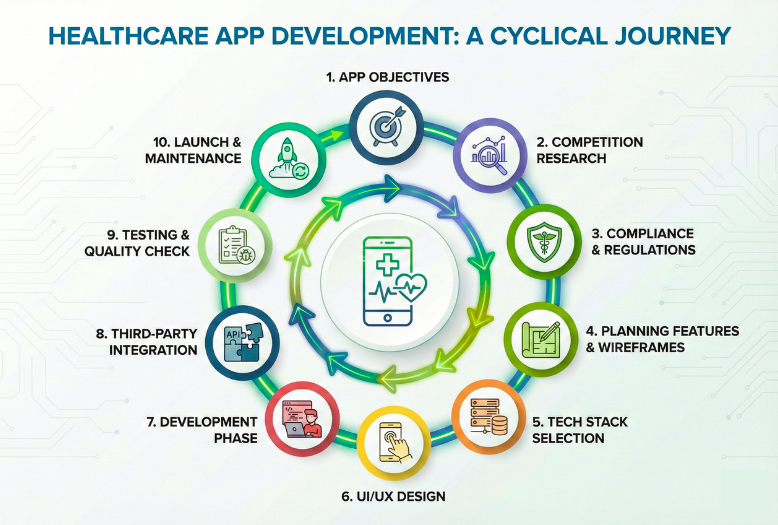
How to Create a Healthcare App – Step-by-Step Guide
Healthcare apps require careful and detailed planning because they must comply with strict security and data protection regulations.
| Step | Stage | What You Do | Why It Matters |
| 1 | Define Goals | Identify target users and purpose | Gives clear direction |
| 2 | Market Research | Study competitors and demand | Helps improve features |
| 3 | Compliance Planning | Follow HIPAA and GDPR | Protects patient data |
| 4 | Feature Planning | List booking, video, and EHR features | Defines functionality |
| 5 | Wireframing | Design screen layout | Visualizes user journey |
| 6 | Choose Technology | Select frontend and backend tools | Ensures scalability |
| 7 | UI/UX Design | Create a simple design | Improves experience |
| 8 | Development | Build frontend and backend | Core stage |
| 9 | Integration | Add payment and wearable APIs | Expands functions |
| 10 | Testing | Check security and performance | Ensures reliability |
| 11 | Launch | Publish on app stores | Reaches users |
| 12 | Maintenance | Update and improve | Keeps the app competitive |
Step 1: App Objectives
To begin with, start by answering the following important questions:
- Who is your target audience?
- What specific problem are you trying to solve?
- Is the app intended for telemedicine services or hospital management?
Therefore, identify the key focus areas that will help you support your healthcare mobile app development company in USA more effectively and achieve successful project outcomes.
Step 2: Competition Research
Next, analyze your competitors’ apps carefully. Check the following
- What key features do they offer?
- What feedback are users sharing?
- How are their pricing plans structured?
- What is the current demand in the market?
As a result, this will help you plan the custom healthcare app development process more effectively and ensure smoother execution.
Step 3: Compliance and Regulations
There are many rules and regulations that you need to abide by when creating a healthcare app. They include.
- HIPAA (USA)
- GDPR (Europe)
- HITECH Act
In healthcare, app development is highly specialized, as patient data security is critically important. Therefore, strong encryption, compliance standards, and strict access controls are essential to protect sensitive medical information.
Step 4: Planning Features and Creating Wireframes
Now, let’s explore some of the common features that users generally expect in a healthcare app:
- Secure login
- Bookings
- Video calls
- Access to EHR
- Online Payments
- Push Notifications
Wireframes show how the app will look before development begins.
Step 5: Tech Stack Selection
This is the most important part, as performance and scale are important considerations.
For healthcare applications, the most common technologies are:
- Frontend: Flutter, React Native
- Backend: Node.js, Python
- Database: MongoDB, PostgreSQL (is the most common)
- Cloud: AWS, Azure
So, the right tech stack selection will make a huge difference.
Step 6: UI/UX Design
First of all, the design should be as simple as possible. In addition, it should be easy for patients of all age groups to navigate. As a result, a clear and user-friendly design can significantly improve trust and overall satisfaction.
Step 7: Development Phase
Developers construct:
- Frontend interfaces
- Backend systems
- Security layers
Moreover, healthcare app developers with experience in secure coding practices ensure strong data protection and improved system reliability.
Step 8: Third-Party Integration
Typically, healthcare apps integrate with the following systems and services:
- Payment gateways
- Wearable technology
- EHR
- Video consulting
Moreover, integrating with these services can significantly enhance the app’s overall functionality and improve the user experience.
Step 9: Testing and Quality Check
Some of the key tests include:
- Security testing
- Performance testing
- Compliance testing
- Usability testing
Therefore, thorough testing ensures safe and smooth operation while maintaining reliability and performance.
Step 10: Launch and Maintenance
Once approved, the app can be published to:
- Google Play Store
- Apple App Store
Additionally, updating the app regularly is essential to improve performance, strengthen security, and ensure a smooth user experience.
Different Types of Health Apps in 2026
Additionally, there are several different categories of healthcare applications, each designed to address specific medical requirements and patient needs:
1. Telemedicine Apps
First, telemedicine apps enable remote healthcare services and improve patient accessibility. They typically include:
- In addition, Video consultations allow real-time virtual interaction between doctors and patients.
- Additionally, digital prescriptions enable secure and efficient electronic prescription sharing.
- Moreover, online payments ensure safe and convenient billing for healthcare services.
- Finally, appointment scheduling helps patients easily book, reschedule, and manage their consultations.
2. Remote Monitoring Apps
Additionally, remote monitoring apps play a vital role in continuous patient care. They typically include:
- In addition, heart rate tracking helps monitor cardiovascular health in real time.
- Additionally, blood pressure tracking allows patients to regularly record and review their readings.
- Moreover, diabetes monitoring supports effective glucose level management and timely alerts.
- Finally, wearable integration enables seamless data collection from smart health devices.
3. Hospital Management Apps
Furthermore, hospital management apps help streamline internal operations and improve efficiency. They commonly include:
- In addition, staff coordination ensures smooth communication and efficient task management among healthcare teams.
- Additionally, patient records enable secure storage and quick access to important medical information.
- Moreover, billing management simplifies invoicing and streamlines payment processing.
- Finally, inventory tracking helps hospitals efficiently manage medical supplies and reduce shortages.
4. Fitness and Wellness Apps
In addition, fitness and wellness apps support preventive healthcare and healthy lifestyles. They typically include:
- In addition, diet plans offer personalized nutrition guidance based on individual health goals.
- Additionally, exercise tracking helps users monitor their workouts and measure progress effectively.
- Moreover, mental health support provides tools to manage stress, mood, and overall emotional well-being.
- Meditation guidance, promoting relaxation and overall well-being.
5. EHR/EMR Apps
Finally, EHR/EMR apps focus on managing and securing patient medical data efficiently. They typically include:
- In addition, electronic health records allow digital documentation and easy access to patient information.
- Additionally, secure storage ensures encrypted and compliant data management.
- Moreover, doctor dashboards provide quick access to patient history and essential clinical data for better decision-making.
As a result, many healthcare app development companies are able to offer specialized services tailored to different healthcare needs and industry requirements.
Technology Stack Used in Healthcare App Development 2026
| Layer | Technology |
| Frontend | Flutter, React Native, Swift |
| Backend | Node.js, Python, Java |
| Database | MongoDB, PostgreSQL |
| Cloud | AWS, Azure, Google Cloud |
| Security | SSL, OAuth 2.0 |
| AI Tools | TensorFlow APIs |
Therefore, choosing the right technology stack ensures long-term scalability, stability, and future growth.
Cost of Healthcare App Development in 2026
However, costs may vary depending on the level of complexity, features, and overall project requirements.
| App Type | Estimated Cost |
| Basic Telemedicine App | $25,000 – $50,000 |
| Mid-Level Healthcare App | $50,000 – $100,000 |
| Advanced AI Platform | $100,000 – $250,000+ |
Factors affecting the cost of Healthcare App Development:
- Feature complexity
- Compliance requirements
- API integrations
- Maintenance
Therefore, partnering with the best healthcare app development company enables you to manage costs effectively while ensuring high-quality results and long-term business value.
Safety and Compliance of Healthcare App Development
In healthcare app development, safety is non-negotiable. Therefore, developers must implement the following:
- Regular security audits
- Role-based access
- Secure cloud hosting
- Multi-factor authentication
- End-to-end encryption
Moreover, professional healthcare app developers carefully manage regulatory compliance to ensure the application meets all required industry standards and legal requirements.
Benefits of Custom Healthcare App Development
Many organizations opt for custom healthcare app development because of:
- Increased security
- More adaptability
- Tailored features
- Custom branding
- Competitive/cost advantages
Moreover, custom applications are built to integrate smoothly with hospital systems and wearable devices. As a result, they ensure reliable performance and seamless data exchange across platforms.
Choosing a Healthcare App Development Company
Therefore, making the right choice is crucial for ensuring long-term success and sustainable growth.
- Healthcare Expertise: Choose a company with strong knowledge of the healthcare industry and its workflows.
- Regulatory Understanding: Ensure they are familiar with regulations such as HIPAA and GDPR.
- Technical Capability: Review their development stack and technical expertise.
- Portfolio & Experience: Evaluate their previous projects and proven track record.
- Ongoing Support: Confirm that they provide reliable initial and post-launch support.
Moreover, reliable healthcare app development companies offer end-to-end services, guiding your project from initial concept to final deployment and ongoing support.
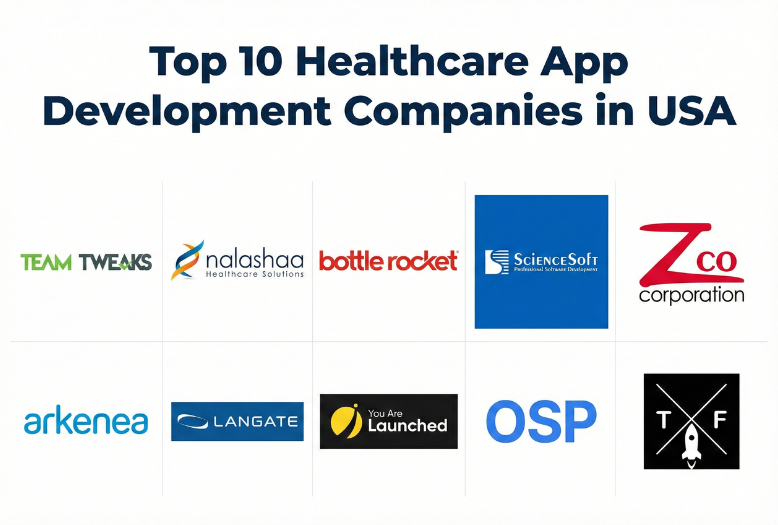
Top 10 Healthcare App Development Companies in USA
Moreover, here are the 10 best healthcare app development companies in the USA, recognized for their expertise, innovation, and strong industry experience:
1. Team Tweaks Technologies
2. Nalashaa Healthcare Solutions
3. Bottle Rocket
4. ScienceSoft
5. Zco Corporation
6. Arkenea
7. Langate
8. URLAUNCHED
9. OSP Labs
10. Topflight Apps
Overview of Healthcare App Development Companies in USA
1. Team Tweaks Technologies
Location: Torrance, California, USA
Moreover, Team Tweaks Technologies is a full-service healthcare app developer that offers custom healthcare app development, telemedicine platforms, hospital management systems, and AI-based health solutions. In addition, they provide HIPAA-compliant, secure, and scalable healthcare app development services for both startups and enterprises. Team Tweaks – the best mobile app development company in Chennai, with its headquarters in India, is also the leading SEO company with more than 12+ years of experience in digital marketing and web development, offering its services across the UAE and USA. The company focuses on delivering result oriented SEO strategies that help businesses improve rankings, traffic, and conversions.
Key Strengths:
- First, telemedicine app development enables secure virtual consultations and remote patient care.
- Additionally, HIPAA-compliant solutions ensure strong data protection and regulatory compliance.
- Moreover, AI and IoT healthcare integration enhance real-time monitoring and smart diagnostics.
- Finally, end-to-end development support ensures smooth execution from planning to deployment.
2. Nalashaa Healthcare Solutions
Location: New Jersey, USA
Similarly, Nalashaa is a healthcare IT consulting and application development company. In addition, they focus on digital transformation, EHR solutions, and healthcare app development with strong regulatory compliance.
Key Strengths:
- In addition, healthcare IT consulting helps organizations optimize their technology infrastructure and workflows.
- Additionally, EHR/EMR integration ensures seamless patient data exchange across systems.
- Moreover, data analytics supports informed decision-making and improved patient outcomes.
- Finally, regulatory compliance expertise ensures adherence to healthcare laws and industry standards.
3. Bottle Rocket
Location: Dallas, Texas, USA
Likewise, Bottle Rocket is a digital product agency that develops enterprise-level healthcare applications. Moreover, they focus on strong user engagement and scalable digital health solutions.
Key Strengths:
- In addition, enterprise app development supports large-scale healthcare operations with secure and scalable systems.
- Additionally, UX-focused design enhances usability and improves patient and provider satisfaction.
- Moreover, a strong digital transformation strategy drives innovation and long-term growth in healthcare organizations.
4. ScienceSoft
Location: McKinney, Texas, USA
Additionally, ScienceSoft is well known for developing healthcare applications, including medical software, patient portals, and hospital automation systems.
Key Strengths:
- In addition, custom healthcare app development delivers tailored solutions to meet specific medical and business needs.
- Additionally, healthcare CRM systems help manage patient relationships and improve communication.
- Moreover, cloud-based solutions provide secure, scalable, and efficient data management
5. Zco Corporation
Location: Nashua, New Hampshire, USA
Additionally, Zco Corporation provides mobile and enterprise healthcare app development services. Moreover, they also develop telehealth solutions and remote patient monitoring systems to support modern digital healthcare needs.
Key Strengths:
- First, telehealth apps enable remote consultations and improve access to medical care.
- Additionally, wearable device integration allows real-time health monitoring and data tracking.
- Moreover, enterprise mobility solutions support secure access to healthcare systems across devices.
6. Arkenea
Location: New York, USA
Furthermore, Arkenea works closely with startups and digital health innovators. They also develop HIPAA-compliant applications tailored for healthcare businesses.
Key Strengths:
- First, startup-focused solutions help new healthcare businesses launch with clarity and direction.
- Additionally, rapid MVP development enables faster market entry and early validation.
- Moreover, compliance-ready applications ensure adherence to healthcare regulations from the start.
7. Langate
Location: New York, USA
In addition, Langate provides healthcare software solutions and offers custom application development for healthcare providers and medical device manufacturers.
Key Strengths:
- First, healthcare analytics helps organizations make data-driven decisions and improve patient outcomes.
- Additionally, medical device integration ensures seamless connectivity between apps and clinical equipment.
- Moreover, enterprise app solutions support large-scale healthcare operations with secure and scalable systems.
8. URLAUNCHED
Location: Los Angeles, California, USA
Furthermore, URLAUNCHED focuses on developing mobile healthcare applications specifically designed for startups and growing businesses.
Key Strengths:
- First, MVP development helps validate healthcare app ideas quickly and cost-effectively.
- Additionally, telemedicine solutions enable virtual consultations and remote patient care.
- Moreover, UI/UX-focused healthcare apps improve patient engagement and overall user experience.
9. OSP Labs
Location: Los Angeles, California, USA
Moreover, OSP Labs provides healthcare software development and IT consulting services. In particular, they focus on building systems that meet strict regulatory compliance requirements.
Key Strengths:
- First, health IT consulting helps healthcare organizations improve systems and workflows.
- Additionally, cloud migration enables secure, scalable, and cost-effective data management.
- Moreover, interoperability solutions ensure seamless data exchange between healthcare systems.
10. Topflight Apps
Location: Irvine, California, USA
Finally, Topflight Apps develops digital health and wellness applications. In addition, they specialize in patient engagement solutions and telemedicine app development.
Key Strengths:
- First, digital health platforms are transforming patient care and service delivery.
- Additionally, HIPAA-compliant systems ensure data security and regulatory adherence.
- Moreover, AI-powered healthcare apps enhance diagnosis, monitoring, and patient engagement.
Overall, these healthcare app development companies in USA have strong expertise in telemedicine, artificial intelligence, cloud-based healthcare solutions, and regulatory-compliant systems.
Challenges in Healthcare App Development
Although demand is high, challenges exist:
- First, strict compliance rules must be carefully followed.
- Additionally, data privacy risks remain a major concern.
- Moreover, high development costs can impact project budgets.
- At the same time, complex system integrations require technical expertise.
- Finally, long approval processes can delay product launches.
As a result, experienced healthcare app development companies are well prepared to handle these challenges effectively and deliver smooth, successful project outcomes.
Market Statistics for 2026
Key Healthcare App Development Statistics:
- According to recent data, over 70% of hospitals now use digital systems.
- Additionally, telemedicine usage has increased by 30% globally.
- Moreover, mobile health app downloads have crossed 4 billion per year.
- At the same time, remote patient monitoring adoption continues to grow steadily.
Overall, these statistics highlight the rising global demand for healthcare app development solutions and confirm the rapid growth of the digital health market.
Future of Healthcare App Development Beyond 2026
The future looks strong.
- In the coming years, AI-based diagnosis tools will continue to expand.
- Furthermore, AR and VR technologies will support advanced medical training.
- At the same time, automation will reduce hospital workload and improve efficiency.
- Additionally, personalized health apps will increase to provide more customized care.
Therefore, investing in healthcare app development services today ensures long-term growth and sustainable business success.
Reasons to Invest Now
Indeed, the digital transformation of healthcare is here to stay, as it supports every stakeholder across the healthcare delivery continuum. In particular, patients increasingly seek convenience and faster access to care through digital solutions.
Therefore, building partnerships with companies that specialize in healthcare application development can transform how patients access and interact with healthcare services. As a result, it also creates new opportunities for business growth and innovation.
Conclusion
Healthcare services as of the year 2026 will undoubtedly include mobile healthcare applications in all their various facets, from telehealth and artificial intelligence to mobile applications. Furthermore, these applications will enhance the delivery of healthcare services and the administration of healthcare facilities.
If you want to cultivate a new idea and develop it into a secure and scalable solution, then you must seek out the most knowledgeable healthcare application developers who possess a sound understanding of the relevant regulations and the latest technological
FAQ:
1. Who provides custom healthcare web app development?
Many healthcare app development companies in the USA offer custom web solutions. For example, the following companies are well known in this space:
- Team Tweaks Technologies – California
- ScienceSoft – Texas
- Nalashaa Healthcare Solutions – New Jersey
- Topflight Apps – California
In addition, these companies provide HIPAA-compliant web portals, telemedicine systems, and EHR platforms designed to meet strict healthcare regulations and industry standards.
2. How to develop a healthcare app?
Here are the simple steps to follow:
- First, define your app idea and identify your target users.
- Next, research competitors and study market trends.
- Then, plan for HIPAA compliance and data protection.
- After that, design wireframes and finalize the UI/UX.
- Subsequently, develop both frontend and backend systems.
- Additionally, test the app for security and performance.
- Finally, launch the app and provide ongoing maintenance.
3. How much does it cost to develop a healthcare app?
Estimated cost in the USA:
- Basic app: $25,000 – $50,000
- Mid-level app: $50,000 – $100,000
- Advanced AI app: $100,000 – $250,000+
However, the total cost depends on features, security requirements, integrations, and regulatory compliance needs.
4. How to design and develop a healthcare app?
- First, use a simple and user-friendly design.
- Additionally, ensure strong encryption to protect patient data.
- Moreover, implement secure login and multi-factor authentication.
- Furthermore, strictly follow HIPAA regulations.
- Finally, use a scalable cloud infrastructure for long-term growth.
5. How to choose healthcare mobile app development companies?
- First, check their healthcare industry experience.
- Additionally, verify their knowledge of HIPAA and other regulations.
- Moreover, review their portfolio and previous work.
- Furthermore, confirm they provide post-launch support.
- Finally, compare pricing models and ensure transparency.