Starting a business in the United States is no easy feat, but picking the right business idea is perhaps the biggest challenge. A good startup ideas addresses a real problem, is a good fit for the skills of the person launching it, and can be sustained over the long term by virtue of its demand in the market.
The U.S. market is ripe for business opportunities across artificial intelligence, software, healthcare, e-commerce, professional services, food, and sustainable technology. Some businesses can be started from home on a shoestring budget, while others require employees, equipment, licenses, or outside funding. In this guide, covering 50 startup ideas in the U.S. for 2026. These investment ranges are only estimates. Real costs of starting a business will differ depending on the state, the business idea, the licensing, and the scale of operations.
Key Takeaways
- AI, cybersecurity, healthcare technology and business automation offer strong opportunities for skilled founders.
- Service-based businesses generally cost less to start than product, food or infrastructure businesses.
- A subscription model or recurring service business can generate more predictable revenue.
- Check your local laws, licences, insurance and tax requirements before starting a business.
- Test market demand with a small pilot before making a large investment.
Quick Comparison of Startup Opportunities
| Business Type | Typical Starting Investment | Revenue Model | Best Suited For |
|---|---|---|---|
| Digital Services | $500–$15,000 | Projects or monthly retainers | Skilled individuals and small teams |
| Software and AI | $5,000–$150,000+ | Subscription, licensing or usage fees | Technical founders |
| Local Services | $1,000–$50,000 | One-time and repeat services | Local operators |
| Ecommerce | $500–$50,000 | Product sales or subscriptions | Product and marketing specialists |
| Food Businesses | $10,000–$150,000+ | Direct sales, delivery or catering | Food entrepreneurs |
| Green Businesses | $10,000–$200,000+ | Products, projects or service contracts | Technical and operations-focused teams |
Why Start a Business in the USA?
The United States has a massive and varied consumer base. There are more than 8 million employer establishments in the United States, as reported by the U.S. Census Bureau. This gives startups a huge market to potentially compete in. The U.S. Census Bureau also releases Business Formation Statistics on a monthly basis, giving insight into the latest numbers on new businesses.
Businesses have access to well established digital infrastructure, payment systems, and specialized talent, and depending on the nature of the business, capital can be raised through a variety of routes: personal savings, bank loans, SBA loans, angel investors, or venture capital. That said, the U.S. market is large, so competition is intense and there are many businesses selling to the same potential customers. A startup will need a defined customer, a useful product or service, and a realistic path to market. Entrepreneurs should not assume that the rules are the same in every state and local laws should be checked.

Low Investment and Skill Based Business Ideas – Top Startup Ideas for Beginners
1. Business Consulting
A business consultant offers advice on a variety of topics such as business operations, accounting, sales, human resources, and business growth to businesses.
It is easier to market and position a consulting business with a clearly defined niche in which the founder has expertise. Consultants can charge per project, per workshop, or per month for ongoing consulting services. Start with one consulting niche and a clearly-defined result (cutting operating costs, increasing sales, or preparing for a business exit, to name a few). Offer case studies and a paid discovery call to build credibility and attract customers who are willing to pay higher fees for your services.
Estimated startup cost: $1,000-$10,000
2. Digital Marketing Agency
A digital marketing agency specializes in search engine optimization (SEO), paid media, content marketing, email marketing, and social media management. Many small businesses don’t have the budget or expertise to build a full in-house digital marketing team, so they choose to work with an outside agency.
A digital marketing agency can generate recurring revenue with monthly retainers. It is easier to launch a digital marketing agency specializing in one industry or with one core service, but clearly connect your reporting to leads, sales, and revenue as a proof point of the value you are providing to the client to increase chances of retaining the customer.
Estimated startup cost: $500-$8,000
3. SEO Consulting
An SEO consultant helps businesses improve their organic ranking on search engines with a technical website audit, keyword and competitor research, on-page optimization, and content strategy. You can start as a solopreneur and add writers, web developers, and link builders as you grow your team.
Consider focusing on one target industry to best serve your customers and maximize your rates. You can sell a one time SEO audit, monthly SEO optimizations, or monthly content strategies as SEO services to customers. However, keep expectations realistic and be transparent about the factors that influence your ranking (SEO can take months to produce results, your competitor sites have been optimized for years, etc.).
Estimated startup cost: $500-$5,000
4. Content Writing Studio
A content writing studio creates blogs, website content, case studies, email marketing campaigns, and product content for businesses. You can command a higher rate for content writing services if you specialize in writing for one industry such as healthcare, finance, or SaaS.
A content writing studio can monetize services through per project fees or monthly content packages. Create clear systems for research, fact checking, and brand voice to maintain consistency and high quality output as your team grows.
Estimated startup cost: $500-$5,000
5. Personal Branding Consultancy
Personal branding consulting is becoming an in-demand service as executives, entrepreneurs, and high level professionals look to position themselves as authorities in their fields with a consistent presence online. A personal branding consultancy service can help with positioning, social media profile optimization, editorial calendar, and thought leadership strategy.
Services can include one on one interviews to develop a strategy, creation of LinkedIn posts, speaking engagements, or press pitches, and reputation management. The goal is to maintain the client’s authentic voice and brand personality rather than generating generic content that could be used by any other client.
Estimated startup cost $1,000-$7,500
6. Online Coaching Business
A coach can create an online program around a specific skill or subject, such as leadership development, executive presence, and entrepreneurship. The first rounds of sales can be one on one coaching, while future income can be generated with group programs and digital product sales.
A strong online coaching business will clearly define the target audience, the length of the program, the medium for delivery (Zoom, WhatsApp, email, or in person), and what the result will be for students. Include testimonials, milestones, and a syllabus to build credibility and deliver on promises. Maintain boundaries and be honest about what you can deliver to customers to build a reputable business.
Estimated startup cost: $500-$5,000
7. Virtual Assistant Agency
A virtual assistant agency can provide businesses with support in the form of calendar management, inbox organization, research, and customer communication. Once the processes are well defined, a virtual assistant agency can add writers, customer service reps, and social media managers as support for multiple customers.
Services can be offered per-project, hourly, or as a dedicated virtual assistant per month. Put clear security protocols in place around password-sharing, as virtual assistants often have access to confidential information and payment platforms at customer businesses.
Estimated startup cost: $500-$5,000
8. Bookkeeping Services
Many small businesses need accurate books, but aren’t large enough to justify hiring a full-time bookkeeper. A virtual bookkeeping company can offer transaction categorization and processing, bank statement reconciliations, invoicing support, and financial reporting. The proper training, insurance, and data security will need to be in place for this business to succeed.
Monthly packages can be priced based on the number of transactions processed and level of reporting. Integrations with accounting, payroll, and payment platforms will save time, but it is important to make it clear that bookkeeping services are not tax or accounting advice.
Estimated startup cost: $1,000-$10,000
9. Recruitment Agency
A recruitment agency can specialize in sourcing candidates in a certain sector, family of roles, or geography. A recruitment agency business can generate revenue through contingency fees for placements, retained fees for contract hires, or hourly rates for contract work.
The key to success is a large employer and candidate network. Differentiate your agency through faster interview and hiring processes, more in-depth candidate screening, or access to hard to source specialty talent. Candidate consent, employment laws, data privacy, and fee structure should be considered when establishing policies.
Estimated startup cost: $2,000-$10,000
10. Online Course Business
Subject matter experts can create online courses with video lessons, templates and guides, quizzes and assessments, and live office hours. The best online courses solve a narrow problem for a clearly defined audience.
Test your concept with a live in-person workshop before investing in the production of an entire course. Online courses can be monetized by individual sale, in cohorts, via monthly subscription, or as a corporate bundle with discounts for volume purchases. Include student support and ongoing content updates to increase course completion and positive word of mouth.
Estimated startup cost: $500-$10,000
| Business Idea | Startup Cost | Revenue Model | Best For |
|---|---|---|---|
| Business Consulting | $1,000–$10,000 | Projects, workshops or monthly consulting | Experienced business and industry professionals |
| Digital Marketing Agency | $500–$8,000 | Monthly retainers or project fees | SEO, advertising and marketing specialists |
| SEO Consulting | $500–$5,000 | SEO audits, monthly optimization or content strategy | SEO professionals and digital marketers |
| Content Writing Studio | $500–$5,000 | Project fees or monthly content packages | Writers, editors and content strategists |
| Personal Branding Consultancy | $1,000–$7,500 | Strategy packages or monthly retainers | Branding, PR and social-media professionals |
| Online Coaching Business | $500–$5,000 | Individual coaching, group programs or digital products | Coaches, trainers and subject experts |
| Virtual Assistant Agency | $500–$5,000 | Hourly, project-based or monthly packages | Administrative and customer-support professionals |
| Bookkeeping Services | $1,000–$10,000 | Monthly packages based on transactions and reporting | Trained bookkeepers and finance professionals |
| Recruitment Agency | $2,000–$10,000 | Placement fees, retained fees or hourly rates | Recruiters and human-resource professionals |
| Online Course Business | $500–$10,000 | Individual sales, cohorts, subscriptions or corporate bundles | Subject experts, educators and professional trainers |
AI and Technology Startup Ideas: Best Startup Opportunities for Entrepreneurs
11. AI Automation Agency
An AI automation agency helps companies reduce repetitive work in areas such as customer service, document processing, reporting and lead qualification. Successful agencies begin with a measurable workflow problem and connect AI tools with the client’s existing systems.
A pilot should measure time saved, error reduction or response speed before wider deployment. Human review, access controls, privacy and monitoring are necessary because an automation that produces unreliable output can create more work instead of less.
Estimated startup cost: $2,000-$15,000
12. AI Chatbot Development Company – Startup Ideas 2026
Businesses are using chatbots to answer repetitive questions, qualify sales leads, support employees, and assist customers outside of regular business hours. An AI chatbot development company can customize integrations, provide knowledge base setup, analytics, and continuous improvement to clients.
Popular potential customers for this service are e-commerce brands, customer service departments, educational institutions, and internal HR and support teams. Generate recurring revenue with hosting, maintenance, and optimization services. There should be a clearly defined path for customers to speak with a human when the AI chatbot is unable to answer their query.
Estimated startup cost: $5,000-$40,000
13. Vertical SaaS Platform
Vertical SaaS serves one industry with industry-specific software and functionality, as opposed to a horizontal SaaS solution with a generic feature set that can be implemented in many different industries. Examples are SaaS for clinics, inspection management for property inspection companies, and job tracking and scheduling for home improvement contractors.
Industry knowledge and expertise can be a competitive advantage over a generic feature-packed offering. Observe the workflow process in person before developing a solution and identify the most expensive pain point. Launch with a small feature set to test the market, and build integrations, compliance features, and customer support to increase retention over time.
Estimated startup cost: $20,000-$50,000+
14. Cybersecurity Consultancy – Unique Startup Ideas
A cybersecurity consultancy can generate revenue through security risk assessments, security audits, security awareness training, and incident response planning. Trust, qualified team members, and appropriate handling of sensitive customer data are necessary to run a cybersecurity consultancy business successfully.
Some security services require specialized insurance and certifications. Small to mid-sized businesses often need security consulting without the expense of hiring a dedicated in-house cybersecurity team. Generate recurring revenue with ongoing monitoring, security audits, and training offerings. Clearly define the scope of each service in your contracts, since a consulting engagement is inherently different from an employee relationship.
Estimated startup cost: $5,000-$20,000
15. Data Analytics Service
Many companies collect data, but struggle with transforming it into decision making. An analytics business can build dashboards, clean datasets, automate reporting, and build forecasting models. The service becomes much more valuable if outcomes can be measured, rather than just delivering charts.
Target customers can be retailers, manufacturers, marketing teams, or professional-service firms. It is easier to make an impact starting with one business decision, such as demand forecasting or campaign profitability, and data quality checks must be implemented to avoid drawing wrong conclusions based on the analysis.
Estimated startup cost: $3,000 – $25,000
16. Cloud Migration and Management
This business helps companies evaluate, migrate, and manage their applications or data in the cloud. It can include consulting on cloud architecture, migration, cost optimization, backup, and monitoring. Partnerships and certifications from major cloud providers would add to the credibility of the business.
Projects can result in recurring managed-service deals covering security, availability, and spending. A credible provider would have documented disaster recovery plans, perform migration in phases, and avoid vendor choices that create unnecessary cost or lock-in for the client.
Estimated startup cost: $10,000 – $45,000
17. Mobile App Development Company
A mobile app development company can design, develop, and maintain iOS, Android, and cross platform apps. Founders can focus on a particular industry such as healthcare, mobility, ecommerce, or field services, and make money through maintenance and feature-development deals after the launch of the app. Services offered can be discovery, UI/UX design, development, quality assurance, and store submission.
Building a large library of reusable components, and having a defined way of delivering will increase margins, and post-launch analytics will help the client make decisions about which features need improvement.
Estimated startup cost: $5,000 – $35,000

18. No Code Development Studio
No-code and low code platforms allow businesses to test ideas and build internal systems and products very quickly. A no-code development studio can build prototypes, portals, workflow apps, and simple e-commerce sites for customers who want to move fast without hiring a large engineering team. Ideal customers include startups testing an idea, and departments replacing spreadsheets or manual processes.
The studio should communicate platform limitations, data ownership, and future migration possibilities so that customers understand when a custom solution may be necessary in the future.
Estimated startup cost: $1,000 – $15,000
19. Internet of Things Solutions Company
An IoT business can help customers build dashboards and alerts from data being collected by sensors in their devices, whether they are deployed in smart water management, manufacturing, agriculture, buildings, or logistics.
Hardware reliability, connectivity, cybersecurity, and after sales support must all be considered from the start. Begin with a focused use case such as leak detection, energy management, or predictive maintenance. Selling hardware can be a source of initial revenue, but the recurring revenue model of selling alerts, software subscriptions, and maintenance services is a more resilient long term revenue stream.
Estimated startup cost: $20,000 – $70,000+
20. AR/VR Training Studio
An immersive-technology studio can build safety training, product demos, simulations, and educational experiences. B2B use cases with a measurable training or operational benefit are often more easily monetized than entertainment use cases.
Manufacturers, healthcare providers, and training organizations are good potential customers. The business can begin with fixed price projects, and later sell modules to be licensed, proving value in terms of training time, accuracy, or travel saved.
Estimated startup cost: $15,000 – $40,000
| Business Idea | Startup Cost | Market Demand | Profit Potential | Best For |
|---|---|---|---|---|
| AI Automation Agency | $2K–$15K | Very High | High | AI and automation specialists |
| AI Chatbot Development Company | $5K–$40K | High | High | AI developers and software professionals |
| Vertical SaaS Platform | $20K–$50K+ | Very High | Very High | SaaS founders and industry experts |
| Cybersecurity Consultancy | $5K–$20K | Very High | High | Cybersecurity professionals |
| Data Analytics Service | $3K–$25K | High | High | Data analysts and BI specialists |
| Cloud Migration and Management | $10K–$45K | High | High | Cloud engineers and IT consultants |
| Mobile App Development Company | $5K–$35K | Very High | High | App developers and technology entrepreneurs |
| No-Code Development Studio | $1K–$15K | Growing | High | No-code and low-code specialists |
| Internet of Things Solutions Company | $20K–$70K+ | Growing | Very High | IoT, hardware and engineering professionals |
| AR/VR Training Studio | $15K–$40K | Growing | High | AR/VR developers and training specialists |
Online and Creator-Economy Business Startup Ideas: Best Online Startup Ideas to Launch
21. Affiliate Content Website
An affiliate website makes money through commissions for products bought by website visitors through referral links from the site. The business can grow sustainably with original expertise, honest recommendations, and multiple traffic sources.
It is easier to build authority and identify customer intent with a focused niche. Email subscribers and a direct audience reduce reliance on algorithmic traffic from social media or search engines, and affiliate partnerships should be disclosed to visitors of the site.
Estimated startup cost: $500 – $5,000
22. Digital Product Store
Designers, developers, and subject matter experts can sell templates, plugins, guides, spreadsheets, and creative assets. Since there is no cost to deliver the product, this is a great startup ideas, but it is not as easy to build a successful digital product business as it seems.
Validate the market by pre-ordering or starting with a small collection of products. Higher order value can be achieved through bundles, commercial licenses, and updates, and repetitive customer support questions can be minimized with thorough documentation.
Estimated startup cost: $250 – $5,000
23. Paid Newsletter
A specialized newsletter can be a source of revenue through subscription, sponsored content, and premium research. The most successful businesses are serving a specific audience with information that is useful, timely, or difficult to source elsewhere. The value of a newsletter is not determined by its audience size, but by consistency and trust.
A free newsletter can be used to build awareness before offering a paid version with added benefits such as research, job postings, events, and a paid community for the most loyal customers.
Estimated startup cost: $100 – $3,000
24. Podcast Production Agency
Companies and experts may want to have a podcast but do not have time to invest in recording, editing, and publishing. A podcast production agency can offer idea development, guest bookings, audio editing, video clips, and publishing. The business can be structured to sell per episode or monthly retainers for podcast production.
Having a repeatable process for scheduling and approving each episode keeps the workflow efficient, and repurposing each episode into short videos or articles increases the value delivered to clients.
Estimated startup cost: $2,000 – $15,000
25. Short-Form Video Agency
Brands need a high volume of videos for TikTok, Instagram Reels, YouTube Shorts, and ads. A specialized agency can provide scripting, filming, editing, creator bookings, and reporting.
The agency should develop platform specific creative rather than posting the same video everywhere. Testing multiple hooks and formats helps determine what works, and a content library and approval calendar make it easy to maintain a high volume of video.
Estimated startup cost: $2,000 – $20,000
26. YouTube Production Business
Rather than relying on revenue from just one YouTube channel, business owners can sell channel development and production as a service. Services offered can include research, scripts, thumbnails, editing, and publishing for executives or businesses.
The business can be structured to sell monthly packages based on a defined number of videos. The service becomes more valuable when it tracks retention, click through rate, and lead generation, rather than just relying on view count as a success metric.
Estimated startup cost: $1,000 – $15,000
27. Online Community Platform – Online Startup Ideas
A paid community can unite like minded professionals or hobbyists around education, networking, and shared interests. Revenue can be generated through membership fees, events, sponsorships, and paid resources. Community engagement is important for retention, and a successful business owner will prioritize building relationships between members through regular programming.
A community should be built around a specific goal first. Member introductions, expert Q&As, and peer accountability can drive engagement, and community guidelines will keep discussion productive and positive.
Estimated startup cost: $500 – $10,000
28. Remote Workshop Business
Interactive live online workshops can teach skills to individuals or teams at corporate offices. Founders can sell spots in a workshop or to an office as a whole, and later convert successful workshops into on demand products.
Workshop value is increased when attendees are given hands-on exercises, templates to use, and expert feedback. Common questions can be documented and used to improve the curriculum and sell advanced workshops or consulting services.
Estimated startup cost: $500 – $7,500
| Business Idea | Startup Cost | Market Demand | Profit Potential | Best For |
|---|---|---|---|---|
| Affiliate Content Website | $500–$5K | High | Medium to High | Content creators and SEO specialists |
| Digital Product Store | $250–$5K | High | High | Designers, developers and subject experts |
| Paid Newsletter | $100–$3K | Growing | Medium to High | Writers, analysts and industry experts |
| Podcast Production Agency | $2K–$15K | Growing | High | Audio editors and content producers |
| Short-Form Video Agency | $2K–$20K | Very High | High | Video creators and social media specialists |
| YouTube Production Business | $1K–$15K | High | High | Video producers and YouTube strategists |
| Online Community Platform | $500–$10K | Growing | High | Community builders and niche experts |
| Remote Workshop Business | $500–$7.5K | High | Medium to High | Trainers, consultants and educators |
Local and Home-Service Business Ideas: Best Startup Ideas for Small Businesses
29. Mobile Car Detailing – Low-Cost Startup Ideas
A mobile detailing business cleans and protects vehicles at the customer’s home or office. Convenience is the main differentiator between this business model and other car wash and detailing businesses. Equipment, transportation, insurance, and knowledge of local water usage and wastewater regulations are all required. Services offered can range from basic interior cleaning to paint correction and fleet discounts.
Online booking, route planning, and maintenance memberships can increase utilization of the service and result in more recurring customers.
Estimated startup cost: $3,000 – $20,000
30. Residential Cleaning Company – Profitable Startup Ideas
Home cleaning can produce recurring revenue through weekly, bi-weekly, and monthly service contracts.
A business can stand out through dependability of appointments, trained employees, transparency about pricing and products, and offering eco-friendly alternatives. Trust is especially important because employees are working in customers’ homes, and processes for employee screening, insurance, service checklists, and complaints can lead to positive reviews and referrals.
Estimated startup cost: $2,000 – $15,000
31. Commercial Cleaning Service
Offices, retail stores, and other types of businesses need to be cleaned after normal business hours. This business can be structured as a series of contracts with a set price and performance expectations, resulting in consistent monthly revenue. Attention must be paid to hiring and retaining the best employees, employee safety, and insurance.
The business can specialize in small offices, medical facilities, or post construction cleaning. Site visits and detailed scopes of work will prevent errors in pricing, and supervisor inspections will maintain service quality across multiple jobsites.
Estimated startup cost: $5,000 – $30,000
32. Pet Care Service
Pet sitting, walking, transportation, and in-home care can be offered as individual services or through a small team. Trust, background checks, clear emergency protocols, and liability insurance are important factors in the decision making process for most customers.
Photo updates, GPS tracking of walks, and dependability of service schedule increase customers’ trust in the business. Packages of regular weekday care and weekend or holiday stays will result in more consistent revenue than relying on last minute bookings.
Estimated startup cost: $500 – $7,500
33. Property Management Company – Best Startup Ideas
Property managers oversee tenants, collection of rent, inspections, maintenance, and reporting to property owners. Many states have requirements for a real estate license or other restrictions, so research should be done before providing this service.
Revenue can be generated through a percentage of rent collected, successful leasing, and maintenance coordination. Web portals for tenants and owners simplify collection and communication, but most importantly, issues and maintenance requests must be addressed in a timely manner for owner retention.
Estimated startup cost: $5,000 – $30,000
34. Home Support Service for Seniors
Non-medical assistance provides older individuals with companionship, help running errands, meal preparation and completion of daily activities. The business will need to make a clear distinction between non medical support and medical care, as required by state law for caregivers.
Customers look for trustworthy caregivers, effective communication, and consistency. Proper training, screening processes, documentation for services rendered, and emergency procedures should be in place before accepting your first vulnerable patient.
Estimated startup cost: $5,000–$50,000
35. Home Organization Service
Professional organizers assist customers in simplifying their spaces, completing projects, and getting ready for moves or transitions. Organization services can be paired with digital planning and organization, or maintenance visits.
Referrals can be generated through partnerships with movers, real estate agents, and senior transition coordinators. Before and after photo portfolios are a powerful visual tool for demonstrating the results of your work, assuming that clients sign a release allowing for the use of their photos.
Estimated startup cost: $1,000–$8,000
| Business Idea | Startup Cost | Market Demand | Profit Potential | Best For |
|---|---|---|---|---|
| Mobile Car Detailing | $3K–$20K | High | Medium to High | Automotive enthusiasts and mobile-service operators |
| Residential Cleaning Company | $2K–$15K | Very High | High | Service entrepreneurs and small teams |
| Commercial Cleaning Service | $5K–$30K | High | High | Operations-focused entrepreneurs |
| Pet Care Service | $500–$7.5K | High | Medium to High | Pet lovers and independent service providers |
| Property Management Company | $5K–$30K | High | High | Real-estate and property professionals |
| Senior Home-Support Service | $5K–$50K | Very High | High | Experienced caregivers and care coordinators |
| Home Organization Service | $1K–$8K | Growing | Medium to High | Professional organizers and creative planners |
Healthcare & Wellness Business Ideas: Future-Focused Startup Ideas for 2026
36. Telemedicine Platform – Successful Startup Ideas
A telemedicine platform can facilitate remote check-ins with providers and offer other virtual features for healthcare organizations. Healthcare platforms require careful attention to regulatory compliance, privacy and security, and ease of use.
Consider focusing on a particular specialty, type of provider, or population of patients. Assemble a legal, compliance, and security team, and ensure that the product is easy to implement and will save healthcare teams time rather than add to their workload.
Estimated startup cost: $50,000–$100,000+
37. Mental Wellness App
Mental wellness apps often offer users journaling features, access to on-demand therapy, and/or the ability to complete check-ins with their therapist. The founder should be careful not to make unfounded medical claims, and include the necessary safeguards, especially for vulnerable users.
User retention will depend on how well the app fits into the user’s daily life. Features like in-app guided sessions, progress tracking, and push notifications will help, but the app must also be well-equipped to handle crisis situations and protect user data. The business should be built with expert input, and include mental health resources and information for users to reference.
Estimated startup cost: $20,000–$100,000
38. Fitness Coaching Platform: Creative Startup Ideas
A fitness platform can offer users personalized workouts, progress tracking, virtual live sessions, and community features like challenges and competitions. Certified personal trainers can begin with an in-person program and test a focused audience before building an app based version.
Consider a unique angle, like targeting new gym goers, seniors, or athletes. Monthly subscriptions, one on one personal training, and corporate wellness packages can be monetized, and safety is an important factor when designing workouts for users.
Estimated startup cost: $2,000–$50,000
39. Nutrition Consulting Business
Qualified nutrition professionals can offer education, support with meal plans, and workplace wellness programs. Scope of practice and required credentials vary by state, so make sure you know the rules for any states in which you operate.
Consider specializing in a certain niche, like working with athletes, working professionals, or families. Revenue can be generated through individual or group coaching, consulting services for employers, and speaking engagements. Maintain professional liability insurance and be diligent about storing and protecting patient records.
Estimated startup cost: $1,000–$10,000
| Business Idea | Startup Cost | Market Demand | Profit Potential | Best For |
|---|---|---|---|---|
| Telehealth Platform | $50K–$100K+ | Very High | Very High | Health-tech founders and healthcare professionals |
| Mental Wellness App | $20K–$100K | Very High | High | Wellness experts, app developers and mental-health professionals |
| Fitness Coaching Platform | $2K–$50K | High | High | Certified fitness coaches and technology entrepreneurs |
| Nutrition Consulting Business | $1K–$10K | High | Medium to High | Qualified nutritionists and wellness professionals |
Food & Hospitality Business Ideas: Innovative Startup Ideas for Entrepreneurs
40. Ghost Kitchen
A ghost kitchen prepares food primarily for delivery and pickup. Though this option minimizes overhead compared to a traditional brick and mortar, costs for rent, ingredients, packaging, and delivery fees can still be high. A limited menu is the best way to start, since you’ll want to test and refine the menu before building out a large kitchen.
Menus must be designed to travel well and remain profitable after delivery commissions and discounts are factored in. Offering the option to order directly, building a loyal following through discounts and incentives, and carefully choosing delivery areas can help minimize fees.
Estimated startup cost: $20,000–$50,000+
41. Food Truck – Emerging Startup Ideas
A food truck can reach offices, neighborhoods, and events and offer a rotating menu and catering services. Location flexibility is attractive, but the cost of a food truck and related equipment, plus permits and fees, and compliance with health and safety requirements will need to be considered.
A short menu improves speed and inventory control. Social media updates and advance notice of location and hours will bring in crowds, and event partnerships and catering orders can help bring in additional revenue on off days.
Estimated startup cost: $50,000–$100,000+
42. Meal-Prep Delivery Service
Meal prep companies cater to busy professionals, athletes, families, and anyone looking for convenience or who follows a special diet. Monthly subscriptions can increase predictability of revenue, and proper temperature control, food safety, and refrigerated packaging are essential.
Test the service in a small geographic area before launching, and keep menu offerings simple to minimize food waste and improve efficiency. Food cost, packaging, and delivery costs must be closely managed to stay within the price point of busy customers.
Estimated startup cost: $10,000–$75,000
43. Catering Company
Caterers provide food for weddings, office parties, community events, and other celebrations. Consider focusing on a specific type of event, such as large parties or small meetings, for your first few months in business. Build out a strong proposal process that clearly defines the number of guests, number of servers, rental items included, expected length of service, and cancellation and refund policies.
Build relationships with local event venues, offer tasting sessions, and hire a professional to take food and event photos for use in future promotions and proposals.
Estimated startup cost: $10,000–$60,000
| Business Idea | Startup Cost | Market Demand | Profit Potential | Best For |
|---|---|---|---|---|
| Ghost Kitchen | $20K–$50K+ | High | High | Chefs, restaurant operators and food entrepreneurs |
| Food Truck | $50K–$100K+ | High | Medium to High | Mobile food operators and culinary entrepreneurs |
| Meal-Prep Delivery Service | $10K–$75K | Growing | High | Nutrition-focused founders and food-service professionals |
| Catering Company | $10K–$60K | High | High | Chefs, event professionals and hospitality entrepreneurs |
E-commerce Business Startup Ideas: Best Online Startup Ideas to Launch
44. Niche E-commerce Brand
Niche e-commerce businesses sell to a specific type of customer with a particular need, often with a limited selection of products. Before purchasing large quantities of inventory, consider a test run with a small batch or launching via a marketplace to gauge interest.
Strong brands are able to compete on product quality and fit rather than price alone. Be sure to understand the full cost of goods sold, including product sourcing, freight and delivery, and advertising.
Estimated startup cost: $2,000–$30,000
45. Print-on-Demand Store – Top Startup Ideas
Print on demand e-commerce businesses produce branded products only after a customer places an order. This reduces risk, but the business must still create original art and target a specific audience, and monitor product quality and delivery times carefully.
Sample products can help you evaluate product quality before going public with a large number of product offerings. Focused businesses with strong content partnerships will be most successful, rather than launching with a large portfolio of unrelated products.
Estimated startup cost: $500–$5,000
46. Subscription Box Service
Subscription boxes deliver a curated selection of products on a regular basis. This model enables businesses to generate repeat revenue, but it can be expensive to store inventory, and it is challenging to keep customers engaged over the long term.
Be sure to calculate the cost of goods and margins at all price points, and determine whether customers value the experience of discovering new products, convenience, or exclusive items. Gift boxes, flexible billing cycles, and partnerships with other brands will support a growing customer base.
Estimated startup cost: $3,000–$25,000
47. Refurbished Electronics Store
A refurbished electronics store can sell phones, laptops, and other electronics that have been tested and repaired. Proper sourcing, data destruction, repair, and evaluation processes are essential. Revenue can be generated through direct sales, trade-ins, and partnerships with businesses that provide technology to employees.
Condition reports and testing results should be documented to avoid conflict and liability, and the proper steps must be taken to dispose of electronics that are not resalable.
Estimated startup cost: $10,000–$75,000
| Business Idea | Startup Cost | Market Demand | Profit Potential | Best For |
|---|---|---|---|---|
| Niche Ecommerce Brand | $2K–$30K | High | High | Product creators and brand-focused entrepreneurs |
| Print-on-Demand Store | $500–$5K | High | Medium to High | Designers, artists and content creators |
| Subscription Box Business | $3K–$25K | Growing | High | Curators and ecommerce entrepreneurs |
| Refurbished Electronics Store | $10K–$75K | High | High | Electronics technicians and retail entrepreneurs |
Sustainable Business Ideas: Innovative Startup Ideas for Entrepreneurs
48. Solar Installation and Maintenance: Smart Startup Ideas
Solar businesses install, monitor, and repair solar panels for residential and commercial buildings. Proper electrical and installation expertise, a network of qualified vendors, and awareness of changing laws and incentives are all necessary to succeed.
Transparent, honest communication about energy usage and potential cost savings are essential in the sales process. Monitoring and maintenance can be sold as long term services after a system is installed.
Estimated startup cost: $25,000–$1,00,000+
49. EV Charging Solutions – Top Startup Ideas
EV charging businesses install, operate, and maintain charging stations at residential, retail, and commercial properties and for fleet owners. A successful business model must consider installation costs, utilization, and ongoing technical support.
Revenue can be generated through installation fees, network management subscriptions, charging fees, and fleet partnerships. Research daily traffic and parking time, utility pricing, and responsibility for maintenance and repairs before investing in hardware.
Estimated startup cost: $25,000–$1,00,000+
50. Sustainable Packaging Company – Profitable Startup Ideas
This business sells sustainable, reusable, compostable, or resource efficient packaging to brands and retailers. Begin as a reseller or design partner before building out your own manufacturing capability. Make accurate claims and verify certifications.
Food businesses, manufacturers, and ecommerce sellers will be looking for functional, affordable, and sustainable options. Offer sample orders, small minimum order quantities, and custom design support to build your brand and attract customers that your larger suppliers are overlooking.
Estimated startup cost: $10,000–$100,000+
| Business Idea | Startup Cost | Market Demand | Profit Potential | Best For |
|---|---|---|---|---|
| Solar Installation and Maintenance | $25K–$100K+ | Very High | High | Solar professionals, electricians and energy entrepreneurs |
| EV Charging Solutions | $25K–$100K+ | Very High | Very High | Electrical contractors and clean-tech entrepreneurs |
| Sustainable Packaging Company | $10K–$100K+ | Growing | High | Packaging specialists and sustainability-focused founders |
Here’s how to pick a great idea:
1.Start With a Real Customer Problem:
A hot trend doesn’t make a good business idea. Get out there and talk to your customers, or would be customers, and find a problem that they are already solving on their own by spending time or money on. A well defined pain point makes designing your product or service and marketing to people much easier.
2.Match the Idea With Your Strengths:
Think about what you are good at, who you know, what technical skills you have, and how much time you can devote to the business. A business idea that fits your strengths is easier to make happen and makes you less reliant on expensive outside help.
3.Estimate the Complete Cost:
Include more than just the cost of developing your product or service. Add in the cost of any business licenses, insurance, equipment, payroll, professional fees (like an accountant or lawyer), software, and marketing, as well as the money you will need to keep things going until you start making money. Add on a little extra for unforeseen costs or unexpected delays.
4.Examine Competition:
The presence of competition means there is demand for your product or service. See what they charge, how they sell, and how they support their customers. Find ways to differentiate your business, whether there is a customer segment that isn’t being served, an opportunity to deliver a better customer experience, or an opportunity to streamline a process that isn’t working as well as it could.
5.Test Before Scaling:
Use interviews, a landing page, a prototype, a limited amount of service, or a small product batch to test demand. People saying they like your idea is not as powerful as watching people pay for it. Use your learnings to improve your product or service before pouring a bunch of money into the business.
6.Check Profitability and Scalability:
Estimate your gross margin, customer-acquisition cost, repeat-purchase opportunity, and the amount of time required to deliver your service. A business idea can have a large market opportunity and still not be a great business if every new sale brings with it a huge cost or operational burden.
Steps to Start a Business in the USA
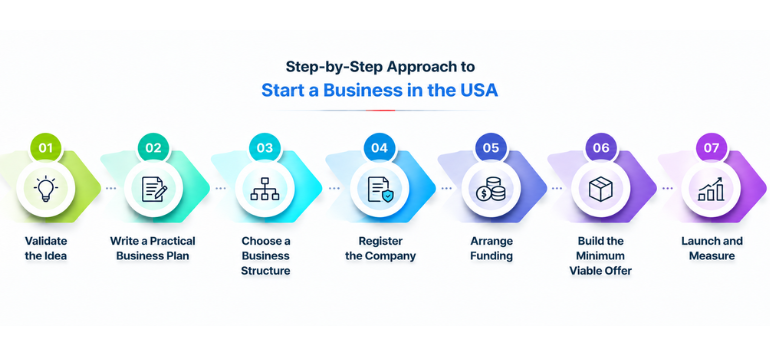
Step1. Validate the Idea
Define who the customer is and test the problem, proposed solution and willingness to pay. Make notes about what you discover instead of believing your preconceptions.
Step2. Write a Practical Business Plan
Describe the offering, target customer, competitive advantage, sales approach, operating structure and financial forecast. The U.S. Small Business Administration provides guidance for planning and launching a company.
Step3. Choose a Business Structure
Options include: sole proprietorship, partnership, limited liability company, and corporation. Your decision will impact your liability, tax obligations, documentation and ability to secure financing; consult with a qualified attorney or tax professional for guidance.
Step4. Register the Company
Requirements vary by entity type and state, but may include: registering with your state government, acquiring an Employer Identification Number, filing a fictitious business name and procuring city and county business licenses.
Step5. Arrange Funding
Estimate the amount of capital required to execute a meaningful proof of concept. Options include: personal savings, bank loan, government grant, family and friends, angel investment and venture capital. Choose the appropriate fit for your degree of risk and anticipated rate of growth.
Step6. Build the Minimum Viable Offer
Assemble the barebones offering that delivers your primary value. A service business might begin with only one offering, while a software company might release only the workflow that solves the main customer problem.
Step7. Launch and Measure
Use existing channels where you are most likely to reach your target customer; for example, if your customers spend hours browsing social media, test an online marketing strategy. Track: leads, conversions, retention, gross margin and customer feedback. Iterate the offering based on results.
Common Mistakes New Founders Should Avoid
Some common mistakes made by first time entrepreneurs are listed below, and a new venture should carefully examine their strategy for each of the following areas.
- Creating a product before talking to potential customers.
- Failing to plan for the amount of working capital required to operate the business.
- Selecting an overly large target market.
- Ignoring local, state, or federal regulations.
- Relying on a single customer or marketing channel.
- Hiring and scaling too early before repeatable sales have been created.
- Focusing solely on revenue while ignoring profit and cash flow.
Turn Your Startup Idea Into a Digital Product
Choosing an idea is only the beginning. Your startup may also need a website, mobile application, cloud infrastructure, IoT platform, or custom business software to reach customers and operate efficiently.
Team Tweaks is a leading app development company in Chennai with 12+ years of experience in designing and developing digital solutions for startups, small businesses, and enterprises. Since 2013, we have helped businesses turn ideas into functional, scalable, and user focused digital products.
From an early prototype to a market ready platform, our team can support your product journey with mobile app development, web development, cloud solutions, DevOps, IoT, custom software development, and digital solutions. We work with modern technologies to build solutions that can adapt as your business grows.
Why Choose Team Tweaks for Your Startup?
Startups need more than just development. They need a technology partner who understands their goals, budget, timeline, and growth plans. Team Tweaks brings technical expertise and practical development experience to help businesses move from an initial concept to a working digital product.
With our team based in Chennai, India, we work with clients across India, the USA, UAE, and other international markets. Our experience across different industries allows us to understand varied business requirements and create solutions based on specific needs rather than using a one size fits all approach.
Whether you need a mobile app to connect with customers, a website to establish your online presence, cloud infrastructure to support growth, or an IoT platform to manage connected devices, Team Tweaks can help you plan and develop the right technology solution.
Our Startup Technology Services
- Mobile App Development: Build Android, iOS, Flutter, and cross platform applications for your startup.
- Web Development: Create responsive websites and web applications designed around your business objectives.
- Custom Software Development: Develop tailored software to streamline operations and solve specific business challenges.
- Cloud Solutions: Build scalable and flexible cloud environments to support your growing digital product.
- DevOps Services: Improve development workflows, deployment processes, automation, monitoring, and infrastructure management.
- IoT Development: Connect devices, collect data, and develop smart solutions for connected business environments.
- UI/UX Design: Create intuitive digital experiences that make your product easier for customers to use.
- Digital Marketing: Support your product launch with digital marketing strategies that help improve online visibility and customer reach.

Final Thoughts
The USA offers opportunities across technology, ecommerce, healthcare, local services and sustainable industries. However, the right startup idea will depend on your experience, resources, location and understanding of customer needs.
You do not need to launch everything at once. Start with one focused product or service, test it with real customers and expand after developing a reliable business model. Careful execution is ultimately more important than selecting the most popular idea.
Read Too: Top 50+ Low Investment Business Ideas
Frequently Asked Questions(FAQs)
A good startup ideas solves a clear customer problem and fits the founder’s skills and budget. AI automation, specialized SaaS, cybersecurity, home services, ecommerce and healthcare support solutions are among the areas founders can explore.
Possible options include SEO consulting, content writing, virtual assistance, online coaching, paid newsletters, digital products and selected pet-care services. Actual costs depend on insurance, software, marketing and local requirements.
SaaS subscriptions, maintenance contracts, marketing retainers, membership communities, subscription boxes, property management and recurring home services can all support repeat revenue when customers continue receiving value.
Not every business must begin as an LLC. The appropriate structure depends on liability, ownership, tax treatment and future plans. Review federal, state and local requirements and seek qualified professional advice.
Some online services can begin with a few hundred or a few thousand dollars. Software, food, healthcare, energy and infrastructure businesses may require tens or hundreds of thousands of dollars. Prepare a detailed budget for the specific location and model.
There is no fixed timeline. A small service business may reach profitability comparatively quickly, while a technology or product company may require a longer development and customer-acquisition period. Pricing, costs, demand and execution all influence the result.
Technology, professional services, healthcare, ecommerce, clean energy, logistics and local consumer services all contain startup opportunities. Founders should research a specific customer segment rather than selecting an industry only because it appears popular.
In many situations, non-residents can own a U.S. company, but registration, banking, taxation and immigration are separate matters. Anyone considering this route should obtain professional legal and tax advice based on their location and intended activities.