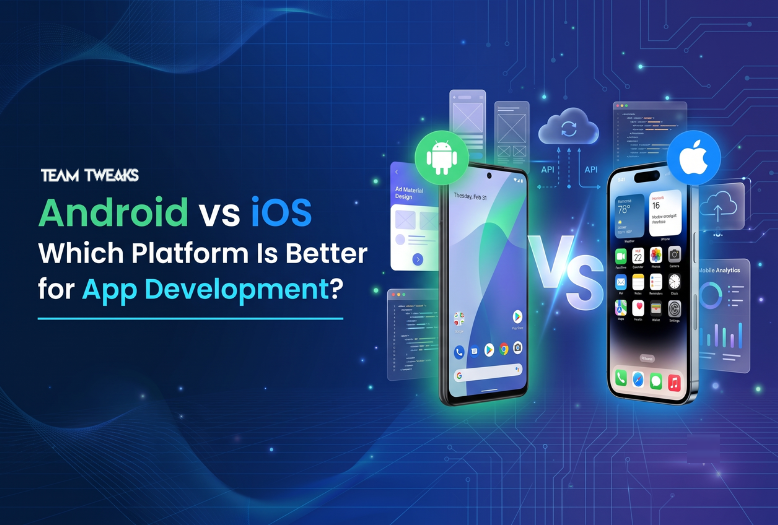
Mobile apps have changed the way people communicate, shop, travel, work, and access digital services. From food delivery and online shopping to mobile banking and healthcare, mobile applications have become an important part of everyday life. For businesses, a mobile app provides a direct way to connect with customers. A well developed application can improve the customer experience, increase user engagement, simplify business operations, and create new revenue opportunities. However, before starting a mobile app development project, businesses often face one important question. Android vs iOS: Which platform is better for app development?
Android and iOS are the two leading mobile operating systems used around the world. Both platforms provide powerful technologies, development tools, and app ecosystems for building modern mobile applications.
Android is known for its large global user base, wide range of supported devices, and flexible development environment. In comparison, iOS offers a controlled Apple ecosystem, consistent user experience, strong privacy and security standards, and a significant presence in premium markets.
However, there is no single mobile platform that is perfect for every business.
The right choice depends on your target audience, app features, development budget, project timeline, monetization strategy, and long term business goals. In this Android vs iOS app development comparison, we will explore the major differences between the two platforms. We will compare their market reach, development costs, programming languages, development tools, UI/UX design, device testing, security, app store approval, monetization opportunities, and maintenance requirements.
Understanding these differences can help you choose the right mobile platform for your app development project.
Let’s begin..
Android vs iOS User Market Share in 2026
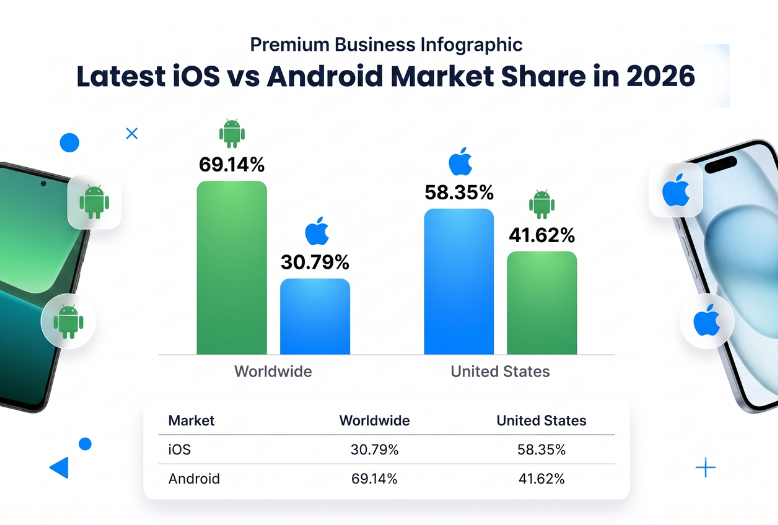
Android continues to lead the global mobile operating system market in 2026. As of June 2026, Android holds approximately 69.18% of the worldwide mobile OS market, while iOS accounts for around 30.89%.
One of the main reasons for Android’s strong global presence is its availability across many smartphone brands and price ranges. Users can choose from affordable Android smartphones as well as premium flagship devices. This wide device availability allows Android to reach a large and diverse global audience.
However, the mobile market looks different in the United States.
As of June 2026, iOS holds approximately 58.38% of the US mobile operating system market, compared with 42.72% for Android.
Latest Android vs iOS Market Share in 2026
| Market | iOS | Android |
|---|---|---|
| Worldwide | 30.79% | 69.14% |
| United States | 58.35% | 41.62% |
Android vs iOS Market share data: June 2026.
These figures show an important difference between the two mobile platforms. Android leads the global mobile market, while iOS has a stronger market position in the United States.
Therefore, businesses should consider their target location and user base before choosing between Android and iOS app development. If your goal is to reach a broad global audience, Android may provide wider market access. If your primary customers are based in the United States, iOS may offer stronger access to your target audience.
What Is Android App Development?
Android app development is the process of designing and building mobile applications for devices that use the Android operating system.
Android is developed by Google and is used by many smartphone manufacturers. Popular Android device brands include Samsung, Google Pixel, Xiaomi, OnePlus, Oppo, Vivo, and Motorola.
Because Android is available across a wide range of smartphones, businesses can reach users with different device preferences and budgets. This broad device ecosystem is one of the main reasons Android has a large global user base.
Native Android applications are commonly developed using Kotlin and Java.
Kotlin is widely preferred for modern Android app development because it offers clean syntax and helps developers write more concise and maintainable code. Java is also widely used, particularly for maintaining existing Android applications and older projects.
The official development environment for Android applications is Android Studio.
Most Android applications are published through the Google Play Store. However, Android also supports other app distribution methods depending on business and technical requirements.
Android app development is commonly used for:
- eCommerce applications
- Food delivery apps
- Taxi booking apps
- Healthcare applications
- Banking and fintech apps
- Education platforms
- IoT applications
- Enterprise applications
- Social networking apps
- On-demand service platforms
Android’s large user base and flexible development ecosystem make it a popular choice for businesses that want to reach a broad audience.
What Is iOS App Development?
iOS app development is the process of designing and building mobile applications for Apple’s mobile ecosystem.
iOS is primarily used on Apple’s iPhone devices. Apple also provides related operating systems and development technologies for products such as the iPad and Apple Watch.
iOS applications are mainly distributed through the Apple App Store.
Swift is the primary programming language used for modern iOS app development. Developed by Apple, Swift is designed to help developers build fast, reliable, and secure applications.
Objective-C is another programming language used in many older iOS applications. Although existing Apple applications may still contain Objective-C code, Swift is generally preferred for new iOS development projects.
The official development environment for iOS is Xcode.
Xcode provides the tools developers need to write code, design user interfaces, test applications, debug issues, manage app builds, and prepare applications for App Store submission.
One of the main differences between Android vs iOS is the level of control over devices.
Apple develops both the hardware and operating system for its devices. As a result, iOS provides a more controlled development environment.
Developers also work with a smaller range of supported devices compared with Android.
iOS app development is commonly used for:
- Premium service applications
- Subscription apps
- Fintech applications
- Healthcare apps
- Fitness applications
- Business applications
- Entertainment platforms
- Social networking apps
- eCommerce app
- Lifestyle apps
Businesses often consider iOS development when their target audience mainly uses Apple devices or when the app focuses on premium and subscription based digital services.
Major Differences Between Android vs iOS App Development
Choosing between Android vs iOS involves more than simply comparing two operating systems.
Businesses need to understand how both platforms differ in terms of target users, development technologies, programming languages, testing, UI/UX design, security, app distribution, and revenue opportunities.
Here are the major differences between Android and iOS app development.
1. Target Audience
Your target audience is one of the most important factors when choosing a mobile development platform.
Before selecting Android vs iOS, consider where your customers are located and which mobile devices they use.
Android has a large and diverse global user base. Android smartphones are available across different brands and price ranges, making the platform accessible to a broad range of users.
For example, a grocery delivery company operating across multiple cities may choose Android to reach a wider customer base. Education platforms, local service applications, and mass market eCommerce apps may also benefit from Android’s broad reach.
iOS primarily targets users within the Apple ecosystem. Businesses whose customers mainly use iPhones may consider iOS development.
For example, a premium fitness membership application or subscription based digital service may find iOS suitable for its target audience.
Before choosing between Android vs iOS, businesses should analyse customer data. If you already have a website, check your analytics to understand which mobile devices visitors use.
Market research and customer surveys can also provide useful information.
The best platform is the one your target customers actually use.
2. Global Market Reach
Android devices are widely used around the world because many smartphone manufacturers use the Android operating system.
Android smartphones are also available across a wide range of price categories. This helps the platform reach users from different customer groups and markets.
For businesses that want to reach a broad global audience, Android can be an important mobile platform. It is particularly useful for consumer applications that depend on attracting a large number of users.
iOS has a smaller and more controlled device ecosystem. However, Apple devices have a strong presence in several important mobile markets, particularly the United States.
Businesses should not make a platform decision based only on worldwide market share.
Mobile usage can vary significantly between countries, cities, industries, and customer groups. A platform with the largest global audience may not always be the most popular among your actual customers.
Therefore, geographic location and customer demographics should be important factors when comparing Android vs iOS app development.
3. Development Cost: Android vs iOS
App development cost is a major consideration for startups and growing businesses.
Many companies want to know whether Android app development is cheaper than iOS development.
The answer depends on the specific project.
Several factors can affect mobile app development costs, including:
- App design
- Number of screens
- User registration
- Payment integration
- Maps and GPS
- Push notifications
- Chat functionality
- Video features
- Third party integrations
- Backend development
- Admin dashboard
- Security requirements
- Testing
- App maintenance
A simple mobile application will usually cost less than a complex on-demand platform, whether it is developed for Android vs iOS.
However, Android applications may require additional testing because they run on many smartphones with different screen sizes, hardware specifications, and operating system versions.
The additional testing and optimization work can sometimes increase Android app development costs.
iOS has a more controlled device ecosystem, which can make device testing more manageable for some projects.
However, iOS applications must also meet Apple’s technical requirements and App Store guidelines.
Ultimately, the cost of mobile app development depends on the app’s features, design, technical architecture, integrations, and overall complexity.
4. Programming Languages: Android vs iOS
Android and iOS use different programming languages for native mobile app development.
For Android development, Kotlin and Java are the most commonly used programming languages.
Kotlin is widely preferred for modern Android development because it offers a cleaner coding structure and works well with existing Java projects.
Java has been used for Android development for many years and continues to support a large number of existing applications.
For iOS development, Swift is the primary programming language.
Swift is a modern programming language developed by Apple. Its clear syntax helps developers write readable and maintainable code. It also includes features designed to improve code safety and help developers identify potential programming errors.
Objective-C was widely used for iOS development before Swift and is still used to maintain many older applications.
However, Swift is generally preferred for new iOS app development projects.
5. Development Tools: Android vs iOS
Android and iOS provide dedicated development environments for building mobile applications.
The Android developers mainly use Android Studio.
Android Studio provides tools for writing code, designing UI layouts, integrating app features, testing applications, analysing performance, and managing application builds.
It also includes an Android emulator that allows developers to create and test virtual device configurations.
iOS developers use Xcode, Apple’s official development environment.
Xcode provides tools for Swift development, interface design, app testing, debugging, performance monitoring, and App Store preparation.
Both Android Studio and Xcode provide the essential tools needed to develop applications for their respective platforms.
The development team selects the appropriate tool based on the mobile ecosystem and technical requirements of the project.
6. User Interface and App Design
Android and iOS users have different expectations when it comes to app design and user interaction.
Android applications commonly follow Google’s Material Design guidelines.
Material Design provides guidance for layouts, navigation, typography, buttons, icons, animations, and user interactions.
Android also provides flexibility for interface customization depending on the app’s requirements.
iOS applications follow Apple’s Human Interface Guidelines.
Apple’s design guidelines focus on clarity, consistency, and familiar user interactions.
iPhone users are familiar with specific navigation patterns, gestures, buttons, and screen behaviours.
A well designed Android app should feel natural to an Android user. Similarly, an iOS app should provide an experience that feels familiar to an iPhone user.
Businesses can maintain the same brand identity across both platforms. However, navigation and interaction patterns may need to be adjusted to match platform specific user expectations.
7. Device Fragmentation
Device fragmentation is one of the biggest challenges in Android app development.
Many manufacturers produce Android smartphones, and these devices can have different:
- Screen sizes
- Screen resolutions
- Processors
- Memory capacities
- Camera systems
- Hardware sensors
- Android versions
Developers need to consider these differences when designing and testing Android applications.
For example, an application may perform smoothly on a premium Android smartphone but run more slowly on a device with limited memory and processing power.
The app layout may also appear differently across various screen sizes and resolutions.
Android developers use responsive design, performance optimization, emulators, and real device testing to reduce these problems.
Device fragmentation is less complex in iOS because Apple controls the hardware and operating system of iOS devices.
Developers still need to test applications across different iPhone models and screen sizes. However, the number of device configurations is generally more controlled compared with Android.
8. App Testing
Testing is an essential part of mobile app development.
Once an application is developed, developers and quality assurance teams need to check whether the app works correctly across its supported devices and features.
Common mobile app testing methods include:
- Functional testing
- UI testing
- Performance testing
- Security testing
- API testing
- Device testing
- Network testing
- User acceptance testing
Android app testing can be more complex because of the wide range of available devices and operating system versions.
Developers may need to test the application across multiple smartphone brands, Android versions, and hardware configurations.
iOS testing can be more manageable because Apple controls its device ecosystem.
However, iOS applications still need detailed testing across supported iPhone models, screen sizes, iOS versions, and Apple services.
Regardless of the platform, proper testing is necessary to deliver a reliable and user-friendly mobile application.
9. App Store Approval Process
After development and testing are complete, the mobile application needs to be published.
Most Android applications are published through the Google Play Store, while iOS applications are distributed through the Apple App Store.
Both app stores have policies and technical requirements that developers must follow.
Apple is known for its detailed App Store Review Guidelines. Applications may be reviewed for:
- Privacy
- Security
- Functionality
- User experience
- Data collection
- Payments
- Account management
- Content
If an application does not meet Apple’s requirements, the review team may reject it and request changes.
Google also has policies covering user privacy, application permissions, payments, content, and app behaviour.
Businesses should review app store requirements during the development process rather than waiting until the application is complete.
Planning for app store compliance from the beginning can help reduce unnecessary publishing delays.
10. Security and Privacy
Mobile application security has become increasingly important as apps process online payments, location information, customer details, and sensitive business data.
Both Android and iOS provide built-in security technologies for application developers.
Apple operates within a tightly controlled hardware and software ecosystem. iOS provides privacy controls and security technologies designed to protect application and user data.
Android also provides modern application security features, including secure storage, permission controls, authentication support, and encryption technologies.
However, app security does not depend only on the operating system.
Developers should implement important security practices such as:
- Secure HTTPS connections
- Authenticated APIs
- Data encryption
- Secure login systems
- Multi-factor authentication when required
- Secure token storage
- Limited application permissions
- Regular security updates
Security should be considered from the initial planning stage of mobile app development.
11. App Customization and Flexibility
Android is often considered a flexible mobile development platform.
Its broad device and hardware ecosystem can support applications that require integrations with:
- IoT devices
- Bluetooth technology
- Smart device controls
- Fleet management systems
- Industrial equipment
- Hardware monitoring systems
Depending on the technical requirements, Android may provide greater flexibility for certain device and hardware integrations.
iOS operates within a more controlled environment.
Apple defines clear rules for how applications interact with the operating system and device features. These controls are designed to support security, privacy, performance, and a consistent user experience.
For common applications such as eCommerce, booking, fintech, and business apps, the controlled iOS ecosystem may not create significant limitations.
However, applications that require advanced device-level or hardware integrations should undergo a technical evaluation before the development platform is selected.
12. App Performance
Users expect mobile applications to open quickly and respond smoothly.
Poor app performance can lead to negative reviews and application uninstallations.
Both native Android and native iOS applications can provide excellent performance when they are properly developed.
Android devices have a wider range of hardware capabilities. Some users may have high performance flagship smartphones, while others may use devices with limited memory and processing power.
Android applications should therefore be optimized for the target range of devices.
iOS developers work within Apple’s controlled hardware ecosystem. The smaller range of hardware configurations can make performance optimization more predictable.
However, the quality of the code remains important on both platforms.
App performance also depends on backend architecture, API response times, database design, network usage, and testing.
Choosing Android or iOS alone does not guarantee a fast application.
13. Monetization and Revenue Opportunities
Your application’s business model can also influence your choice between Android and iOS.
Mobile applications can generate revenue through:
- Paid app downloads
- In-app purchases
- Subscription services
- Advertisements
- Transaction fees
- Service commissions
- Premium features
Android’s large global user base can be valuable for applications that depend on broad market reach and high user volume.
Advertising supported apps and mass market digital services may benefit from Android’s wide audience.
iOS is often considered attractive for premium applications, subscriptions, and in-app purchases.
However, revenue opportunities depend on several factors, including:
- App category
- Target country
- Customer behaviour
- Pricing model
Businesses should study their target audience and revenue strategy before selecting a mobile development platform.
14. App Maintenance
Mobile app development does not end after an application is launched.
Applications require continuous maintenance and technical support.
Mobile app maintenance may include:
- Bug fixes
- Security updates
- Performance improvements
- New feature development
- API updates
- Support for new devices
- Support for new operating system versions
Android applications may require additional testing when new devices and operating system versions are introduced.
Similarly, iOS applications need updates to support new Apple devices, iOS versions, and development requirements.
Both Android and iOS applications require regular monitoring, updates, and technical support.
Businesses should include app maintenance in their long term mobile app development budget.
Pros and Cons of Android App Development
Understanding the advantages and disadvantages of Android app development can help businesses make a more informed decision.
Advantages of Android App Development
- Access to a large global user base
- Support for a wide range of smartphones
- Flexible application development options
- Strong support for IoT, Bluetooth, and smart device integrations
- Suitable for businesses targeting broad customer markets
Disadvantages of Android App Development
- Multiple screen sizes and hardware configurations
- More device brands to test
- Performance can vary between devices
- Supporting multiple Android versions may increase development complexity
Pros and Cons of iOS App Development
iOS also offers several advantages and limitations.
Advantages of iOS App Development
- Consistent User Experience: Apple’s controlled ecosystem helps developers create a consistent application experience across supported devices.
- Strong Security Environment: iOS provides strict privacy and application security requirements.
- Controlled Device Ecosystem: A smaller device range can make application testing more manageable.
- Premium Customer Reach: iOS can be suitable for businesses targeting Apple users and premium customer markets.
- Subscription Opportunities: Many subscription based and premium digital services consider iOS an important platform.
Disadvantages of iOS App Development
- Strict App Store Guidelines: Applications must follow Apple’s detailed review and publishing requirements.
- Limited Device Ecosystem: iOS applications are developed specifically for supported Apple devices.
- Controlled System Access: Developers may face limitations when accessing certain system level functions.
- Platform Specific Development: Native iOS app development requires Apple development technologies and tools.
Android vs iOS App Development: Quick Comparison
| Comparison Factor | Android | iOS |
|---|---|---|
| Platform Developer | Apple | |
| Programming Languages | Kotlin, Java | Swift, Objective-C |
| Development Tool | Android Studio | Xcode |
| App Distribution | Google Play and supported channels | Apple App Store |
| Device Variety | High | Controlled |
| Global Audience | Broad | Strong Apple user base |
| UI Guidelines | Material Design | Human Interface Guidelines |
| Device Testing | More complex | More controlled |
| Customization | Flexible | More controlled |
| Security | Strong with proper development | Strong controlled ecosystem |
| Monetization | Large audience opportunities | Premium and subscription opportunities |
| Hardware Integration | Flexible for many use cases | Controlled system integration |
Which Platform Is Better for Startups? Android vs iOS
For startups with a limited budget and a short launch timeline, customer demand should play an important role in choosing a mobile platform.
Launching on one platform first can be a practical strategy for startups that want to test their app idea before investing in a larger development project.
If most target users use Android smartphones, launching an Android app first may be the right choice. If the target audience mainly uses Apple devices, an iOS first strategy may be more suitable.
Cross platform app development is another option.
Frameworks such as Flutter and React Native allow businesses to develop applications for Android and iOS using a shared codebase.
However, the final decision should be based on the app’s features, technical requirements, target users, budget, and long term development plans.
Which Mobile Platform Is Best for Your Business?
When choosing a mobile platform for your business, consider the devices your customers actually use and the type of service your company provides.
For example, a local delivery company may choose Android if most customers and delivery partners use Android smartphones.
A premium digital service may focus on iOS if the majority of its target customers use Apple devices.
An eCommerce business may choose both platforms because customers can shop using either Android smartphones or iPhones.
Enterprise businesses should also consider the devices used by their employees.
For example, if a field service company provides Android devices to its employees, an Android enterprise application may be the most practical choice.
There is no single mobile platform strategy that works for every business.
Your target users, business operations, and technical requirements should guide the final decision.
Which Mobile Platform Should You Use First, Android vs iOS?
Choose Android first if:
- Most of your customers use Android.
- You want to reach a diverse audience.
- You are targeting broad global markets.
- Your app requires flexible device integrations.
- You are building a mass market service.
Choose iOS first if:
- Most of your customers use iPhones.
- Your target audience is active within the Apple ecosystem.
- You are developing a premium service application.
- Your business uses a subscription model.
- Your target market has strong iOS usage.
Choose Android and iOS if:
- You want to reach the maximum number of customers.
- Your target users are active on both platforms.
- You are building an eCommerce application.
- You are developing an on-demand service.
- Your business operates across multiple markets.
Android vs iOS: Which App Development Platform Is Better?
Both Android and iOS are powerful platforms for mobile app development.
Android may be a better choice for businesses that want broad market reach, flexible device support, and access to a diverse global user base.
iOS may be suitable for companies targeting Apple users, premium customer segments, or subscription based digital services.
Ultimately, the right choice depends on your business requirements.
Before starting mobile app development, consider the following questions:
- Who is your target audience?
- Features does your application need?
- What type of business are you operating?
- Development budget – What’s yours?
- What is your expected launch timeline?
- What security requirements does your app have?
- How will your application generate revenue?
- How do you plan to scale the application?
If your target audience uses both operating systems, supporting Android and iOS can improve accessibility and help you reach more customers.
Depending on the technical requirements, businesses can choose separate native applications or a suitable cross platform development framework.
Development Cost Comparison: Android vs iOS
The cost of developing a native iOS app and a native Android app is generally similar. However, Android apps need to support a wider range of devices, screen sizes, and hardware specifications. This can increase testing and optimization work, which may make Android app development slightly more expensive in some projects.
iOS has a more controlled device ecosystem, so developers usually have fewer device variations to test. This can simplify testing and optimization. However, the final iOS vs Android app development cost mainly depends on the app’s features, design, technical complexity, integrations, and overall business requirements.
Read More: How Much Does It Cost to Develop an iOS App?
Wrapping Up
Choosing between Android and iOS app development mainly depends on your target audience, budget, app requirements, and long term business goals. If your business wants to reach a wider global audience and increase market coverage, Android can be a strong choice. On the other hand, if you are targeting Apple users, premium customer segments, or subscription based services, iOS may be the better option. Both Android and iOS have their own advantages and limitations. Understanding the differences between these platforms can help you make the right development decision and build a mobile application that meets user expectations.
Whether you choose Android, iOS, or both platforms, working with an experienced mobile app development team can simplify the entire process. At Team Tweaks, they skilled developers support businesses from app planning and UI/UX design to development, testing, deployment, and ongoing maintenance. They build reliable and user-friendly mobile applications based on your business requirements and help turn your app idea into a successful digital product.
Frequently Asked Questions
Both platforms are suitable for app development. Android is useful for reaching a broad audience, while iOS can be suitable for targeting Apple users and premium customer segments.
The development difficulty depends on the application’s features. iOS has a more controlled device ecosystem, while Android requires support for a wider range of devices.
Not necessarily. Android may require additional device testing, but the overall app development cost mainly depends on features, design, backend systems, and technical complexity.
Kotlin and Java are commonly used for native Android app development.
Swift is commonly used for modern iOS app development. Objective-C is also used in some existing applications.
Startups should choose a platform based on their target customers. Android may be suitable for a broad audience, while iOS may be useful for Apple focused or premium customer markets.
If your customers use both Android and iOS devices, supporting both platforms can help you reach more users.
Yes. Cross platform development technologies such as Flutter and React Native can be used to create applications for Android and iOS with a shared codebase.
Both Android and iOS provide strong security technologies. App security also depends on secure coding, API protection, encryption, authentication, and regular updates.
The best app development company depends on your project requirements, budget, industry, and the team’s expertise. When choosing a mobile app development company in Chennai, look for experience, a strong portfolio, client reviews, transparent pricing, post-launch support, and expertise in Android, iOS, Flutter, and cross platform app development. A reliable development partner can help turn your app idea into a secure, scalable, and high performing mobile application. If you need custom mobile app development, Team Tweaks offers Android, iOS, Flutter, and cross platform app development services for startups, SMEs, and enterprises.