Last mile delivery software plays a crucial role in modern logistics by helping businesses manage and streamline the final stage of the delivery process, from distribution centres to customers’ doorsteps. With features such as real-time tracking, route optimization, automated task assignment, fleet management, and delivery notifications, businesses can improve delivery efficiency, reduce operational costs, and provide a better customer experience. It is widely used across industries such as e-commerce, retail, food delivery, pharmaceuticals, and logistics.
Developing a last mile delivery solution involves integrating advanced technologies such as Artificial Intelligence (AI), Machine Learning (ML), GPS, and the Internet of Things (IoT) to simplify delivery operations and improve transparency. From understanding essential features and development costs to exploring popular delivery apps, industry challenges, and emerging trends, this guide covers everything businesses need to know about last mile delivery software development and how the right solution can support long-term business growth.
What is Last Mile Delivery Software?
Last mile delivery software is a specialized logistics solution designed to optimize the final leg of the delivery process, where goods are transported from a distribution center to the customer’s doorstep. This stage, known as the “last mile,” is often the most complex and expensive part of the delivery journey, accounting for up to 53% of total shipping costs. The software addresses challenges like route optimization, real time tracking, and efficient communication between drivers, administrators, and customers.
Modern businesses, especially in industries like e-commerce, retail, and food delivery, heavily rely on last mile delivery software to streamline operations. The system integrates advanced technologies to provide transparency and efficiency, ensuring deliveries are completed on time and to the right location.
Features of Last Mile Delivery Software
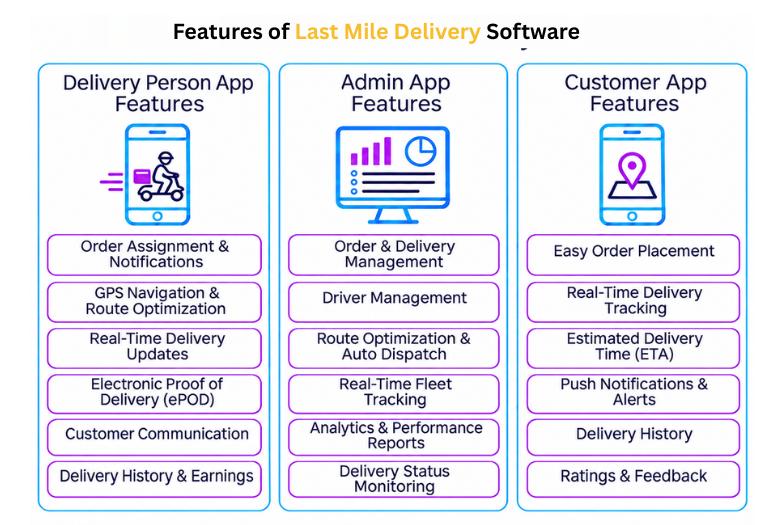
Last mile delivery software bridges the gap between businesses and their customers by streamlining operations, improving transparency, and ensuring efficient logistics management. The core features are designed for three primary stakeholders: delivery personnel, administrators, and customers. Below is a detailed overview, including additional features that shows the software’s capabilities.
Delivery Person App Features
The delivery person app focuses on simplifying the tasks of drivers, ensuring they can perform their duties efficiently and accurately.
- Route Optimization
- Calculates the most efficient delivery routes in real-time, considering:
- Traffic conditions.
- Delivery time windows.
- Weather disruptions.
- Reduces fuel consumption and ensures timely deliveries, even in urban areas with high congestion.
- Calculates the most efficient delivery routes in real-time, considering:
- Real-Time Task Assignment
- Dynamically assigns tasks to drivers based on proximity to the delivery location and order priority.
- Enables seamless reassignments if drivers face unexpected issues, such as vehicle breakdowns or delays.
- Proof of Delivery
- Collects digital signatures, photographs, or barcodes as evidence of successful delivery.
- Supports contactless proof-of-delivery options, ensuring safety and convenience for both customers and drivers.
- Delivery Assistance
- Includes turn-by-turn navigation with step-by-step delivery instructions, such as gate codes or specific drop-off points.
- Offers voice-guided navigation for hands-free operation.
- Driver Performance Metrics
- Tracks delivery times, successful drop-offs, and feedback to provide drivers with performance reports.
- Encourages accountability and continuous improvement.
- Offline Functionality
- Allows delivery personnel to update status and access essential delivery data without an active internet connection.
- Syncs data automatically when connectivity is restored.
- Communication Tools
- Enables direct communication with customers and administrators through in-app messaging or calls.
- Reduces confusion or delays due to miscommunication.
Admin App Features
The admin panel is the backbone of last mile delivery software, offering tools to monitor and manage the entire delivery process effectively.
- Centralized Fleet Management
- Provides a unified dashboard to monitor multiple delivery vehicles in real-time.
- Tracks vehicle locations, driver availability, and package statuses, enabling optimal resource utilization.
- Analytics and Reporting
- Generates comprehensive reports on:
- Delivery times.
- Fuel consumption.
- Driver productivity.
- Provides insights for improving delivery efficiency and reducing operational costs.
- Generates comprehensive reports on:
- Real-Time Delivery Status
- Tracks every package from the warehouse to the customer’s doorstep.
- Identifies potential delays and provides administrators with tools to resolve issues swiftly.
- Dynamic Route Reallocation
- Reassigns deliveries mid-route if priorities change or drivers encounter issues, ensuring uninterrupted service.
- Inventory Management Integration
- Syncs with warehouse systems to provide real-time updates on stock availability and package readiness.
- Compliance Monitoring
- Tracks adherence to delivery regulations, such as vehicle maintenance schedules and driver certifications.
- Multi-Location Support
- Manages deliveries across multiple hubs or warehouses, ensuring smooth operations in different regions.
- Driver Performance Evaluation
- Offers tools to assess driver performance based on key metrics, rewarding top performers and identifying areas for improvement.
Customer App Features
The customer app focuses on enhancing the delivery experience by providing transparency, convenience, and engagement.
- Live Delivery Tracking
- Provides real-time updates on delivery progress with accurate estimated arrival times (ETA).
- Enables customers to see the driver’s location on a live map.
- Notifications and Updates
- Sends automatic alerts for:
- Package pickup.
- Estimated arrival times.
- Delays or rescheduling.
- Ensures customers are informed throughout the delivery process.
- Sends automatic alerts for:
- Feedback System
- Collects reviews and ratings post-delivery to help businesses identify improvement areas.
- Includes options for reporting issues directly through the app.
- Contactless Delivery Options
- Allows customers to select contactless delivery and specify drop-off instructions for safety and convenience.
- Delivery Preferences
- Enables users to schedule delivery times or specify alternate drop-off locations.
- Offers features for signature-required deliveries or age-restricted items.
- Order Modification Tools
- Allows customers to make last-minute changes to their delivery details, such as address updates or special instructions.
- Support and Assistance
- Provides in-app access to customer support through chat, email, or calls.
- Includes a FAQ section for resolving common issues without contacting support.
- Delivery History
- Maintains a record of past deliveries, allowing customers to review order details or re-order products.
Technologies
Artificial Intelligence (AI) and Machine Learning (ML):
AI and ML enhance route optimization by analyzing historical data, traffic conditions, and delivery patterns. Predictive analytics helps anticipate delays and suggest proactive solutions.
B. Internet of Things (IoT):
IoT-enabled devices like GPS trackers and sensors provide real-time data on vehicle locations, package conditions, and delivery times, ensuring transparency and accountability.
C. Blockchain:
Blockchain technology secures data exchange between stakeholders, preventing tampering and ensuring accurate delivery records.
D. GPS Integration:
GPS systems enable real-time navigation and tracking, allowing drivers to follow optimized routes and customers to monitor their packages.
Integration with Other Systems
Last mile delivery software is most effective when integrated with existing systems like:
- Warehouse Management Systems (WMS): Facilitates seamless inventory updates and package tracking from warehouse to doorstep.
- Enterprise Resource Planning (ERP): Synchronizes delivery data with broader business operations like billing and customer relationship management.
- Customer Relationship Management (CRM): Enhances customer service by providing real-time updates and tracking information directly to clients.
Such integrations ensure that businesses operate efficiently, reducing manual intervention and errors.
Development Process for Software
Creating last mile delivery software involves a structured process to ensure it meets the unique needs of businesses and their customers. Here are the key steps:
1. Requirement Gathering
- Identify business objectives: Faster deliveries, cost savings, or better customer satisfaction.
- Understand user requirements for delivery personnel, admins, and customers.
2. UI/UX Design
- Create user-friendly interfaces tailored for each stakeholder:
- Delivery Person App: Simple navigation and task updates.
- Admin Panel: Intuitive dashboards for monitoring and analytics.
- Customer App: Easy access to tracking and notifications.
3. Backend Development
- Integrate critical functionalities:
- GPS tracking for real-time navigation.
- Data synchronization across apps and admin systems.
- Payment gateway integration for COD (Cash on Delivery) or prepaid orders.
4. Technology Stack
- Frontend: React Native, Flutter for cross-platform apps.
- Backend: Node.js, Python for robust data handling.
- Database: PostgreSQL or MongoDB for efficient storage.
- APIs: Google Maps API for route optimization, Twilio for notifications.
5. Testing and Quality Assurance
- Conduct functional and usability testing to ensure smooth operations.
- Test the app under real-world conditions to address issues like traffic delays and device compatibility.
6. Deployment and Maintenance
- Launch the software with a phased approach to minimize disruptions.
- Regularly update features based on user feedback and technological advancements.
Cost Analysis of Last Mile Delivery Software
The cost of developing last mile delivery software depends on various factors:
1. Features and Complexity
- Basic Features: Real-time tracking, task assignment, and notifications cost less to implement.
- Advanced Features: AI-driven route optimization, IoT integration, and blockchain require higher investment.
2. Platform Type
- Single Platform (iOS or Android): Costs are lower for single-platform apps.
- Cross-Platform Apps: Slightly more expensive but cater to a broader audience.
3. Development Team
- Costs vary based on hiring an in-house team, freelancers, or outsourcing to a development agency.
Estimated Cost Range
- Small-scale business solution: $20,000 – $50,000.
- Medium-scale customized software: $50,000 – $100,000.
- Large-scale enterprise solutions: $100,000+.
Subscription vs. Custom Development
- Subscription Models: $500-$2,000/month depending on features.
- Custom Development: Higher upfront cost but tailored to business needs.
Sustainability Features in Last Mile Delivery Software
As sustainability becomes a priority, last mile delivery software incorporates eco-friendly solutions:
1. EV Integration
- Supports electric vehicle fleets, reducing carbon emissions and fuel costs.
2. Carbon Footprint Tracking
- Tracks and reports emissions for each delivery, helping businesses monitor their environmental impact.
3. Optimized Delivery Routes
- Minimizes fuel consumption by reducing delivery miles through AI-driven route planning.
These features not only help businesses contribute to sustainability goals but also reduce operational costs.
Top 10 Last Mile Delivery Apps in USA
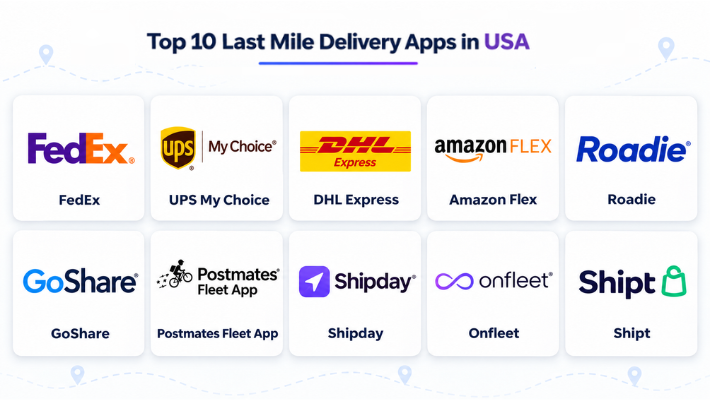
Efficient last mile delivery is crucial for businesses to meet customer expectations, reduce costs, and ensure timely deliveries. Last mile delivery apps play a significant role in managing and optimizing this process. Below, we explore the top 10 last mile delivery apps in USA that help businesses enhance their logistics operations.
Introduction to Last Mile Delivery Apps
Last mile delivery apps simplify logistics by bridging the gap between businesses, drivers, and customers. They provide features like real-time tracking, route optimization, and delivery updates, ensuring seamless operations and customer satisfaction. These apps are particularly valuable for parcel and package deliveries, offering tailored solutions for businesses of all sizes.
Key Criteria for Selecting a Last Mile Delivery App
When choosing a last mile delivery app, businesses should consider:
- Real-Time Tracking: Ensures visibility into package locations.
- Ease of Integration: Compatibility with existing systems like inventory and CRM.
- Scalability: Ability to adapt to growing delivery needs.
- Driver and Customer Support: Tools for efficient communication and problem resolution.
Top 10 Last Mile Delivery Apps in the USA
- FedEx Delivery Manager
- Overview:
Offers personalized delivery options, such as scheduling deliveries or redirecting packages to alternate locations. - Features:
- Real-time tracking.
- Notifications for package status.
- Signature-on-delivery options.
- Best For: E-commerce businesses needing reliable parcel delivery.
- Overview:
- UPS My Choice
- Overview:
Provides detailed package tracking and flexible delivery options for customers. - Features:
- Delivery alerts and updates.
- Address changes for packages in transit.
- In-app delivery rescheduling.
- Best For: Businesses focused on enhancing customer convenience.
- Overview:
- DHL Express Mobile App
- Overview:
Specializes in international and domestic deliveries, with advanced tracking tools. - Features:
- Real-time package tracking.
- Delivery management for time-definite services.
- Secure proof of delivery.
- Best For: Companies with global delivery needs.
- Overview:
- Amazon Flex
- Overview:
Leverages independent contractors for last mile delivery of Amazon packages. - Features:
- Real-time driver tracking.
- Optimized delivery routes.
- Seamless integration with the Amazon ecosystem.
- Best For: Businesses looking for flexible delivery solutions.
- Overview:
- Roadie
- Overview:
Connects businesses with local drivers for same-day delivery. - Features:
- Real-time tracking and notifications.
- Crowdsourced delivery options.
- Support for oversized or irregular packages.
- Best For: Small businesses needing affordable same-day delivery.
- Overview:
- GoShare
- Overview:
Provides on-demand delivery for parcels and larger freight. - Features:
- Flexible scheduling for same-day or next-day delivery.
- GPS tracking for drivers.
- Transparent pricing and instant quotes.
- Best For: Companies handling mixed delivery sizes.
- Overview:
- Postmates Fleet App
- Overview:
Primarily used for food and grocery delivery, but also supports package delivery. - Features:
- Driver tracking and proof of delivery.
- Flexible delivery schedules.
- In-app customer communication.
- Best For: Urban businesses requiring fast deliveries.
- Overview:
- Shipday
- Overview:
A cost-effective solution for small and medium businesses. - Features:
- Live order tracking for customers.
- Automatic dispatching for drivers.
- Route optimization and delivery reports.
- Best For: SMBs looking for an easy-to-use delivery management tool.
- Overview:
- Onfleet
- Overview:
A sophisticated delivery management platform designed for efficient last mile operations. - Features:
- Predictive ETAs and real-time updates.
- Driver analytics and performance tracking.
- API integrations for seamless workflows.
- Best For: Medium to large businesses managing high delivery volumes.
- Overview:
- Shipt
- Overview:
Known for its retail delivery services, including package delivery. - Features:
- Real-time package tracking.
- Dedicated support for last mile logistics.
- Scheduled and on-demand delivery options.
- Best For: Retailers offering same-day delivery services.
- Overview:
Comparison Table
| App | Key Features | Best For | Unique Benefit |
|---|---|---|---|
| FedEx Delivery Manager | Real-time tracking and delivery options | E-commerce businesses | Personalized delivery scheduling |
| UPS My Choice | Alerts, rescheduling and address changes | Customer-focused businesses | Flexible package management |
| DHL Express | Advanced tracking and secure deliveries | Global delivery needs | International delivery expertise |
| Amazon Flex | Route optimization and contractor model | Flexible solutions | Seamless Amazon integration |
| Roadie | Local drivers and same-day delivery | Small businesses | Cost-effective same-day options |
| GoShare | Mixed delivery sizes and GPS tracking | Parcel and freight companies | Transparent pricing and flexible options |
| Postmates Fleet App | Driver tracking and in-app messaging | Urban deliveries | Dual-purpose support for food and parcels |
| Shipday | Order tracking and automatic dispatching | Small and medium-sized businesses | Simple and affordable logistics solution |
| Onfleet | Predictive ETAs and driver analytics | Medium and large businesses | Advanced delivery analytics |
| Shipt | Scheduled and on-demand deliveries | Retailers | Retail-focused delivery options |
How These Apps Support Small Businesses
Many of these apps, such as Roadie, Shipday, and GoShare, provide flexible pricing models and intuitive interfaces, making them ideal for small and medium-sized businesses (SMBs). These apps eliminate the need for complex logistics systems by offering on-demand drivers, real-time tracking, and affordable delivery options.
Benefits of Last Mile Delivery App for Businesses
The last mile delivery process is one of the most critical aspects of logistics, directly impacting customer satisfaction and business efficiency. Last mile delivery apps are transformative tools that enable businesses to manage their delivery operations effectively. Here’s a detailed look at how businesses benefit from adopting these apps.
Why Businesses Need Last Mile Delivery Apps
- Customer Expectations
- With rising e-commerce trends, customers expect faster, accurate, and transparent deliveries.
- Last mile delivery apps provide real time tracking, delivery notifications, and personalized options to meet these demands.
- Operational Challenges
- Managing multiple delivery vehicles, unpredictable traffic, and order priorities can be overwhelming.
- These apps simplify complex logistics, ensuring smooth operations from dispatch to delivery.
- Competitive Edge
- Businesses using advanced delivery apps can outperform competitors by offering better delivery experiences and efficiency.
- Features like route optimization and customer communication set companies apart in crowded markets.
Key Benefits for Businesses
- Cost Reduction
- Optimized Routes: Reduces fuel consumption and delivery times with AI-powered route planning.
- Resource Utilization: Maximizes fleet efficiency, minimizing idle time for drivers.
- Fewer Failed Deliveries: Real-time updates and customer feedback reduce missed or incorrect deliveries.
- Enhanced Customer Experience
- Real-Time Tracking: Builds trust by allowing customers to track their orders.
- Delivery Notifications: Keeps customers informed about package status.
- Flexible Options: Enables customers to reschedule deliveries or choose specific time slots.
- Scalability
- Businesses can easily expand delivery operations without overhauling their logistics systems.
- Apps support additional drivers, locations, and warehouses as companies grow.
- Data-Driven Decision Making
- Analytics dashboards provide insights into delivery times, driver performance, and customer satisfaction.
- Businesses can identify bottlenecks and optimize processes based on data trends.
- Better Fleet Management
- Centralized dashboards help monitor vehicle locations, fuel usage, and driver availability.
- Proactive maintenance alerts reduce vehicle downtime.
Industry-Specific Applications
- E-Commerce
- Faster order fulfillment ensures lower cart abandonment rates.
- Same-day or next-day delivery options boost customer loyalty.
- Pharmaceuticals
- Real-time tracking ensures timely delivery of critical medicines.
- Temperature-controlled logistics can be monitored for sensitive items.
- Retail
- Facilitates in-store pickup and curbside delivery options.
- Seamlessly integrates with inventory systems to avoid stockouts.
- Food and Beverage
- Enables fast, contactless delivery of fresh or prepared meals.
- Increases efficiency during peak ordering hours with optimized delivery schedules.
Real-Time Data Use Cases
- Predicting Delays
- Apps analyze traffic patterns and alert drivers to avoid congestion, ensuring on-time delivery.
- Optimizing Delivery Zones
- Based on customer locations and delivery history, businesses can allocate resources more effectively.
- Customer Feedback Analysis
- Businesses use app-generated feedback to address recurring complaints and enhance service quality.
Cost-Benefit Analysis
Adopting a last mile delivery app may require an initial investment, but the long-term benefits far outweigh the costs.
- Investment Costs
- Subscription-based apps: $500–$2,000 per month.
- Custom-developed apps: $50,000–$100,000 upfront.
- Cost Savings
- Reduced fuel costs due to optimized routes.
- Fewer re-deliveries save labor and vehicle expenses.
- Revenue Growth
- Better customer satisfaction leads to repeat orders and higher customer retention rates.
- Enhanced operational efficiency translates to faster order cycles and increased delivery capacity.
Challenges and Solutions in Last Mile Delivery
The last mile delivery process is often the most complex and expensive stage in the logistics chain. Businesses face several challenges that impact efficiency, customer satisfaction, and operational costs. However, with the right strategies and tools, these challenges can be addressed effectively.
Common Challenges in Last Mile Delivery
- Traffic and Route Constraints
- Urban areas often face heavy traffic, causing delays in delivery schedules.
- In rural areas, poor infrastructure and longer distances add to delivery times.
- High Delivery Costs
- The last mile accounts for up to 53% of total delivery costs, driven by fuel consumption, driver wages, and vehicle maintenance.
- Failed deliveries and reattempts further increase operational expenses.
- Failed or Missed Deliveries
- Incorrect addresses, customers being unavailable, or miscommunication can lead to failed deliveries.
- Businesses incur additional costs for re-delivery attempts and damaged goods.
- Unpredictable Customer Demands
- Sudden spikes in delivery requests, especially during peak seasons, strain resources.
- Balancing urgent and standard deliveries can disrupt operations.
- Lack of Real-Time Visibility
- Without real-time tracking, businesses struggle to monitor delivery progress and respond to delays.
- Customers experience dissatisfaction due to limited transparency.
- Environmental Concerns
- Increased delivery volumes contribute to carbon emissions and environmental degradation.
- Traditional delivery methods are often not aligned with sustainability goals.
Effective Solutions for Last Mile Delivery Challenges
- AI-Powered Route Optimization
- How It Helps:
- Uses real-time traffic data to calculate the fastest and most efficient delivery routes.
- Reduces delivery times and fuel consumption.
- Example: FedEx implemented AI-based route optimization, reducing delivery times by 30%.
- How It Helps:
- Dynamic Delivery Scheduling
- How It Helps:
- Automatically adjusts delivery schedules based on driver availability, package priority, and real-time conditions.
- Ensures resources are allocated optimally during peak times.
- Example: Amazon Flex uses dynamic scheduling to handle fluctuating customer demands efficiently.
- How It Helps:
- Address Verification Tools
- How It Helps:
- Validates delivery addresses before dispatch to reduce errors and failed attempts.
- Example: DHL Express integrates address verification to enhance first-attempt delivery success rates.
- How It Helps:
- Real-Time Tracking and Notifications
- How It Helps:
- Provides businesses and customers with live updates on package locations and estimated delivery times.
- Increases transparency and improves customer satisfaction.
- Example: Onfleet offers real-time tracking and predictive ETAs to optimize deliveries.
- How It Helps:
- Customer Communication Tools
- How It Helps:
- Enables direct communication between drivers and customers to clarify instructions or delivery preferences.
- Reduces delays caused by miscommunication.
- Example: Roadie’s in-app messaging feature allows customers and drivers to coordinate efficiently.
- How It Helps:
- Sustainability Initiatives
- How It Helps:
- Adopts green logistics solutions, such as electric vehicles (EVs) and carbon-neutral delivery options.
- Aligns with environmental regulations and customer expectations.
- Example: UPS introduced EV fleets, reducing emissions by 25% in urban areas.
- How It Helps:
- Micro-Fulfillment Centers
- How It Helps:
- Establishes smaller warehouses closer to urban centers, reducing delivery distances and times.
- Example: Walmart uses micro-fulfillment centers to achieve faster last mile deliveries.
- How It Helps:
- Delivery Hubs and Lockers
- How It Helps:
- Provides centralized locations for customers to pick up packages at their convenience.
- Reduces the need for multiple delivery attempts.
- Example: Amazon Hub lockers allow customers to collect parcels securely.
- How It Helps:
How Technology Mitigates Challenges
- IoT Sensors
- Monitor package conditions, such as temperature and handling, ensuring product safety during transit.
- Useful for sensitive goods like pharmaceuticals and perishables.
- Blockchain Technology
- Secures delivery data and ensures accurate record-keeping.
- Reduces disputes over delivery errors or mismanagement.
- Drones and Autonomous Vehicles
- Offers faster and cost-effective delivery solutions for urban and rural areas.
- Reduces dependency on human drivers during peak periods.
Benefits of Addressing Last Mile Challenges
- Improved Customer Satisfaction
- Transparency and faster deliveries build customer trust and loyalty.
- Cost Efficiency
- Optimized routes and fewer failed deliveries significantly reduce operating costs.
- Scalability
- Addressing bottlenecks allows businesses to expand operations seamlessly.
- Environmental Impact
- Sustainable practices position businesses as environmentally responsible, attracting eco-conscious customers.
Emerging Trends in Last Mile Delivery
As businesses continue to optimize logistics operations, the last mile delivery segment has become a hub of innovation. Emerging trends are reshaping the industry, enabling companies to deliver faster, more cost-effectively, and sustainably. Below are the key trends driving the future of last mile delivery.
Drone and Autonomous Vehicle Deliveries
- Drone Deliveries
- How It Works:
- Drones transport small packages over short distances, bypassing road traffic.
- Ideal for rural areas and urgent deliveries.
- Example: Amazon Prime Air is testing drone deliveries for faster package drop-offs.
- Benefits:
- Reduces delivery time and costs.
- Eco-friendly with minimal energy consumption.
- How It Works:
- Autonomous Vehicles
- How It Works:
- Self-driving vans and robots deliver parcels to customers without human drivers.
- Example: FedEx is piloting autonomous delivery bots for urban areas.
- Benefits:
- Eliminates driver shortages and reduces labor costs.
- Enhances safety with AI-driven navigation systems.
- How It Works:
Micro-Fulfillment Centers and Urban Warehousing
- Micro-Fulfillment Centers
- What They Are:
- Small, automated warehouses located close to urban centers.
- How They Help:
- Reduce delivery distances and times by storing high-demand products near customers.
- Example: Walmart uses micro-fulfillment centers to support same-day delivery services.
- What They Are:
- Urban Warehousing
- What It Is:
- Leveraging underutilized urban spaces for storing and dispatching goods.
- Benefits:
- Minimizes transportation costs.
- Speeds up last mile delivery in densely populated areas.
- What It Is:
Hyperlocal Delivery Models
- What It Means:
- Focuses on serving a small geographic area with ultra-fast delivery times.
- How It Works:
- Businesses partner with local couriers or use on-demand delivery platforms to handle deliveries.
- Example: DoorDash uses hyperlocal networks to fulfill food and grocery deliveries quickly.
- Benefits:
- Increases customer satisfaction with faster service.
- Supports small and medium-sized businesses by connecting them to local delivery networks.
Sustainable Delivery Practices
- Electric Vehicles (EVs)
- Companies are adopting EV fleets to reduce carbon emissions.
- Example: UPS’s “Green Fleet” initiative incorporates electric and hybrid vehicles.
- Carbon-Neutral Deliveries
- Businesses invest in carbon offset programs to achieve sustainable delivery goals.
- Example: DHL Express offers customers the option to offset emissions with its GoGreen program.
- Reusable Packaging
- Reduces waste by encouraging customers to return packaging materials for reuse.
- Example: Loop, a zero-waste delivery service, partners with brands to provide reusable containers.
Real-Time Data and Predictive Analytics
- How It Works:
- AI and predictive analytics forecast delivery times, traffic patterns, and order volumes.
- Helps businesses plan better and avoid delays.
- Benefits:
- Reduces operational inefficiencies.
- Provides accurate ETAs for customers.
- Example: Onfleet uses predictive analytics to optimize driver performance and delivery routes.
Smart Lockers and Crowdshipping
- Smart Lockers
- Customers pick up packages from secure lockers at their convenience.
- Example: Amazon Hub Locker provides contactless and flexible delivery options.
- Crowdshipping
- Leverages a network of local drivers or everyday commuters to deliver packages.
- Example: Roadie connects businesses with individuals willing to transport goods on their existing routes.
Future of Last Mile Delivery Software
The evolution of last mile delivery software is shaping the logistics landscape, addressing existing challenges, and setting the stage for innovative solutions. Businesses that adopt advanced technologies and future-ready strategies can stay ahead of the curve and meet the growing demands of efficient delivery systems. Here’s what the future holds for last mile delivery software.
Increasing Integration of AI and Machine Learning
- Predictive Analytics for Smarter Operations
- AI-powered systems will analyze historical data to predict delivery times, traffic patterns, and order volumes.
- Predictive capabilities will help businesses allocate resources effectively and avoid delays.
- Automated Dispatching and Scheduling
- Machine learning algorithms will dynamically assign drivers, ensuring optimized delivery routes and schedules.
- Enhanced automation will reduce human intervention, streamlining operations.
- Personalized Customer Experiences
- AI will enable tailored delivery options, such as preferred time slots and personalized updates, improving customer satisfaction.
Widespread Adoption of Autonomous Technologies
- Drone Deliveries
- Drones will play a larger role in last mile delivery, especially for small packages and hard-to-reach areas.
- Reduced dependency on traditional vehicles will lower costs and delivery times.
- Robotic Deliveries
- Autonomous robots will handle deliveries in urban environments, navigating sidewalks and neighborhoods to reach customers.
- Robotics companies are already testing secure, contactless solutions to improve package handling.
- Self-Driving Delivery Vehicles
- Businesses will integrate autonomous vehicles for larger deliveries, leveraging AI for navigation and safety compliance.
Enhanced Real-Time Tracking and Transparency
- Blockchain for Secure Transactions
- Blockchain technology will enhance transparency by providing immutable records of delivery data, ensuring accuracy and security.
- Customers and businesses can track packages with complete confidence in the data’s authenticity.
- Advanced GPS Systems
- GPS tracking will become more precise, integrating real-time traffic and weather updates for even better route optimization.
- Customers will receive hyper-accurate delivery ETAs, improving overall satisfaction.
- Interactive Customer Interfaces
- Delivery apps will feature more interactive tracking tools, allowing customers to communicate with drivers or reschedule deliveries effortlessly.
Focus on Sustainability and Green Logistics
- Expansion of EV Fleets
- Electric vehicles will dominate last mile delivery fleets as businesses aim to meet emission reduction targets.
- Governments are providing incentives to accelerate EV adoption in logistics.
- Carbon-Neutral Goals
- Many companies will adopt carbon offset programs, investing in renewable energy projects to counteract delivery emissions.
- Sustainable Packaging Solutions
- Recyclable and reusable packaging will become the norm, minimizing environmental waste and appealing to eco-conscious consumers.
Smart Warehousing and IoT Integration
- IoT-Enabled Sensors
- IoT devices will monitor package conditions, such as temperature and humidity, ensuring safe transit for sensitive goods.
- Real-time alerts will notify businesses of issues, such as package tampering or delays.
- AI-Driven Inventory Management
- Smart warehouses will leverage AI to maintain optimal inventory levels, reducing delays caused by stockouts.
- IoT-enabled systems will synchronize with delivery software for seamless operations.
- Warehouse Robots
- Automation in warehouses will increase efficiency, speeding up the dispatch process and ensuring faster deliveries.
Greater Emphasis on Hyperlocal Delivery Models
- On-Demand Services
- Customers will continue to demand faster delivery options, pushing businesses toward hyperlocal delivery strategies.
- Platforms like Shipday and Roadie will thrive in offering local businesses affordable last mile solutions.
- Micro-Fulfillment Expansion
- Small, strategically located warehouses will further reduce delivery times, catering to urban markets with high demand.
Conclusion
Last mile delivery app process is a cornerstone of modern logistics, directly influencing customer satisfaction, operational efficiency, and overall business success. From understanding the functionalities of advanced last mile delivery software to exploring innovative delivery apps and addressing industry challenges, businesses must embrace cutting edge tools and strategies to stay competitive. Emerging trends, such as drone deliveries, micro-fulfillment centers, and hyperlocal delivery models, present exciting opportunities for businesses to enhance speed, reduce costs, and adopt sustainable practices. At the same time, adhering to evolving regulations ensures smooth operations and builds customer trust.
By leveraging the right software and apps, businesses can transform last mile delivery from a logistical challenge into a competitive advantage, ensuring faster deliveries, happier customers, and sustainable growth. Whether you’re a small business owner or an enterprise leader, adopting these solutions is no longer optional, it’s essential.
Frequently Asked Questions(FAQs)
Last mile delivery software helps businesses manage the final stage of delivery, from a distribution centre or local hub to the customer. It can support route planning, dispatching, live tracking, delivery updates, and proof of delivery.
Common features include route optimization, driver task assignment, real-time tracking, customer notifications, proof of delivery, delivery scheduling, fleet management, and reporting. The right feature set depends on the business’s delivery process.
It helps teams plan routes, assign deliveries, track progress, and respond to delays from a central system. This can reduce manual coordination and give businesses and customers better visibility into delivery status.
Yes. It can be integrated with systems such as warehouse management software, ERP, CRM, inventory platforms, and e-commerce applications. Integration requirements depend on the systems and data flows involved.
Retailers, e-commerce companies, restaurants, grocery businesses, courier services, and manufacturers can use it. It is useful for businesses that coordinate local deliveries and need to manage drivers, orders, or delivery updates.
Yes. A solution can include separate tools for administrators, delivery personnel, and customers. For example, administrators can manage orders, drivers can view assigned tasks, and customers can track deliveries.
The cost depends on the required features, platforms, integrations, design, and project scope. A basic delivery management system will generally require less development than a solution with live tracking, route optimization, multiple apps, and complex integrations.
The timeline varies based on the features, integrations, and number of platforms required. Defining the scope and priorities early helps create a more accurate development estimate.